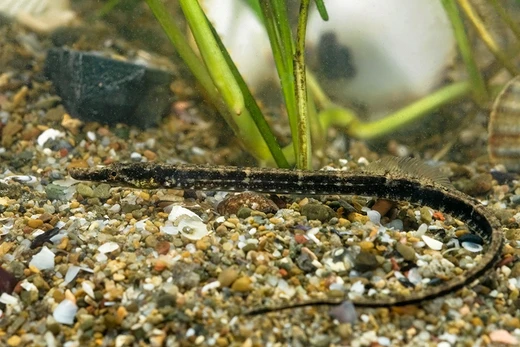
Japanese pygmy seahorse
A tiny seahorse with a bony ridge running down its back

The Japanese pygmy seahorse, also called the Japan pig, is a marine fish found only in Japanese waters. It belongs to the seahorse family Syngnathidae and is known for a few unique traits: it has a single pair of wing-like structures on its neck—other seahorses have two—and it is the only seahorse species with a bony ridge running down its back. This seahorse lives in the northwestern Pacific near Japan, typically at depths between 10 and 13 meters, though it can be found from 5 to 22 meters. It does not attach to a specific host species but instead clings to algal turfs on subtropical reefs. As of 2018, it has been recorded at several locations: Kashiwa-jima Island and Sukumo Bay; Kushimoto on the Kii Peninsula; Osezaki on the Izu Peninsula; the Izu Islands of Miyake and Hachijo; Sagami Bay; and Chichi-jima in the Ogasawara Islands. The type specimen was collected off Imasaki, Okago, on Hachijo-jima Island at a depth of 10 meters. Growing to just 1.6 centimeters—about the size of a jellybean—it has 28 tail rings, 14 dorsal fin rays, 9 pectoral fin rays, and 4 subdorsal rings. Its coloration helps it hide among algae-covered reefs, where it clings to soft corals and feeds on plankton. Unlike non-pygmy seahorses, which brood their young in a pouch on the tail, the Japanese pygmy seahorse’s brood pouch is located inside the body cavity on the trunk. The species was first photographed in 2013 by Richard Smith, who had just completed his PhD on other pygmy seahorses. While attending a fish biology conference in Okinawa, he dove off Hachijo-jima, about 180 miles from Tokyo, and found around a dozen specimens. The formal description was published by Short and colleagues in a 2018 issue of ZooKeys, based on one female holotype, one male and one female paratype, and two photographs. The holotype and one paratype are held at the Burke Museum at the University of Washington; the other paratype is at the Kagoshima University Museum. The authors proposed the common name Japanese pygmy seahorse, and the scientific name *Hippocampus japapigu* comes from the Japanese nickname “Japan pig” or “Japapigu.”
Quick Facts
- Taxon
- Hippocampus japapigu
Facts from the source article.
Lore & Background
The Japanese pygmy seahorse was first photographed in 2013 by Richard Smith after a fish biology conference in Okinawa, during dives off Hachijo-jima, one of the Izu Islands about 180 miles from Tokyo. There he found about a dozen specimens. The species description was published by Short and colleagues in a 2018 issue of ZooKeys, based on one female holotype, a male and a female paratype, and two photographs of additional specimens. The holotype and one paratype were deposited at the Burke Museum at the University of Washington; the other paratype was deposited at the Kagoshima University Museum. It lives in the Northwestern Pacific near Japan, at depths from 5 to 22 meters, but is usually found at 10 to 13 meters. It does not live with any specific host species, instead clinging onto algal turfs in subtropical reefs. Its coloration is made for hiding in algae-covered reefs, and it clings to soft corals while feeding on plankton. The broad pouch of the pygmy seahorse is present within the body cavity and located on the trunk, in contrast to tail-brooding non-pygmy seahorses.
Reader's Guide
The Japanese pygmy seahorse is significant as a distinct species discovered relatively recently, with its formal description published in 2018. Its specific epithet, japapigu, comes from its colloquial Japanese name: Japan Pig or Japapigu. The species is known only from Japan, including locations such as Kashiwa-jima Island, Sukumo Bay; Kushimoto, Kii Peninsula; Osezaki, Izu Peninsula; the Izu Islands of Miyake and Hachijo; Sagami Bay; and Chichi-jima, Ogasawara Islands. Its type locality was collected off Imasaki, Okago, Hachijo-jima Island, Izu Islands at a depth of 10 m. The species is notable for its unique morphology: it is the only seahorse in the world known to have a bony ridge running down its back, and it possesses only one pair of wing-like protrusions on its neck instead of the two pairs seen in other species. At a length of 1.6 cm, it is the size of a jellybean. Its discovery and description add to the known diversity of pygmy seahorses and highlight the importance of Japanese subtropical reefs as habitats for cryptic marine life.
Did You Know?
- It has only one pair of wing-like protrusions on its neck, unlike other species which have two pairs.
- The species was formally described in a 2018 issue of ZooKeys by Short and colleagues.
More in Seahorses and Pipefish, Part 2 1-24
Spotted an error? Know more?
Reader corrections go straight into our review queue. Suggest an edit · How this site is sourced