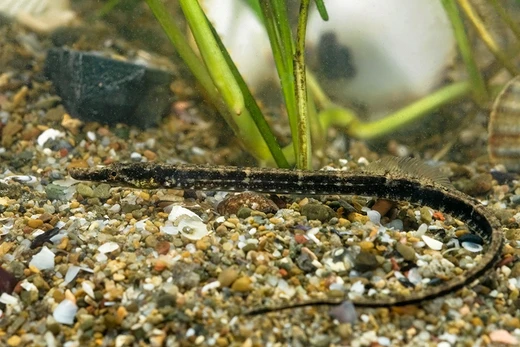
Hippocampus nalu
First pygmy seahorse discovered in African waters.

Hippocampus nalu, also called the Sodwana pygmy seahorse, African pygmy seahorse, or Honeypot seahorse, belongs to the seahorse family Syngnathidae and is native to South Africa. It stands out as the first pygmy seahorse ever recorded in African waters.
Its discovery was announced in May 2020 by an international research team. The species lives in Sodwana Bay. A local diver tipped off the researchers, who then came to South Africa originally to search for the pygmy pipehorse; instead, they stumbled upon this new seahorse.
In appearance and color, H. nalu closely resembles H. pontohi and H. japapigu. Adults have honey-brown skin marked with irregular white reticulation and a reddish tail, while juveniles are darker. Like many syngnathids, this coloration helps it blend into its surroundings and algae. Its spine morphology along the superior trunk ridge is notably different from other pygmy seahorses. As a pygmy species, it is very small: juveniles measure about 10 mm, and adults reach up to 2 cm in length.
So far, this seahorse has only been found in shallow coastal waters between 12 and 17 meters deep, where flat sandstone-based coral reefs and short algal turfs occur.
Quick Facts
- Genus
- Hippocampus
- Species
- nalu
Facts from the source article.
Lore & Background
The discovery of Hippocampus nalu was revealed by an international team of researchers in May 2020. A diver from the region gave a tip to the researchers, who then arrived in South Africa to look for the pygmy pipehorse and unintentionally found this new species. The species inhabits the waters of Sodwana Bay in South Africa.
In appearance and colouration, Hippocampus nalu is quite similar to H. pontohi and H. japapigu. Adults have a honey-brown coloured skin with an overlay of white irregular reticulation and a reddish tail, while juveniles have a darker colouration. Like most syngnathids, their colouration helps them to camouflage with their surrounding habitat, as well as with algae. The species is distinguished from other pygmy seahorses by its highly different spine morphology along the superior trunk ridge.
This species is currently only known to occur in shallow coastal waters at depths between 12 and 17 meters that contain flat sandstone-based coral reefs and short algal turfs. Being a pygmy seahorse, H. nalu is very small, with juveniles being approximately 10 mm long and adults growing up to a length of 2 centimetres.
Reader's Guide
Hippocampus nalu holds significance as the first pygmy seahorse species documented from African waters, expanding the known geographic range of pygmy seahorses. Its discovery in Sodwana Bay, South Africa, was announced in May 2020 by an international team of researchers, following a tip from a local diver. The team had originally traveled to South Africa to search for the pygmy pipehorse but instead found this new species. The species' appearance and colouration closely resemble those of H. pontohi and H. japapigu, but it is differentiated by its unique spine morphology along the superior trunk ridge. Its honey-brown skin with white reticulation and reddish tail provides camouflage among algae and coral reefs. The species is currently known only from shallow coastal waters at depths of 12 to 17 meters, on flat sandstone-based coral reefs with short algal turfs. As a pygmy seahorse, it is very small, with adults reaching only 2 centimetres in length. This discovery highlights the biodiversity of South African marine habitats and the value of local diver knowledge in scientific research.
Did You Know?
- Hippocampus nalu is the first known pygmy seahorse found in the waters around Africa.
- The species was discovered unintentionally while researchers were looking for the pygmy pipehorse.
- Adults have honey-brown skin with white irregular reticulation and a reddish tail.
- Juveniles are approximately 10 mm long, while adults grow up to 2 centimetres.
More in Seahorses and Pipefish, Part 2 1-24
Spotted an error? Know more?
Reader corrections go straight into our review queue. Suggest an edit · How this site is sourced