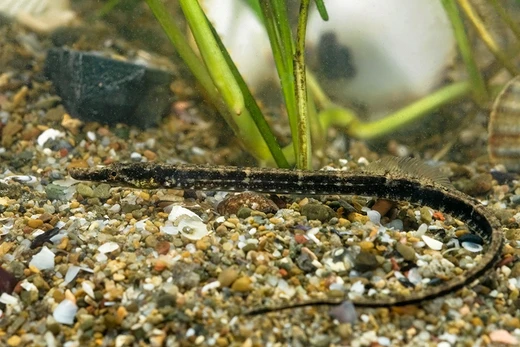
Gulf pipefish
A marine-estuarine pipefish with declining seagrass habitat.

The Gulf pipefish (Syngnathus scovelli) is a species of pipefish in the family Syngnathidae. It is native to south Florida, the Atlantic Ocean, and other regions, and is similar to Microphis brachyurus. This elongated fish is encased in body rings and is notable for its declining populations due to human impacts.
Quick Facts
- Taxon
- Syngnathus scovelli
Facts from the source article.
Lore & Background
The Gulf pipefish is uniformly brown or dark olive green with silvery, white vertical bars along the sides, sometimes Y-shaped. It has a short snout (1.9-2.3 times into head length), a moderate dorsal fin, a rounded caudal fin, a greatly reduced anal fin, and no pelvic fins. Females have a well-developed keel on the abdomen, reduced in juveniles and males. Mature males have a brood pouch on the underside spanning 10-13 tail rings.
Its diet consists mainly of crustaceans such as copepods, amphipods, tanaids, and isopods. Individuals less than 50 mm SL feed almost exclusively on copepods; larger individuals eat more amphipods, crustacean eggs, and caridean shrimp. The species inhabits shallow, highly vegetated shoreline areas with clear, tannin-stained streams and rivers, as well as estuarine seagrass meadows.
Reproduction involves an elaborate courtship ritual initiated by the female, with swimming, bobbing to the surface, and intertwining bodies. After mating, the male rubs his brood pouch along the bottom, thought to move eggs rearward. Eggs are bright orange, oval to pear-shaped, and hatch after 14-15 days at 24.5°C. Males collect eggs from several females.
Reader's Guide
The Gulf pipefish is significant as a marine-estuarine species whose populations have been declining due to human impacts, including nutrient loading, pollution, harmful algae blooms, and habitat degeneration. Substantial declines have occurred in the Atlantic Ocean coast and the coast of Florida, particularly with the loss of seagrass meadows in the Indian River Lagoon and ongoing algae blooms. The species ranges from northern Georgia southward along the Florida coast into the Gulf of Mexico and south to São Paulo, Brazil, with inland reports in Louisiana (Lake St. John, about 150 miles inland) and Texas (Lake Texana, about 50 miles inland). Its breeding occurs in fresh, brackish, or highly saline water, and spawning can happen year-round except on the northern Gulf Coast where winter reproductive activity declines. The species may mature within six months and typically lives less than one year. Its etymology honors Josiah T. Scovell, who helped collect original specimens.
Did You Know?
- The Gulf pipefish has 18-19 trunk rings and 30-34 tail rings.
- Females have a well-developed keel on their abdomen, reduced in juveniles and males.
- Males collect eggs from several different females and incubate them for 14-15 days at 24.5°C.
- The species is named after Josiah T. Scovell, who helped collect the original specimens.
More in Seahorses and Pipefish, Part 2 1-24
Spotted an error? Know more?
Reader corrections go straight into our review queue. Suggest an edit · How this site is sourced