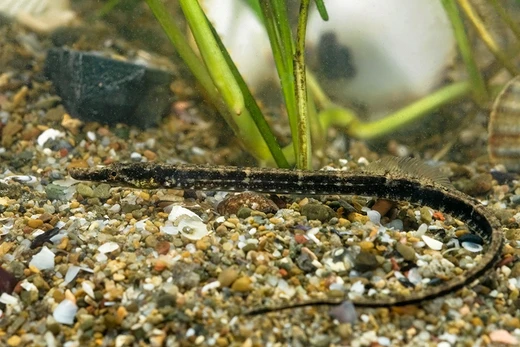
Greater pipefish
Type species of Syngnathus, a seawater pipefish of the British Isles.

The greater pipefish (Syngnathus acus) is a seawater fish of the family Syngnathidae and the type species of the genus Syngnathus. It is notable for its long, segmented, armored body and its role as the type species for its genus.
Quick Facts
- Taxon
- Syngnathus acus
Facts from the source article.
Lore & Background
The greater pipefish has a long, segmented, armored body that is angular in cross section and can stretch up to 45 cm long, with a stiff appearance. Its color ranges from brown to green with broad alternating light and dark hues. It has a long snout with a mouth on the end and a slight hump on the top of the body just behind the eyes. The body segments are almost square, and the fish feels rigid when handled. Distinctive body rings are sandy brown with darker bars covering the body in between.
Anatomy differs by sex: the top third of the female's belly is deep when egg-bound, twice the breadth of the lower two thirds below the vent. The male has twin folds of skin below the vent that form a brood pouch; during brooding these folds swell until the young are released at a size of 22 mm to 35 mm. The fish feeds on live mysids and small prawns. It is ovoviviparous and reproduces usually three times each year, with a few females depositing partial clutches under the tail into the male's brood pouch, which may contain up to 400 eggs.
The greater pipefish is found all around the British Isles and regularly in the Mediterranean Sea. It is common on southerly and westerly coasts in a variety of habitats, often amongst seaweeds and seagrass.
Reader's Guide
The greater pipefish serves as the type species of the genus Syngnathus, a taxonomic anchor for the group. Its genus name derives from Greek roots meaning 'grown together jaw,' and its species name acus means 'needle' in Latin. The species is widely distributed around the British Isles and the Mediterranean Sea, inhabiting coastal areas with seaweed and seagrass. Its biology includes ovoviviparous reproduction with males brooding up to 400 eggs in a pouch formed by skin folds. The species has been taxonomically confused with Syngnathus temminckii from southern Africa, but morphological and genetic data now show that S. temminckii is distinct and not even the sister taxon of S. acus, but rather of another southern African species, the river pipefish S. watermeyeri. This clarification underscores the importance of careful morphological and genetic analysis in pipefish taxonomy. The greater pipefish remains a well-known representative of its family in European waters.
More in Seahorses and Pipefish, Part 2 1-24
Spotted an error? Know more?
Reader corrections go straight into our review queue. Suggest an edit · How this site is sourced