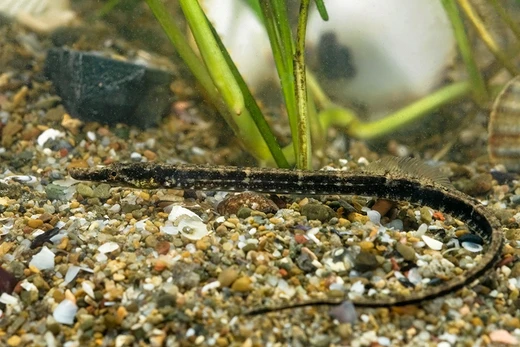
Dusky pipefish
Male dusky pipefish carry eggs and provide all post-zygotic care.

The dusky pipefish (Syngnathus floridae) is a marine subtropical demersal fish found in the western Atlantic from Bermuda, Chesapeake Bay, the northern Gulf of Mexico, the Bahamas, and the western Caribbean Sea to Panama. It is notable for its sex-role reversal, where males carry and nourish the developing embryos in a brood pouch.
Quick Facts
- Taxon
- Syngnathus floridae
Facts from the source article.
Lore & Background
The dusky pipefish belongs to the genus Syngnathus, which is characterized by sex-role reversal. Females deposit eggs into the male's brood pouch during copulation; the male then fertilizes the eggs and provides all post-zygotic care, physically carrying the eggs and transferring nutrients through a placenta-like connection. The eggs hatch about 10 days later, after which the young are independent.
Dusky pipefish are polygynandrous, with both males and females mating with multiple partners. Males are the limiting sex because their brood pouch can only carry a certain number of eggs, while females produce more eggs than they can deposit, giving them unlimited success. Sexual selection acts on body size, favoring larger males, which can carry more eggs and attract more mates, leading to higher reproductive success.
Environmental variations, particularly water temperature, influence reproductive success. Higher temperatures increase the rate of potential reproduction for both sexes, but faster for males, selecting against the slower female rate. Higher temperature also increases the number of eggs produced by females, reducing the number of mates a male needs to fill its pouch. Lower temperatures yield lower reproductive success in males because they accept fewer eggs.
Reader's Guide
The dusky pipefish is significant as a clear example of sex-role reversal and polygynandry in fish. The species demonstrates that males provide all post-zygotic care, including nutrient transfer via a placenta-like connection, a rare reproductive strategy. The article highlights that males are the limiting sex due to brood pouch capacity, while females have unlimited egg production, driving sexual selection for larger male body size. Temperature is a key environmental factor affecting reproductive success: higher temperatures accelerate male reproduction rates and increase female egg production, altering mating dynamics. Lower temperatures reduce male egg acceptance, lowering their reproductive success. These findings underscore how environmental variation can shape sexual selection and reproductive outcomes in a species. The dusky pipefish thus serves as a model for studying the interplay between ecology, behavior, and evolution in syngnathid fishes.
Did You Know?
- The dusky pipefish lives at depths up to 22 m, usually up to 4 m.
- Males carry the eggs in a brood pouch and transfer nutrients via a placenta-like connection.
- Eggs hatch about 10 days after fertilization.
- Higher water temperature increases the number of eggs females produce.
More in Seahorses and Pipefish, Part 2 1-24
Spotted an error? Know more?
Reader corrections go straight into our review queue. Suggest an edit · How this site is sourced