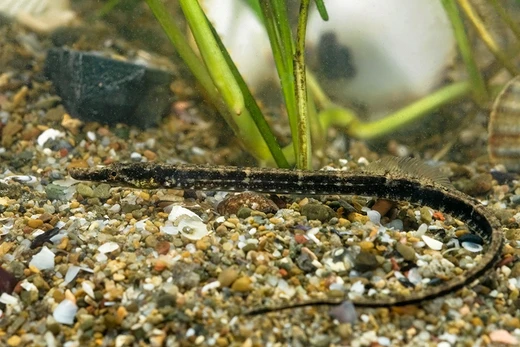
Duncker's pipehorse
A spiny, variable-colored pipehorse endemic to eastern Australia.

Duncker's pipehorse (Solegnathus dunckeri) goes by several common names, including nose-ridge pipefish, red-and-gold pipehorse, red-hair pipefish, and spiny sea dragon. This fish belongs to the Syngnathidae family and is found only in the waters off eastern Australia and around Lord Howe Island. It lives in the open ocean over the continental shelf and slope. Fishermen in its range report catching it over hard bottoms like hard sand, shale, sandstone, or gravel, often in the company of gorgonians, black corals, algae, or sponges. The species is ovoviviparous: males carry fertilized eggs in a brood pouch under the tail. It is carnivorous, feeding on small planktonic crustaceans.
The body color varies widely, from creamy to brown or even black, with pinkish-orange and dark markings along the ridges on the back. There are 10 to 11 irregular, faint pale pink or dark bands across the back and sides, plus dark marks under the tail and ghostly dark barring on the belly rings. In darker individuals, the tip of the snout is often pale. The head and body are covered in spines, except around the gills, fin bases, and vent.
The species was named in honor of German ichthyologist Georg Duncker, who specialized in pipefish. The IUCN lists it as Data Deficient, and it is a listed marine species under Australia’s Environment Protection and Biodiversity Conservation Act 1999.
Quick Facts
- Taxon
- Solegnathus dunckeri
Facts from the source article.
Lore & Background
Duncker's pipehorse was named in honour of Georg Duncker, a German ichthyologist with a particular interest in pipefish. Its body has a variable colour, from creamy through to brown or even black, with pinkish-orange and dark markings along the superior ridges on its back and 10-11 irregularly shaped, indistinct, pale pinkish or dark bands on back and sides. There are also dark markings along the underside of the tail and ghosts of dark barring on the ventral surface of its trunk rings. In darker individuals the tip of the snout is often pale. The head and body is covered in spines except around the gills, the fin bases and the vent.
It is a pelagic species found in the waters of the continental shelf and the continental slope. Fishermen within its range report that it is caught where there are hard substrates such as hard sand, shale, sandstone or gravel, and they are often caught alongside gorgonians, black corals, algae or sponges. It is a carnivorous species which feeds on small planktonic crustaceans. It is an ovoviviparous species in which the male bears the fertilised eggs in a brood pouch located under his tail.
Reader's Guide
Duncker's pipehorse is classified as Data Deficient by the IUCN, indicating that insufficient information exists to assess its risk of extinction. It is also a listed marine species under the Australian Environment Protection and Biodiversity Conservation Act 1999, which provides it with a level of legal protection within Australian waters. The species is known by multiple common names, including nose-ridge pipefish, red-and-gold pipehorse, red-hair pipefish, and spiny sea dragon, reflecting its distinctive appearance. Its association with hard substrates and benthic organisms such as gorgonians, black corals, algae, and sponges suggests a specific ecological niche, though further study is needed. The naming after ichthyologist Georg Duncker highlights its taxonomic and historical interest within the Syngnathidae family. Its variable coloration and spiny body make it a visually notable species, but its pelagic nature and limited known range contribute to the data deficiency that currently characterizes its conservation status.
Did You Know?
- Duncker's pipehorse is also known as the nose-ridge pipefish, red-and-gold pipehorse, red-hair pipefish, or spiny sea dragon.
- It is endemic to eastern Australia and Lord Howe Island.
- It was named in honour of German ichthyologist Georg Duncker.
More in Seahorses and Pipefish, Part 2 1-24
Spotted an error? Know more?
Reader corrections go straight into our review queue. Suggest an edit · How this site is sourced