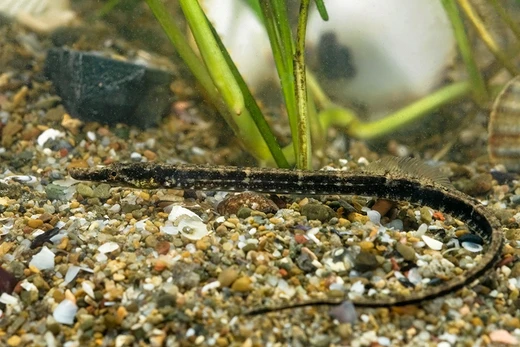
Broadnosed pipefish
A pipefish with a broad snout and reversed sex roles.

The broadnosed pipefish (also called the deepnosed pipefish, *Syngnathus typhle*) belongs to the same family as seahorses and other pipefishes. It gets its name from its snout, which is as deep as its body. This fish lives in the eastern Atlantic Ocean, from Vardø in Norway and the Baltic Sea (reaching the Gulf of Finland) and the British Isles down to Morocco. It is also found in the Mediterranean Sea, the Black Sea, and the Sea of Azov. It is common in shallow coastal waters, especially on reefs where seagrasses grow.
The body is slender and elongated, with a hexagonal cross-section—unlike the rounder, more threadlike straightnose pipefish. Bony plates cover the surface. The head looks like a seahorse’s, with a long, flattened snout and a sloping mouth. It has a fan-shaped tail fin, unlike the straightnose pipefish. Its color is generally greenish, often with darker mottling, and a yellow belly. Average length is 15 to 20 cm, with a maximum of 25 cm. It lives at depths up to about 20 meters.
This pipefish often rests upright among seaweed fronds and feeds by sucking in plankton, such as copepods. Its mating system is sex-role reversed: females compete for males, and males are the choosier sex because they brood the eggs. Breeding happens in summer. The male has a brood pouch, where several females deposit clutches of about twenty eggs each. The eggs are fertilized there, and the fry hatch after about four weeks. The male then releases them into open water, but the fry can retreat back into the pouch if danger threatens.
Courtship and copulation follow a set pattern. Either sex can start a ritualized dance, but females court more often. If the other is receptive, they align and dance together until the female uses an ovipositor to deliver eggs into the male’s pouch. The male shakes the eggs in, releases sperm, and assumes an S-shaped posture to fertilize them.
Both males and females mate with multiple partners during a breeding season (polygynandry). Because males invest more in offspring, they are choosier, while females compete more intensely. Females produce eggs faster than males can brood them, and a male’s pouch cannot hold all the eggs from a female his own size. Brooding takes four to six weeks, during which the male supplies oxygen and nutrients to the embryos.
Quick Facts
- Taxon
- Syngnathus typhle
Facts from the source article.
Lore & Background
The broadnosed pipefish is a slender, elongated fish with a hexagonal cross-section, distinguishing it from the straightnose pipefish which has a circular cross-section. Its body is covered by small bony plates, and its head resembles that of a seahorse with a long, laterally flattened snout and obliquely sloping mouth. Unlike the straightnose pipefish, it has a fan-shaped caudal fin. The general colour is greenish with darker mottling, and the belly is yellow. It tends to rest in a vertical position among seaweed fronds and feeds on plankton such as copepods, which it sucks in through its mouth. This species is native to the Eastern Atlantic from Vardø, Norway to Morocco, and is also found in the Mediterranean Sea, Black Sea, and Sea of Azov, in coastal shallow waters usually on reefs with seagrasses.
Reader's Guide
The broadnosed pipefish is significant for its sex-role reversed mating system, where males brood the eggs and are the choosier sex due to their increased investment in offspring. Females compete more intensely for mates, as they can produce eggs faster than males can brood them. Both sexes prefer large mates because size correlates with fecundity: large females produce more and larger eggs, while large males have increased brood clutch size and embryo weight. Males also avoid females with high parasite loads. However, when predators are present, males become less choosy. Both sexes can compensate for mating with non-preferred mates: females deposit more proteinaceous eggs with lower-quality males, and males can selectively absorb eggs of lower-quality females after copulation, gaining nutrients to allocate to future broods with preferred females. The species has a polygynandrous mating system, with one to six females contributing to each brood clutch, the highest rate of multiple maternity among pipefish.
Did You Know?
- The broadnosed pipefish has a hexagonal cross-section, unlike the circular cross-section of the straightnose pipefish.
- Males brood the eggs in a pouch for approximately four to six weeks, providing oxygen and nutrients to the embryos.
- Females can deposit more proteinaceous eggs when mating with a lower-quality male to increase offspring viability.
- One to six females can contribute to a single male's brood clutch, the highest rate of multiple maternity in pipefish.
More in Seahorses and Pipefish, Part 2 1-24
Spotted an error? Know more?
Reader corrections go straight into our review queue. Suggest an edit · How this site is sourced