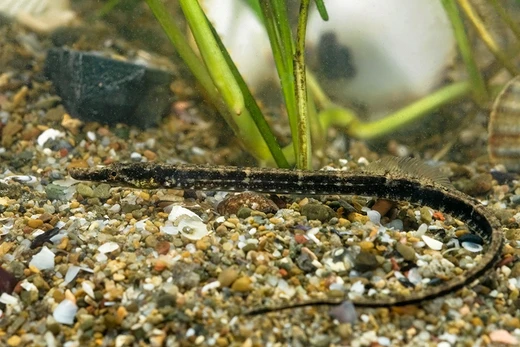
Black-striped pipefish
A pipefish relative of seahorses, found in European coastal and inland waters.

The black-striped pipefish (Syngnathus abaster) is a species of fish in the family Syngnathidae, a close relative of the seahorse. It is notable for its presence in the eastern Atlantic from the southern Gulf of Biscay to Gibraltar, as well as in the Mediterranean and Black Seas, and as an introduced species in the Caspian Sea and fresh waters of its basin. It has significantly expanded its range within the Volga River basin, becoming common and often abundant in coastal fish communities of the Lower Volga reservoirs, the unregulated section of the river, and the Volga Delta.
Quick Facts
- Genus
- Syngnathus
- Species
- abaster
Facts from the source article.
Lore & Background
The black-striped pipefish is a marine species that lives in shallow-water seagrass in the Mediterranean Sea, and is also found in brackish waters. Its long, narrow body is encased in bony plates that serve as protective armor and camouflage, yet the body remains flexible and moves like a snake. The elongated head resembles a horse head, similar to seahorses, and it can wrap its tail around sea grasses to anchor itself. Unlike seahorses, it swims horizontally, using a side-to-side wiggling motion or undulation of its dorsal fin. Its long, pipe-shaped snout gives the fish its name and is used as a sucking tool when feeding; the pipefish wraps its tail around sea grass, waits for prey such as small crustaceans or fish fry, then sucks it up, puffing out its cheeks and creating a small current accompanied by a sucking noise.
Reader's Guide
The black-striped pipefish is significant as a species that has successfully expanded its range through introduction, particularly in the Volga River basin where it was introduced with mysids brought from the Don estuary. Genetic studies indicate that Volga populations are closely related to those from the Black Sea basin, suggesting a dispersal route from the Azov-Black Sea region. In reproduction, males carry fertilized eggs in specialized pouches, similar to seahorses, and the young exit through a longitudinal slit; if threatened, young can re-enter the pouch. The species has no real defense against predators aside from camouflage and swimming away, making it an easy target for large fish, otters, and blue crabs. Its presence in both marine and introduced freshwater habitats highlights its adaptability and ecological impact in the regions it colonizes.
Did You Know?
- Males carry fertilized eggs in specialized pouches and expel young through a longitudinal slit in the front of the pouch.
- The pipefish uses its long snout as a sucking tool, creating a small current and a sucking noise when feeding.
- It was introduced into reservoirs of the middle and lower Volga with mysids brought from the Don estuary.
- Young pipefish can re-enter the male's brooding pouch if they sense danger or feel threatened.
More in Seahorses and Pipefish, Part 2 1-24
Spotted an error? Know more?
Reader corrections go straight into our review queue. Suggest an edit · How this site is sourced