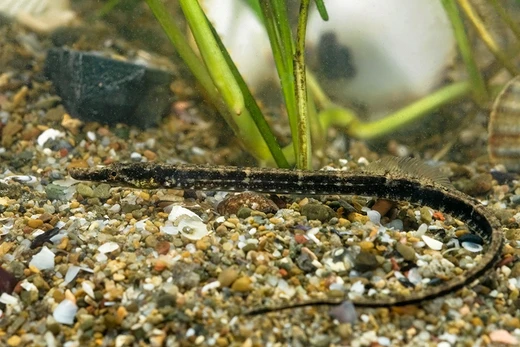
Bay pipefish
A pipefish that blends into eelgrass with its sinuous shape.

The bay pipefish (Syngnathus leptorhynchus) is a pipefish native to the eelgrass beds of the Eastern Pacific (Southern Baja California to Gulf of Alaska), where its sinuous shape and green color allow it to blend in with the waving blades of eelgrass. It is notable for its elongated, slim body, weak dorsal and pectoral fins, and bony plates that provide protection and structural support.
Quick Facts
- Taxon
- Syngnathus leptorhynchus
Facts from the source article.
Lore & Background
Bay pipefish have an elongated, slim body with weak dorsal and pectoral fins, making them poor swimmers that steer using their heads. They possess bony plates spanning their ten-inch frame for protection and structural support, and a toothless, elongated mouth used to suction food. Lacking a stomach, they spend most of their time feeding on algae during the day. Like other members of the seahorse family, male pipefish tend eggs laid by females in specialized pouches. Reproduction involves pairs joining in the morning, with females courting males by displaying colorful appearances during breeding season. Males grow offspring in pouches at the front of their underbelly; females lay about 200 eggs over two hours, and the male nourishes the embryos through his bloodstream. Males are not monogamous and have a breeding period of at least six months, while females mate with several males. Offspring mature into adults in less than a year and begin reproduction by the end of that year. Bay pipefish typically dwell within coastal marine environments that are specific for seagrass. Eelgrass, a type of seagrass, is most commonly distributed from British Columbia to Pacific and Atlantic waters. Therefore, bay pipefish can be found along the coast ranging from the oceans intertidal zone to depths of 10–20 meters.
Reader's Guide
The bay pipefish is significant as a sedentary predator that relies on stealth and slow movement to catch prey. It typically hides in seagrass, wrapping itself around stems and mimicking swaying leaves, using its reduced caudal fin to stay upright. Once prey is detected, it slowly detaches and stealthily approaches, then moves into free water to attack. Its feeding habitat is suspected to be restricted to daylight times. The species has a conservation status of least concern and can be found in eelgrass beds, coastal wetlands, and open waters along Pacific coast waters from high points of North America to Baja California. However, seagrass environments are declining worldwide due to human activities such as habitat fragmentation and natural causes, which could negatively impact pipefish populations despite the species not being endangered.
Did You Know?
- Males nourish embryos through their bloodstream via an extremity connected to their abdominal wall.
- Females lay around 200 eggs over two hours in the male's brooding pouch.
- They migrate into shallow vegetative areas during spring and return to deeper channels in late fall.
More in Seahorses and Pipefish, Part 2 1-24
Spotted an error? Know more?
Reader corrections go straight into our review queue. Suggest an edit · How this site is sourced