Prism (optics)
Transparent element that refracts, reflects, or polarizes light.
Last updated

Polarbear24 · CC BY-SA 3.0
An optical prism is a clear, solid piece with flat, polished faces that bends light as it passes through. To qualify as a prism, at least one of these faces must be set at an angle—if all faces are parallel, the object is simply a window, not a prism.
The classic example is the triangular prism, which has a triangular base and rectangular sides. However, not every optical prism is a geometric prism, and not every geometric prism functions as an optical one. These devices can be crafted from any material that is transparent to the specific wavelengths they are meant to handle; common choices include glass, acrylic, and fluorite.
Dispersive
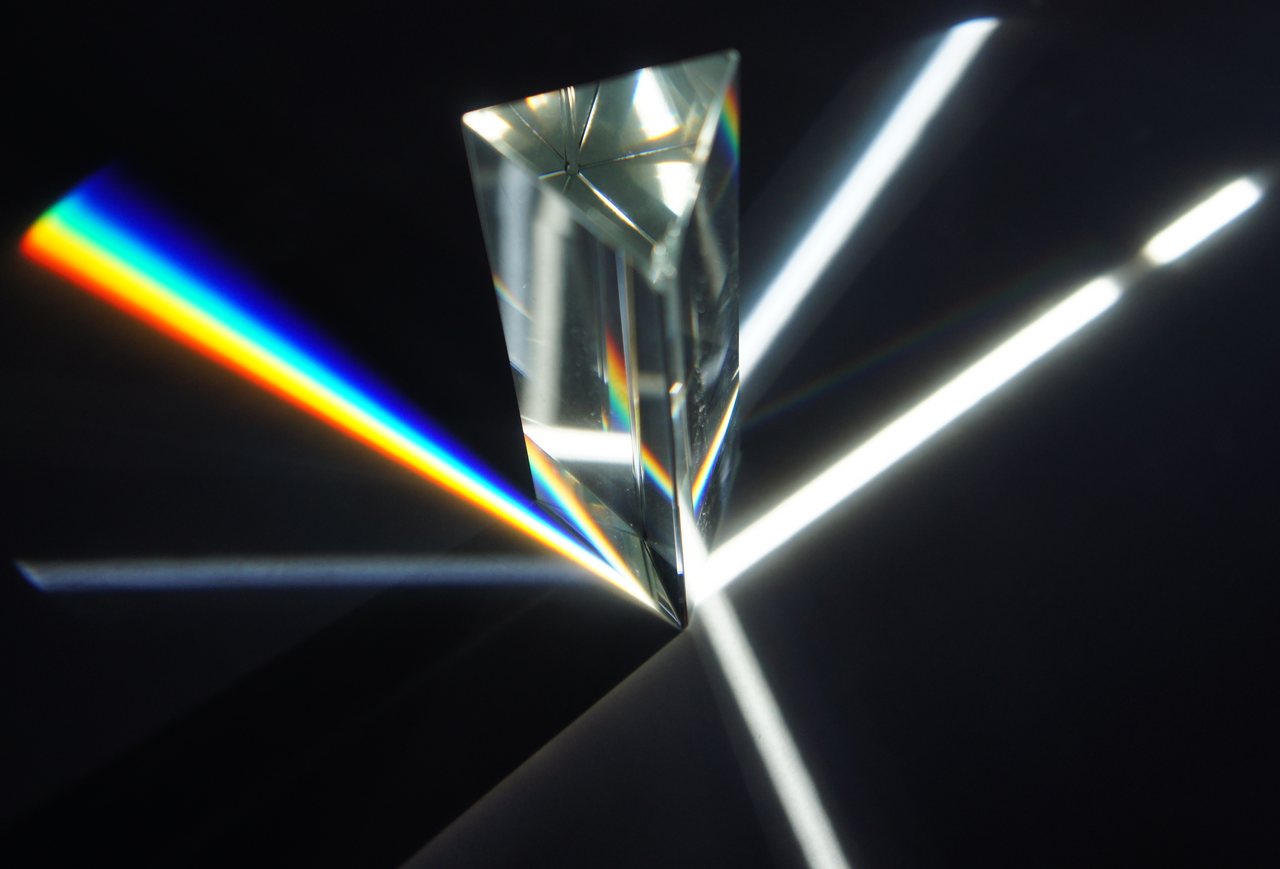
A dispersive prism separates white light into its rainbow of constituent colors, creating a spectrum. This happens because the material’s refractive index changes with wavelength: blue light slows down more than red light and thus bends more sharply. There are many varieties, such as the Abbe, Amici, Féry, and Pellin–Broca prisms, as well as compound types like the grism, which combines a prism with a diffraction grating. While spectral dispersion is the most famous use of prisms, it is not the most common one in practice.
Reflective
Reflective prisms redirect light to flip, invert, rotate, shift, or deviate a beam. They are essential in binoculars and single-lens reflex cameras, where they correct the image orientation—without them, the view would appear upside down. These prisms rely on total internal reflection to achieve nearly perfect reflection when light strikes their facets at a sufficiently steep angle.
Made from optical glass and often coated with anti-reflective layers on input and output faces, they lose far less light than metallic mirrors. Depending on the number of reflections, the image may be mirrored (odd number) or upright (even number). Examples include the triangular prism reflector, roof pentaprism, Dove prism, corner-cube retroreflector, Porro prism, Porro–Abbe prism, Perger prism, Abbe–Koenig prism, Bauernfeind prism, Amici roof prism, pentaprism, Schmidt–Pechan prism, and Uppendahl prism.
Beam-splitting
Beam-splitting prisms use thin-film optical layers deposited on the hypotenuse of a right-angled prism, which is then cemented to another prism to form a cube. The thin layer determines the overall optical performance. Compared to a standard glass substrate, the cube protects the thin film on both sides, offers better mechanical stability, and eliminates etalon effects, back-side reflection, and slight beam deflection. Variants include dichroic color filters (forming a dichroic prism), polarizing cube beamsplitters (cheaper but with lower extinction ratios than birefringent types), partially-metallized mirrors (non-polarizing), and air-gap designs where two triangular prisms are placed very close together.
In the air-gap case, frustrated total internal reflection allows part of the radiation to couple into the second prism, with transmitted power dropping exponentially as the gap widens. The Fresnel biprism consists of two prisms joined at their bases, forming a wide vertex angle near 180°, and is used in common-path interferometry.
Polarizing
Polarizing prisms exploit birefringence to split a light beam into components with different polarizations. In the visible and ultraviolet ranges, they have very low losses and extinction ratios typically exceeding 100,000 to 1, outperforming other polarizer types. Some use total internal reflection to separate one polarization, as in the Nicol, Glan–Foucault, Glan–Taylor, and Glan–Thompson prisms.
Others deviate one polarization by refraction alone, such as the Rochon and Sénarmont prisms. The Wollaston prism deviates both polarizations by refraction, while the Nomarski prism—a variant—displaces them so they emerge converging toward each other, which is important for differential interference contrast microscopy. Finally, polarization beam displacers, typically made from thick anisotropic crystals with plan-parallel faces, keep both polarizations parallel but spatially separate them.
Quick Facts
- Field
- Optics
- Materials
- Glass, acrylic, fluorite, birefringent crystals (e.g., calcite, quartz, α-BBO, MgF2, YVO4, TiO2)
Facts from the source article.
Background
Optical prisms are defined by having at least one angled surface; elements with only two parallel surfaces are windows. The triangular prism is the most familiar type, but not all optical prisms are geometric prisms, and not all geometric prisms count as optical prisms.
Dispersive prisms break white light into constituent spectral colors because the refractive index depends on wavelength—blue light is slowed more than red light and bent more. Reflective prisms use total internal reflection to flip, invert, rotate, deviate, or displace light beams, often used to erect images in binoculars or single-lens reflex cameras. Beam-splitting prisms use thin-film layers or air gaps to split light, while polarizing prisms use birefringence to separate polarization components with very low losses and extinction ratios exceeding 10^5:1.
Frequently Asked Questions
What is Prism (optics) known for?
It refracts light, disperses white light into its spectral colors, redirects beams via internal reflection, and separates light by polarization. It can also couple incident light into surface plasmons for sensing applications. In short, it is a passive tool for steering, splitting, and analyzing a light beam.
What materials is Prism (optics) made of?
Any substance transparent to the target wavelengths will work, with optical glass, acrylic, and fluorite being the most common choices. For polarization or birefringence tasks, crystals such as calcite, quartz, α-BBO, MgF₂, YVO₄, and TiO₂ are selected. The final material is dictated by the wavelength range and the specific optical effect the designer needs.
More in Science & Measurement
Sources
Compiled from Wikipedia and the sources listed below. Text from Wikipedia is available under CC BY-SA 4.0; this entry is adapted from it.
- Wikipedia: Prism (optics) (CC BY-SA 4.0).
Spotted an error? Know more?
Reader corrections go straight into our review queue. Suggest an edit · How this site is sourced