Microscope
Instrument for viewing objects invisible to the naked eye.
Last updated

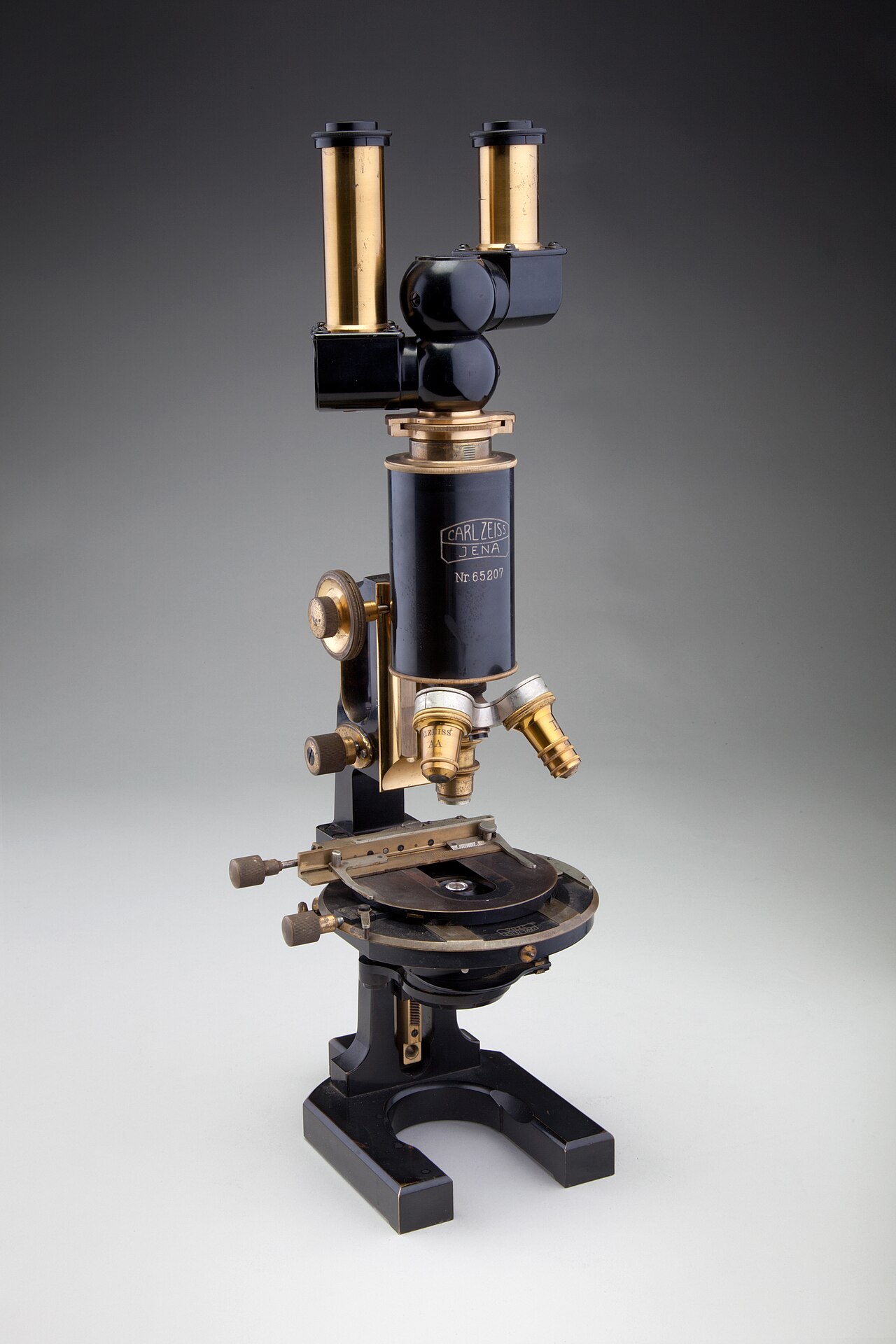
Chad Anderson, staff photographer for SFO Museum · CC BY-SA 2.0
A microscope is an instrument that produces enlarged images of small objects, using methods such as beams of light or electrons to interact with a sample.[1] The most common type is the optical microscope, which uses lenses to refract visible light.[1] Many types exist, including fluorescence, electron, and scanning probe microscopes.[2]
Last updated 2026-10-07 from the source article.
Key facts and history
The earliest known use of simple microscopes dates to the widespread use of lenses in eyeglasses in the 13th century.[3] The earliest known compound microscopes appeared in Europe around 1620, though the inventor is unknown.[3] Several claims about the inventor involve spectacle-makers in the Netherlands, including Zacharias Janssen around 1590 and Hans Lippershey in 1608.[4] Galileo Galilei built his own improved version of a compound microscope after seeing one in Rome in 1624.[4]
Giovanni Faber coined the name "microscopio" for the compound microscope in 1625.[4] The first detailed account of microscopic anatomy using a microscope appeared in 1644 in Giambattista Odierna's work on the fly's eye.[5] The scanning electron microscope was developed in 1935 by Max Knoll, but was not commercially available until 1965.[6] The 1665 work "Micrographia" by Robert Hooke achieved widespread influence due to its detailed engravings.[7]
Using a simple microscope with only one lens, Antonie van Leeuwenhoek could magnify specimens up to 300 times.[7]
What the cited sources add
A Live Science article notes that historians attribute the invention of the microscope to the Janssens, based on letters by Dutch diplomat William Boreel.[8] The same source states that a Middelburg museum has one of the earliest Janssen microscopes, dated to 1595.[8] The Smithsonian article also notes that by the late 1800s, German chemists Otto Schott, Carl Zeiss, and Ernst Abbe began scientifically engineering glass for microscopes.[9] The Nobel Prize website states that the 2014 Nobel Prize in Chemistry was awarded to Eric Betzig, Stefan W. Hell, and William E. Moerner for their work on super-resolved fluorescence microscopy.[10]
References
- Wikipedia, "Microscope" (CC BY-SA 4.0), which cites: Ford, "The Revealing Lens", George G. Harrap, 1973; Croft, "Under the Microscope", World Scientific Publishing, 2006 (we also read that source) en.wikipedia.org
- Wikipedia, "Microscope" (CC BY-SA 4.0), which cites: "Characterization and Analysis of Polymers", Wiley-Interscience, 2008 (original not read by us) en.wikipedia.org
- Wikipedia, "Microscope" (CC BY-SA 4.0), which cites: Ford, "The Revealing Lens", George G. Harrap, 1973; Bardell, "The Invention of the Microscope", BIOS, May 2004, p. 78–84; The history of the telescope by Henry C. King, Harold Spencer Jones Publisher Courier Dover Publications, 2003, pp. 25–27; Atti Della Fondazione Giorgio Ronchi E Contributi Dell'Istituto Nazionale Di Ottica, Volume 30, La Fondazione-1975, p. 554; Ford, "Single Lens", William Heinemann, 1985; Murphy, "Fundamentals of light microscopy and electronic imaging", Wiley-Blackwell, 2011 (we also read that source) en.wikipedia.org
- Wikipedia, "Microscope" (CC BY-SA 4.0), which cites: Sir Norman Lockyer, "Nature Volume 14", 1876; "The Origins of the Telescope", Amsterdam University Press, 2010, p. 32–36, 43; "Who Invented the Microscope?", Live Science, 14 September 2013; "Reading the Book of Nature in the Dutch Golden Age, 1575-1715", BRILL, 2010-10-25; William Rosenthal, Spectacles and Other Vision Aids: A History and Guide to Collecting, Norman Publishing, 1996, pp. 391–92; Raymond J. Seeger, Men of Physics: Galileo Galilei, His Life and His Works, Elsevier – 2016, p. 24; J. William Rosenthal, Spectacles and Other Visi en.wikipedia.org
- Wikipedia, "Microscope" (CC BY-SA 4.0), which cites: Wootton, David, "Bad medicine: doctors doing harm since Hippocrates", Oxford University Press, 2006, p. 110 (original not read by us) en.wikipedia.org
- Wikipedia, "Microscope" (CC BY-SA 4.0), which cites: Knoll, "Aufladepotentiel und Sekundäremission elektronenbestrahlter Körper", Zeitschrift für Technische Physik, 1935, p. 467–475 (original not read by us) en.wikipedia.org
- Wikipedia, "Microscope" (CC BY-SA 4.0), which cites: ; Ford, "Single Lens", William Heinemann, 1985 (original not read by us) en.wikipedia.org
- "Who Invented the Microscope?", Live Science, 14 September 2013. facts only, no text reused. livescience.com
- Liz Logan, "Early Microscopes Revealed a New World of Tiny Living Things", Smithsonian.com, 27 April 2016. facts only, no text reused. smithsonianmag.com
- "The Nobel Prize in Chemistry 2014", www.nobelprize.org. facts only, no text reused. nobelprize.org
Each numbered sentence above was checked against the source it cites before publication. Sentences citing Wikipedia adapt text from the English Wikipedia article Microscope (contributors), used under CC BY-SA 4.0; this entry is available under the same licence. Other sources were used for facts only; no text or images are copied from them.
More in Science & Measurement
Sources
Compiled from Wikipedia and the sources listed below. Text from Wikipedia is available under CC BY-SA 4.0; this entry is adapted from it.
- Wikipedia: Microscope (CC BY-SA 4.0).
Spotted an error? Know more?
Reader corrections go straight into our review queue. Suggest an edit · How this site is sourced