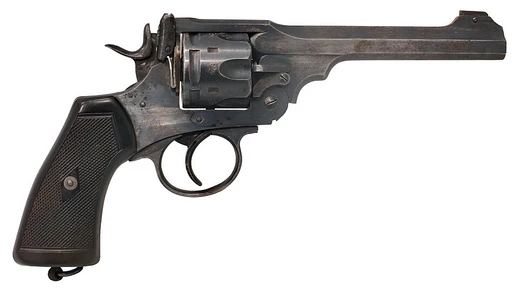
Udar revolver
Russian police revolver firing proprietary 12.3mm less-lethal and lethal rounds.

The U-94 UDAR (У-94 "Удар"; Russian for "Strike" or "Blow") is a compact double-action revolver developed by the KBP Instrument Design Bureau in the early 1990s and first manufactured in 1994. It is notable for its proprietary 12.3mm ammunition, side-breaking cylinder, and shrouded hammer with a manual cocking/decocking slot. Originally designed for less-than-lethal crowd control, it also fires lethal rounds for self-defense.
Quick Facts
- Origin
- Russia
- Is Ranged
- yes
- Service
- MVD
- Designer
- KBP Instrument Design Bureau
- Design Date
- 1994
- Variants
- Udar-S, Udar-TS
- Weight
- 920 g empty
- Length
- 173 mm
- Height
- 134 mm
- Cartridge
- 12.3x50mmR (UDAR) / 12.3x40mmR (UDAR-TS) / 12.3x22mmR PM32 (UDAR-S) / 9x18mm Makarov, 9x17mm Short (R-92)
- Action
- Double action
- Range
- 5 m (Gas- or Liquid-Projection), / 10 m (Plastic Baton), / 25 m (Bullet)
Facts from the source article.
Lore & Background
The UDAR was designed by KBP Instrument Design Bureau in the early 1990s as a police weapon, entering production in 1994. Its unusual 12.3mm shell was intended for tear gas (CS) aerosol, rubber baton, and rubber buckshot for self-protection or crowd control, but it also accommodates jacketed hollow-point, armor-piercing slugs, and lead shot shells. The bore has been alternately described as 12.5mm, 12.7mm, 32-gauge, or 36-gauge, reflecting some ambiguity in its exact dimensions. All ammunition was produced by the Tula Cartridge Works, marked with either civilian "TPZ" or military "539" headstamp codes.
The revolver features a shrouded hammer that can be manually cocked or decocked via a cut-out slot at the top of the shroud. Its cylinder opens to the left and uses a star ejector to simultaneously eject all spent shells. The design was based on the earlier R-92 compact revolver chambered in 9x18mm Makarov, which itself had a variant (R-92S) in 9x17mm Short for private security.
Adoption by Russian police was limited; they preferred semi-automatic pistols for their larger magazines and quicker reloading. The need to unload and reload the cylinder and discard partially spent rounds when changing ammo types in a crisis was seen as impractical. Nonetheless, the UDAR was adopted in some numbers by the MVD.
Reader's Guide
The UDAR revolver represents an attempt to introduce a specialized less-lethal firearm to Russian law enforcement, but it failed to gain widespread acceptance. Its proprietary 12.3mm ammunition, while versatile in offering both non-lethal and lethal options, created logistical challenges and limited its appeal compared to standard-issue semi-automatic pistols. The design's complexity—with three different cylinder sizes and multiple bore descriptions—may have contributed to its niche status. Variants such as the Udar-S (for private security, firing only lead slugs) and Udar-TS (training version with paint-filled bullets) show efforts to expand its market, but the Ratnik and OTs-20 Gnom from other manufacturers indicate that the concept of large-bore revolver-based less-lethal weapons continued to be explored. The UDAR's legacy is that of an innovative but commercially unsuccessful police tool, notable for its unusual ammunition and the technical solutions it employed.
Did You Know?
- The UDAR's name means 'Strike' or 'Blow' in Russian.
- It was originally designed to fire tear gas (CS) aerosol, rubber baton, and rubber buckshot.
- The revolver has three different cylinder sizes: 12.3x22mmR, 12.3x40mmR, and 12.3x50mmR.
- A variant called the Udar-TS fires paint-filled bullets for training or marking rioters.
More in Revolvers, Part 4 1-24
Spotted an error? Know more?
Reader corrections go straight into our review queue. Suggest an edit · How this site is sourced