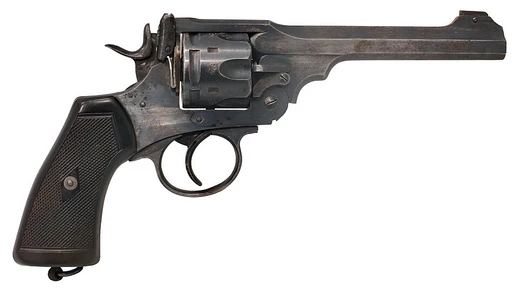
FitzGerald Special
Precursor to the modern snubnosed revolver, custom-built by John Henry Fitzgerald.

The Fitz Gerald Special, often called the Fitz Special or Fitz Colt, is a snubnosed revolver design created by John Henry Fitzgerald. Known as "Fitz," he worked for Colt Firearms from 1918 to 1944. The design is considered the forerunner of the modern snubnosed revolver and served as the prototype for the Colt Detective Special, the first factory-made two-inch snubnosed revolver.
To create a Fitz Special from a standard Colt revolver, the barrel is cut to two inches or less, a new front sight is added, the ejector rod is shortened, the hammer spur is bobbed, the butt is rounded, and the front half of the trigger guard is removed. These modifications—reshaping the hammer and butt—allow the gun to be drawn quickly without snagging on clothing. The halved trigger guard makes it easier to get a finger on the trigger, even for shooters with large fingers or gloves.
Fewer than 200 Fitz Specials were ever made, with some historians believing the total was under 40.
Before working at Colt, Fitzgerald spent his youth as a bare-knuckles prizefighter before boxing gloves were used. He developed an early interest in firearms and became a champion pistol shot. He favored Colt revolvers, especially the New Service, and became skilled at improving their actions by adjusting springs and smoothing internal parts. By 1918, he was well known and hired as a salesman by Colt.
Fitzgerald created his first Fitz Special in the mid-1920s by converting a .38 Special Colt Police Positive Special revolver. He later converted two .45 Colt New Service revolvers the same way and was known to carry both in his front pockets. He also served as a New York State Trooper, a police firearms instructor, and a noted firearms expert. In 1930, he published a book called *Shooting*, which strongly promoted his snubnosed revolver concept along with other pistol shooting techniques and tactics. He developed the "Colt Police Silhouette Target" at a time when most shooters used bulls-eye targets, and he was an early advocate of practical shooting. He pushed for large caliber handguns like the .45 ACP Colt 1911 and was especially fond of .45 Colt New Service revolvers. He was among the first to promote the two-handed shooting stance later refined into the Modern technique by Jack Weaver and Jeff Cooper in the 1960s.
- Developer
- John Henry Fitzgerald
- Employer
- Colt Firearms
- Estimated total production
- Under 200 (some historians argue fewer than 40)
- First conversion
- Mid-1920s, .38 Special Colt Police Positive Special
- Barrel length
- Two inches or less
- Notable proponents
- Colonels Rex Applegate and Charles Askins
Lore & Background
John Henry Fitzgerald developed his snubnosed revolver concept around the mid-1920s while working for Colt Firearms, converting a .38 Special Colt Police Positive Special revolver into his first Fitz Special. He later converted two .45 Colt New Service revolvers in the same manner and was known to carry the pair in his front pockets. The design involved shortening the barrel to two inches or less, attaching a new front sight, shortening the ejector rod, bobbing the hammer spur, rounding the butt, and removing the front half of the trigger guard.
Fitzgerald was a bare-knuckles prizefighter in his younger days, a champion pistol shot, and a New York State Trooper, police firearms instructor, and noted firearms expert. He published a book titled Shooting in 1930, advocating his snubnosed revolver concept and other pistol shooting techniques. He developed the Colt Police Silhouette Target and was an early advocate of practical shooting, large caliber handguns, and the two-handed shooting stance.
Colonels Rex Applegate and Charles Askins were proponents of the Fitz Special. Applegate carried a .45 ACP New Service Fitz Special with ivory handles engraved 'TO REX FROM FITZ.' Askins called his .45 Colt New Service Fitz Special 'The grandest defense gun I have ever had.' Charles Lindbergh, William Powell, and Clyde Barrow were also known to carry Fitz Specials.
Reader's Guide
The Fitz Special is significant as the precursor of the modern snubnosed revolver and specifically the prototype for the Colt Detective Special, the first production two-inch snubnosed revolver. Even after the introduction of the Detective Special in 1927, Fitzgerald continued to make custom revolvers by special order. The Fitz Special went on to become a popular after-market conversion for many gunsmiths. Its design features—bobbed hammer, rounded butt, and halved trigger guard—were intended to allow quick drawing with little risk of snagging on clothing and to facilitate quick trigger acquisition, even for shooters with large fingers or gloves. Fitzgerald's ideas, including his advocacy of practical shooting and the two-handed stance, would become the foundation of modern firearms training and influence generations of firearms instructors. In popular culture, the character of NYPD Commissioner Frank Reagan on the television series Blue Bloods carries a Fitz Special as his standard duty weapon, passed down through his family. A revolver based on the Fitz Special design appears on the cover of the fifth James Bond novel, From Russia, with Love, though it differs in having an intact hammer and being a Smith & Wesson model rather than a Colt.
Did You Know?
- John Henry Fitzgerald was a bare-knuckles prizefighter before becoming a firearms expert.
- Fitzgerald carried two .45 Colt New Service Fitz Specials in his front pockets.
- Colonel Rex Applegate's Fitz Special was engraved 'TO REX FROM FITZ.'
Frequently Asked Questions
What is the FitzGerald Special?
It is a hand-built, snubnosed revolver made by shortening and modifying a standard Colt frame. The design is widely regarded as the direct ancestor of today's factory-produced snubnosed revolvers.
Who was John Henry Fitzgerald and what was his role?
Fitzgerald, nicknamed "Fitz," was a gunsmith employed by Colt Firearms between 1918 and 1944. During that stretch he personally crafted these shortened-revolver conversions, making him the sole developer of the design.
How did Fitzgerald convert a standard Colt into a Fitz Special?
He trimmed the barrel to two inches or less, fitted a new front sight, shortened the ejector rod, filed down the hammer spur, and rounded out the butt. Those changes turned a full-length service revolver into a compact, concealable sidearm.
What is the link between the FitzGerald Special and the Colt Detective Special?
The Fitz Special proved that a two-inch snubnosed Colt could function reliably as a working sidearm. Colt eventually took that concept to the factory floor and rolled out the Detective Special as the first mass-produced version of the style.
How rare is a FitzGerald Special today?
Fewer than 200 units are believed to have been built, and some historians place the true number below 40. That extreme scarcity, combined with the fact that they were never sold through Colt's retail channels, makes surviving examples highly sought after by collectors.
More in Revolvers, Part 4 1-24
Spotted an error? Know more?
Reader corrections go straight into our review queue. Suggest an edit · How this site is sourced