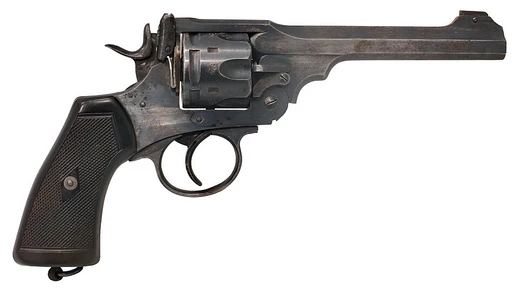
Colt M1889
First revolver with a swing-out cylinder, produced by Colt.

The Colt Model 1889 was a double-action revolver manufactured by the Colt Manufacturing Company from the late 1800s into the early 1900s. Its development stemmed from earlier Colt military revolvers designed by William Mason and Carl J. Ehbets. After Mason left for Winchester in 1882, Ehbets stayed and refined their shared design, leading to the Model 1889.
Colt became the first manufacturer to produce a revolver with a swing-out cylinder, released by a sliding latch. This allowed fast reloading while keeping the solid frame strong. However, the design had a flaw: unlike the later Smith & Wesson Hand Ejector (Model 1896, chambered in .32 S&W Long), which used a combined center-pin and ejector rod to lock the cylinder, the 1889 lacked a center pin. This made the cylinder prone to moving out of alignment.
The revolver was chambered for the .41 Long Colt and .38 Long Colt cartridges. Its cylinder rotated counterclockwise instead of clockwise—a feature likely requested by the U.S. Navy—but this direction worked against the cylinder lock, causing misalignment and allowing the cylinder to rotate while holstered or during trigger pull.
The Navy version had a blued finish, a six-inch barrel, and hard rubber grips. Civilian versions came in blue or nickel finishes with walnut grips, and occasionally ivory grips. The Model 1889 and its variants were adopted by the U.S. military before the M1911 pistol, and were also sold commercially as the Colt New Army and Navy. Approximately 31,000 units were produced.
Quick Facts
- Origin
- United States
- Used By
- United States Navy, occasionally United States Army
- Wars
- Boxer Rebellion / Philippine–American War / Spanish–American War / World War I
- Designer
- William Mason and Carl J. Ehbets
- Design Date
- 1889
- Manufacturer
- Colt
- Production Date
- 1889–1909
- Cartridge
- .38 Long Colt, .41 Long Colt
- Action
- revolver
Facts from the source article.
Lore & Background
The Colt Model 1889 evolved from earlier Colt revolvers designed by William Mason and Carl J. Ehbets. After Mason left Colt in 1882, Ehbets continued refining their collaborative design, leading to the Model 1889. Colt was the first manufacturer to produce a revolver with a swing-out cylinder, released by a sliding latch. Smith & Wesson followed seven years later with the Hand Ejector, Model 1896, which improved upon the Colt design by using a combined center-pin and ejector rod to lock the cylinder. The Model 1889 lacked a center pin, making its cylinder prone to moving out of alignment.
The Model 1889 differed from earlier Colt revolvers in that its cylinder rotated counterclockwise instead of clockwise. This direction of rotation, which seems to have originated with U.S. Navy requirements, worked against the cylinder lock and tended to force the cylinder out of alignment with the barrel. This weakness allowed the cylinder to rotate while holstered or even while the shooter was pulling the trigger.
The Navy version was blued with a six-inch barrel and hard rubber grips. Civilian versions offered either a blue or nickel finish and walnut grips, sometimes with ivory grips. The revolver was chambered for the .41 Long Colt and .38 Long Colt cartridges.
Reader's Guide
The Colt Model 1889 holds significance as the first production revolver to incorporate a swing-out cylinder, a feature that would become standard on later double-action revolvers. Its design allowed for faster reloading compared to earlier loading-gate revolvers, while the solid frame retained structural strength. However, the Model 1889 had a notable weakness: the lack of a center pin to lock the cylinder in place, combined with its counterclockwise cylinder rotation, made the cylinder prone to misalignment. This issue was addressed by Smith & Wesson's later Hand Ejector design. Despite this flaw, the Model 1889 was adopted by the United States Military and used prior to the introduction of the M1911 pistol. It was also sold commercially as the Colt New Army and Navy. Approximately 31,000 units were produced. The Model 1889's legacy includes its influence on subsequent Colt revolvers such as the M1892, M1905 New Marine, New Service, and Official Police.
Did You Know?
- The Colt Model 1889 was the first double-action revolver with a swing-out cylinder.
- Its cylinder rotated counterclockwise, which worked against the cylinder lock and caused alignment issues.
- Approximately 31,000 Colt Model 1889 revolvers were produced.
- The Navy version had a six-inch barrel and hard rubber grips.
Frequently Asked Questions
What is the Colt Model 1889?
The Colt Model 1889 is a double-action revolver produced by the Colt Manufacturing Company from the late 19th century into the early 20th century. It was chambered in .41 Long Colt or .38 Long Colt and held six rounds in its cylinder.
What made the Colt 1889 a groundbreaking design?
Colt introduced the first swing-out cylinder released by a sliding latch, letting the shooter reload quickly without weakening the solid frame. This mechanism set a new standard for revolver ergonomics at the time.
Who was behind the development of the Colt 1889?
The design grew out of earlier military revolver work shared by William Mason and Carl J. Ehbets. After Mason departed for Winchester in 1882, Ehbets remained at Colt and refined the concept into the Model 1889.
What were the key specifications of the Colt 1889 Navy variant?
The Navy version featured a six-inch barrel, a blue finish, and a six-round cylinder. Civilian models were available in either blue or nickel plating.
What design limitation did the Colt 1889 have compared to later revolvers?
Although the swing-out cylinder was a major advance, it carried a structural drawback that later manufacturers such as Smith & Wesson eventually addressed in their own cylinder-release systems.
More in Revolvers, Part 4 1-24
Spotted an error? Know more?
Reader corrections go straight into our review queue. Suggest an edit · How this site is sourced