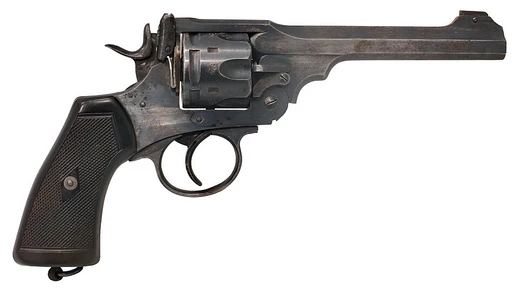
Pfeifer Zeliska .600 Nitro Express revolver
An Austrian single-action revolver chambered in .600 Nitro Express.

The Pfeifer Zeliska .600 Nitro Express revolver is an Austrian single-action revolver produced by Pfeifer Waffen. Except for the Giant 1859 28mm Remington revolver, it may be the largest handgun in the world, weighing 6 kg and measuring 55 cm in length, with a cylinder alone weighing 2 kg. It is one of the most powerful handguns in the world, producing a muzzle energy of 4,592 foot pounds.
Quick Facts
- Origin
- Austria
- Is Ranged
- yes
- Design Date
- 1995
- Manufacturer
- Pfeifer Waffen
- Production Date
- 2001
- Weight
- 6.001 kg
- Length
- 550 mm
- Part Length
- 335 mm
- Cartridge
- .600 Nitro Express
- Action
- Single-action
- Feed
- 5 round cylinder
Facts from the source article.
Lore & Background
The Zeliska is largely based on the Colt Single Action Army revolver. Loading is accomplished through a loading gate located on the right of the cylinder. Added features include a gold-plated hammer, cylinder pivot, and action, as well as a gold-filled inscription on the gun indicating the company's address. The revolver fires a 900 grain .600 Nitro Express slug at 1,516 ft/s, compared to the 1,850–2,050 ft/s regulation level velocities typical of 28-inch barrel rifles chambered in the same cartridge. The weight of the handgun helps control the recoil, making controlled shooting possible.
Reader's Guide
The Pfeifer Zeliska .600 Nitro Express revolver occupies a unique place as one of the largest and most powerful handguns ever produced. Its design, closely following the Colt Single Action Army, combines a classic action with extreme cartridge power. The revolver's substantial weight—6 kg total, with a 2 kg cylinder—is essential for managing the recoil of the .600 Nitro Express round, which produces 4,592 foot-pounds of muzzle energy. This is notably less than the power achieved by a 14-inch revolver chambered in the .500 Bushwhacker cartridge, which can exceed 5,000 foot-pounds. The Zeliska's cost, both for the firearm itself ($17,316) and its ammunition ($40 per round), places it among the most expensive handguns to own and operate. Its gold-plated components and engraved address inscription mark it as a luxury item as well as a functional firearm. The revolver's five-round capacity and loading gate mechanism reflect its heritage, while its sheer size and power ensure its status as a notable entry in the history of handgun design.
Did You Know?
- The cylinder of the Zeliska alone weighs 2 kg.
- Each .600 Nitro Express round for the Zeliska costs $40.
Frequently Asked Questions
What is the Pfeifer Zeliska .600 Nitro Express revolver?
It is an Austrian single-action revolver chambered for the .600 Nitro Express cartridge, manufactured by Pfeifer Waffen. Aside from the Giant 1859 28mm Remington, it is generally considered the largest handgun ever built.
How big and heavy is the Pfeifer Zeliska .600 Nitro Express?
The revolver weighs a full 6 kg and measures 55 cm in overall length, with the cylinder alone tipping the scales at 2 kg. Those dimensions make it a genuinely two-handed, almost rifle-like piece of hardware.
How much power does the Pfeifer Zeliska .600 Nitro Express produce?
It delivers approximately 4,592 foot-pounds of muzzle energy, placing it among the most powerful handguns on the planet. That level of energy is comparable to many dedicated rifles.
What type of action does the Pfeifer Zeliska .600 Nitro Express use?
It is a single-action revolver, so the shooter must manually cock the hammer before every trigger pull. There is no double-action mode or semi-automatic cycling to speak of.
Why is the Pfeifer Zeliska .600 Nitro Express revolver considered so notable?
Pairing a .600 Nitro Express cartridge with a 6 kg, 55 cm frame makes it one of the most extreme and powerful handguns ever produced. Its sheer mass and energy output set it apart from virtually every other revolver in the world.
More in Revolvers, Part 4 1-24
Spotted an error? Know more?
Reader corrections go straight into our review queue. Suggest an edit · How this site is sourced