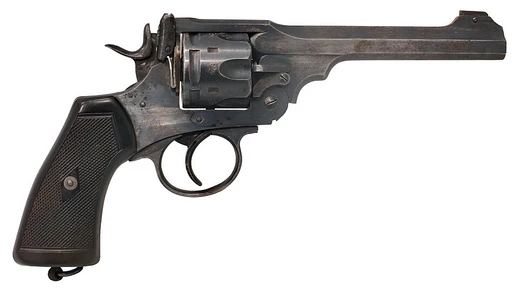
Danish 1865/97 revolver
A Danish pinfire revolver converted to centrefire for reserve troops.

The Danish 1865/97 revolver was a conversion of the earlier Danish 1865 pinfire revolver to centrefire ammunition. It served in the Danish armed forces from 1897 to 1946 as a reserve sidearm, issued to units such as artillerymen who otherwise lacked firearms for self-defence.
Quick Facts
- Origin
- Denmark
- Wars
- World War II
- Number
- 952
- Production Date
- 1897-1899
Facts from the source article.
Lore & Background
The Danish 1865/97 revolver began as the model 1865 pinfire revolver, the first repeating sidearm adopted by the Danish military. It was designed by gunsmith Georg Christensen, stepson of another gunsmith named Löbenitz, and manufactured at the Kronberg Gevaerfabrik where Christensen's stepfather had worked. Approximately 1,000 of these 12 mm pinfire revolvers were produced. By the 1880s, newer revolvers made the model 1865 obsolete, and the older guns were placed in reserve at Kjøbenhavns Tøjhus.
In 1897, 850 of the reserve revolvers were converted to centrefire at Kjøbenhavns Tøjhus, creating the model 1865/97. The conversion added a trigger guard and locked the folding trigger in place. The new centrefire ammunition used a uniquely Danish design with a wooden core and nickel casing, in .45 calibre (roughly 11.5 mm). In 1899, a further 52 revolvers were converted, but these retained the original folding trigger; they were shipped to the West Indies, most probably to the Danish colony there. In total, 952 of the original 1,000 model 1865 revolvers were converted to the 1865/97 standard.
Reader's Guide
The Danish 1865/97 revolver represents a practical adaptation of an obsolete design to extend the service life of existing military stores. Its conversion from pinfire to centrefire allowed the Danish military to equip support units—particularly artillerymen—with a functional sidearm without the expense of new production. The revolver's service from 1897 to 1946, spanning nearly five decades, indicates its role as a reliable reserve weapon. The unique Danish ammunition with a wooden core and nickel casing reflects local manufacturing solutions. The conversion of 952 out of 1,000 original revolvers shows a high rate of reuse, while the 1899 batch sent to the West Indies illustrates the reach of Danish colonial military logistics. The revolver's legacy is tied to its long service as a secondary arm for troops who otherwise would have had no firearm for self-defence.
Did You Know?
- The original model 1865 was the first repeating sidearm adopted by the Danish military.
- The revolver was designed by Georg Christensen, stepson of gunsmith Löbenitz.
- The centrefire ammunition had a wooden core and nickel casing, a uniquely Danish design.
- 52 converted revolvers with unchanged folding triggers were shipped to the West Indies in 1899.
Frequently Asked Questions
What is the Danish 1865/97 revolver?
It is a centrefire-modified version of Denmark's original 1865 pinfire revolver, brought into service in 1897 as a secondary sidearm. The conversion allowed the older frame to accept modern centrefire cartridges instead of the obsolete pinfire design.
What calibre and action does the Danish 1865/97 revolver use?
The revolver fires a .45 round (roughly 11.5 mm) through a pinfire-to-centrefire converted mechanism. Georg Christensen oversaw the redesign, and Kronberg Gevaerfabrik carried out the manufacturing work.
How many Danish 1865/97 revolvers were actually converted?
Out of the 1,000 original 1865 pinfire revolvers, 952 received the centrefire conversion. That small production figure makes surviving examples a sought-after piece among collectors of Scandinavian military firearms.
Who was issued the Danish 1865/97 revolver and what role did it fill?
From 1897 to 1946 it served as a reserve sidearm, typically handed to personnel such as artillerymen who otherwise had no personal firearm for self-defence. It was never intended as a frontline combat weapon, but rather a back-up arm for support troops.
Why is the Danish 1865/97 revolver considered notable?
It is a textbook example of a military workshop extending an aging pinfire platform by reworking it for centrefire ammunition, saving the cost of a full redesign. Its narrow 952-piece run and purely auxiliary service role give it a distinct niche in Danish small-arms history.
More in Revolvers, Part 4 1-24
Spotted an error? Know more?
Reader corrections go straight into our review queue. Suggest an edit · How this site is sourced