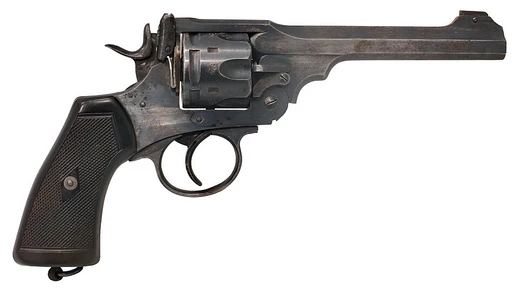
Ruger Old Army
A modern black-powder revolver built on the Blackhawk frame.

The Ruger Old Army is a black-powder percussion revolver that Sturm, Ruger first sold in 1972 and kept in production until 2008. It came with either a 5.5-inch or a 7.5-inch barrel. Unlike most percussion revolvers on the market, this one wasn’t a copy of an old design. Instead, Ruger modified its own Blackhawk model—which itself was based on the cartridge-firing Colt Peacemaker—to create the Old Army. As a result, the revolver includes many modern features but still uses old-fashioned black-powder loading components.
The frame was lengthened in front to accommodate the loading lever and pivot pin, giving it styling similar to the Spiller and Burr cap-and-ball pistol. Early models were listed as .44 caliber, later as .45, but all fire a .457-inch round ball or a .454-inch conical lead bullet. With a drop-in conversion cylinder made by various manufacturers, the Old Army can also shoot modern smokeless .45 Colt (.45 Long Colt) or .45 ACP cartridges, as long as they’re loaded for “cowboy action” with muzzle velocities under about 850 feet per second.
Unlike the Blackhawk, the Old Army lacks Ruger’s transfer bar safety. Instead, it uses safety notches between each chamber on the cylinder, similar to some mid-19th-century Remington, Colt, or other black-powder revolvers. The revolver was tested by loading each chamber to capacity with Bullseye smokeless powder and a lead ball. While that would cause catastrophic failure in many other firearms, the Old Army proved strong enough to handle the pressure.
The Old Army was made in both blued steel and stainless steel. The first series, produced from 1972 to 1981 (serial numbers 140-000000 to 140-46841), were all blued. Stainless steel versions started in 1982, beginning with serial number 145-00000. Adjustable sights were standard at first, but fixed-sight models became available in 1994. A 5.5-inch barrel was introduced in 2002. Some versions came with polymer ivory grips. Barrels made in 1976 were marked “MADE IN THE 200TH YEAR OF AMERICAN LIBERTY.”
Quick Facts
- Origin
- United States
- Is Ranged
- yes
- Manufacturer
- Sturm, Ruger & Co.
- Production Date
- 1972–2008
- Part Length
- 7.5" barrel
- Cartridge
- Black Powder; Cap & Ball
- Caliber
- .44
- Action
- Single Action Revolver
- Feed
- 6-shot Cylinder
Facts from the source article.
Lore & Background
The Ruger Old Army was designed as a modification of Ruger's Blackhawk model, which itself was based on the cartridge-firing Colt Peacemaker. Unlike most percussion revolvers on the market, it was not a copy of a historical design; its styling cues came from the Spiller and Burr cap and ball pistol, due to the frame being longer in front to accommodate the loading lever and pivot pin. The revolver used a .457 in round ball or .454 in conical lead bullet, and could also shoot modern smokeless cartridges in .45 Colt or .45 ACP loaded for cowboy action velocities below about 850 feet per second via a drop-in conversion cylinder.
The Old Army did not use Ruger's transfer bar safety; instead it relied on safety notches between each chamber on the cylinder, similar to some Remington/Colt or other black powder revolvers of the mid-19th century. The revolver was tested by loading each chamber to capacity with Bullseye smokeless powder and a lead ball, and proved strong enough to handle the pressure without catastrophic failure.
Variants included blued steel models from 1972 to 1981, with stainless versions introduced in 1982. Fixed-sight models were first offered in 1994, and a 5.5 in barrel was introduced in 2002. Some versions were sold with polymer ivory grips. Barrels made in 1976 were marked "MADE IN THE 200TH YEAR OF AMERICAN LIBERTY."
Reader's Guide
The Ruger Old Army occupies a unique place in revolver history as a modern black-powder percussion revolver that was not a reproduction of any historical design. Its construction on the Blackhawk frame gave it strength and reliability uncommon in cap-and-ball revolvers, as demonstrated by its ability to withstand smokeless powder loads that would cause catastrophic failure in other firearms. The revolver's design incorporated modern features while maintaining the loading process of black-powder components, bridging a gap between antique technology and contemporary manufacturing.
Its ability to accept drop-in conversion cylinders for .45 Colt and .45 ACP cartridges (at cowboy action velocities) added versatility, allowing owners to use it as either a traditional percussion revolver or a cartridge firearm. The availability of both blued and stainless steel finishes, along with adjustable or fixed sights and two barrel lengths, gave shooters options. The 1976 bicentennial marking on barrels made that year added collector interest. The Old Army's production run from 1972 to 2008—over three decades—demonstrates its sustained appeal among black-powder enthusiasts and shooters who valued a robust, modern take on an old design.
Did You Know?
- The Ruger Old Army was based on the Blackhawk model, which itself was based on the cartridge-firing Colt Peacemaker.
- It could shoot modern smokeless .45 Colt or .45 ACP cartridges via a drop-in conversion cylinder, at velocities below about 850 feet per second.
- The revolver was tested with each chamber loaded to capacity with Bullseye smokeless powder and a lead ball without catastrophic failure.
More in Revolvers, Part 4 1-24
Spotted an error? Know more?
Reader corrections go straight into our review queue. Suggest an edit · How this site is sourced