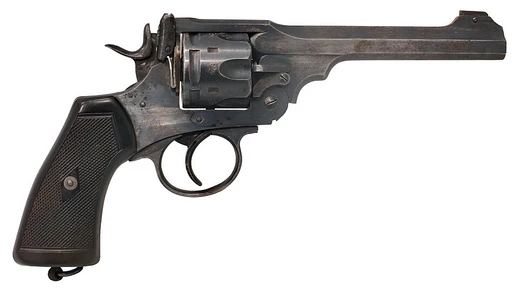
Ruger GP100
A rugged double-action revolver family built for sustained full-power use.

The Ruger GP100 is a family of double-action revolvers manufactured by Sturm, Ruger & Co. in the United States. It is notable for its strength, being designed to fire an unlimited number of full-power .357 Magnum rounds, and for its modular construction that allows disassembly into three major modules with limited use of tools.
Quick Facts
- Origin
- United States
- Is Ranged
- yes
- Manufacturer
- Sturm, Ruger & Co.
- Production Date
- 1985–present
- Number
- 734,500
- Weight
- 35 -
- Length
- 8-11.5 in
- Part Length
- 2.5 in / 3 in / 4 in / 4.2 in / 5 in / 6 in
- Cartridge
- •10mm Auto · •.22 long rifle · •.327 Federal Magnum · •.357 Magnum · •.38 Special · •.44 Special
- Action
- Double-action revolver
- Range
- 55–110 yd
- Max Range
- +/− 550 yd
Facts from the source article.
Lore & Background
The GP100 was introduced in 1985 as an evolution of the earlier Ruger Security Six, intended to replace the Security-/Service-/Speed-Six line. It incorporated a new triple-locking cylinder mechanism with a lever on the crane, a feature first introduced on the Ruger Redhawk, along with stronger steels and a redesigned, beefier frame shape. The frame used a small rectangular 'peg' grip that enclosed the hammer spring and strut, allowing grips of any shape as long as they enclosed the peg—a design previously used by Dan Wesson and some High Standard revolvers.
The GP100 shares the crane lock from the Redhawk, later used in the small frame SP101 revolver. All models use the same thickness on the solid frame and double latching system as used on the heavy .44 Magnum. The firing pin is mounted inside the frame, and a transfer bar connected directly to the trigger must be positioned between the hammer and firing pin for the gun to fire, only assuming that position when the trigger is pulled completely rearward.
The GP100 is manufactured in .327 Federal Magnum, .357 Magnum, .38 Special, .22 long rifle, .44 Special, and 10mm Auto calibers, with barrel lengths of 2.5, 3, 4, 4.2, 5, and 6 inches, in blued steel or stainless steel finishes. Fixed sight models are designated by an 'F' suffix, and stainless models have a 'K' prefix. The run of 5-inch GP100 revolvers was made for the distributor Davidson's.
Reader's Guide
The GP100 series is widely described as one of the strongest medium frame revolvers ever made, due to its solid frame thickness, double latching system, and the elimination of a frame sideplate, which contributes to its reputation for strength. Its design allows easy cleaning through disassembly into three major modules with limited tools. The stock grips are made of Santoprene, a soft elastomer that helps absorb recoil, with side panels of black plastic, goncalo alves wood, or rosewood; later models use Hogue one-piece rubber grips as standard. The GP100 has been produced with numerous variations including barrel lengths and profiles, fixed or adjustable sights, and blued or stainless finishes. Special editions include a 2016 limited run for the Friends of NRA (1,145 stainless .357 Magnum revolvers with 4-inch barrels and NRA-prefix serial numbers) and a 2021 run of 500 GP100s in memory of YouTuber and Gunblast founder Jeff Quinn. The GP100 has been used by local police, the EKAM counter-terrorist unit of the Hellenic Police, the Special Anti-Terrorist Unit, and the New York Police Department (model 'GPNY').
Did You Know?
- The GP100 was introduced in 1985 as a replacement for the Ruger Security-/Service-/Speed-Six line.
- The GP100 uses a triple-locking cylinder mechanism with a lever on the crane, first introduced on the Ruger Redhawk.
- The GP100 is available in 5-shot (.44 Special), 6-shot (.357 Magnum, .38 Special, 10mm Auto), 7-shot (.357 Magnum, .327 Federal Magnum), and 10-shot (.22 long rifle) configurations.
- In 2021, Ruger produced 500 GP100 revolvers in memory of YouTuber and Gunblast founder Jeff Quinn.
More in Revolvers, Part 4 1-24
Spotted an error? Know more?
Reader corrections go straight into our review queue. Suggest an edit · How this site is sourced