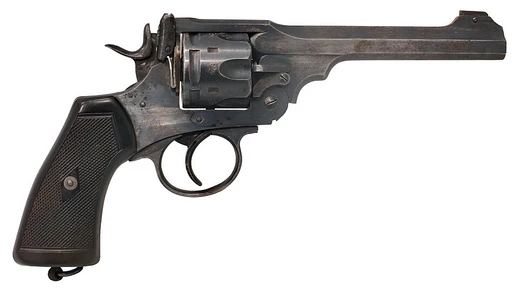
OTs-20 Gnom
Russian smooth-bore revolver firing shotgun-derived 12.5mm ammunition.

The OTs-20 Gnom (ОЦ-20 "Гном") is a Russian revolver built by the KBP Instrument Design Bureau. It fires a proprietary 12.5x40mm STs-110 cartridge, which was adapted from a 32-gauge shotgun shell. The revolver has a smooth bore, which limits its accuracy but gives it high muzzle velocity and strong stopping power. Available ammunition includes a lead slug (STs-110-04), lead shot (STs-110-02), an armor-piercing steel-core slug (STs-110), and three types of non-lethal rounds.
A tactical laser projector can be attached to an accessory rail under the ejector rod shroud. It is activated by a pressure switch mounted on the grip; squeezing the grip turns the laser on or off. According to the manufacturer, the steel-core slug can penetrate 4.5 mm of standard body armor plate at 25 meters, with a dispersion of about 5 cm at that distance.
The weapon was designed by A.N. Nevizhin, V.I. Seregin, and S.V. Zotov at TsKIB SOO. Production began in 1994, and as of 2013, only about 200 units are known to have been made. The Gnom was partially derived from the 9mm OTs-11 Nickel revolver, also developed by Nevizhin and Zotov.
Before the Gnom, the MVD already used a similar weapon: the KBP 12.3mm UDAR revolver. Based on the 9mm R-92 revolver, the UDAR was intended for self-defense and riot control by undercover or plainclothes police. It uses rounds made from cut-down 36-gauge shotgun shells and can fire shot, slug, or aerosol gas shells.
Quick Facts
- Origin
- Russia
- Is Ranged
- yes
- Service
- MVD
- Designer
- TsKIB SOO
- Manufacturer
- KBP Instrument Design Bureau
- Production Date
- 1994
- Number
- 200
- Weight
- 1.1 kg (1.17 with ammo)
- Length
- 250 mm
- Part Length
- 100 mm (3.93 inches)
- Height
- 132 mm
- Cartridge
- 12.5x40mm STs-110
Facts from the source article.
Lore & Background
The OTs-20 Gnom was designed by A.N. Nevizhin, V.I. Seregin, and S.V. Zotov at TsKIB SOO. Its production began in 1994, and only 200 pieces are known to have been made as of 2013. The revolver was partially derived from the 9mm OTs-11 Nickel revolver previously developed by Nevizhin and Zotov.
The Gnom is a smooth-bore revolver, which limits its accuracy but provides high muzzle velocity and stopping power. It can fire lead slug (STs-110-04), lead shot (STs-110-02), and armor-piercing steel-core slug (STs-110) cartridges, as well as three types of non-lethal ammunition. A tactical laser projector is available that mounts on an accessory rail under the ejector rod shroud, activated by a pressure switch attached to the grip.
Before the Gnom, the MVD already had a similar weapon in service: the KBP 12.3mm UDAR revolver. Derived from the 9mm R-92 revolver, the UDAR was designed for self-defense and riot control for undercover or plainclothes police, using rounds derived from cut-down 36-gauge shotgun shells.
Reader's Guide
The OTs-20 Gnom represents a niche approach to revolver design, combining a smooth bore with a powerful shotgun-derived cartridge to maximize stopping power at close range. Its development by the TsKIB SOO design team, partially based on the earlier OTs-11 Nickel revolver, shows an evolutionary path within Russian revolver design. The manufacturer's claims of 4.5 mm armor penetration at 25 meters with the steel-core slug, alongside a dispersion of about 5 cm at that distance, indicate its intended role as a close-quarters weapon capable of defeating body armor. The availability of non-lethal ammunition and a laser projector with a grip-activated pressure switch suggests a design for law enforcement or special operations use, where versatility and rapid target acquisition are valued. However, with only 200 units produced as of 2013, the Gnom remains a rare and specialized firearm, its legacy tied to the specific requirements of Russian security services rather than widespread adoption. Its smooth-bore nature and proprietary ammunition set it apart from conventional revolvers, emphasizing raw power over precision.
Did You Know?
- The OTs-20 Gnom uses a 12.5x40mm cartridge developed from a 32 gauge shotgun shell.
- It is a smooth-bore revolver, which reduces accuracy but increases muzzle velocity and stopping power.
- The revolver can fire armor-piercing steel-core slugs that penetrate 4.5 mm of standard body armor at 25 meters.
- Only 200 pieces of the OTs-20 Gnom were known to have been made as of 2013.
More in Revolvers, Part 4 1-24
Spotted an error? Know more?
Reader corrections go straight into our review queue. Suggest an edit · How this site is sourced