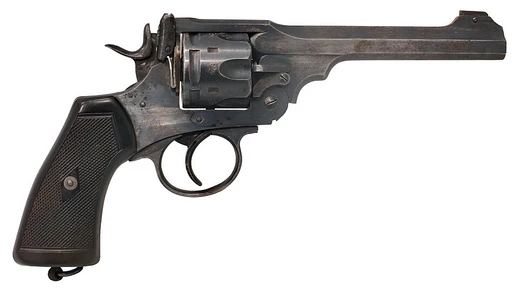
Colt Trooper
A medium-frame revolver offered as an affordable alternative to premium Colt models.

The Colt Trooper is a medium-frame, double-action revolver with a six-round cylinder. It was built as a more affordable option compared to the higher-end Colt .357, and later the Colt Python and Colt King Cobra, and was aimed at both law enforcement and civilian buyers.
Development began in 1953, when Colt introduced the Trooper alongside its premium cousin, the .357 Magnum, to fill a need for a lighter medium-frame revolver that law enforcement officers had long requested. These guns were considered well-sized and easy to handle for both .38 Special and .357 Magnum rounds. They competed directly with Smith & Wesson’s Model 28 "Highway Patrolman," but were lighter and more nimble.
The original Trooper, produced from 1953 to 1969, was essentially a heavy-barreled version of the Officers Model Match, built on Colt’s medium I-frame. It came in .22 Long Rifle and .38 Special, with a carbon steel frame available in blued or nickel finishes. Early blued models had a two-tone look: dull Colt Royal Blue on flat surfaces, with black bead-blasted edges and cylinder flutes. Two versions were offered: Target models, which had large walnut grips, wider target hammers, and adjustable sights; and Service models, with smaller hammers, basic stocks, and fixed sights. Barrel lengths included four inches for .22, and four and six inches for .38 Special; the .22 was also sold as a six-inch practice gun. All early Troopers used hammer-mounted firing pins. The Trooper was the entry-level and service-grade option, while the polished, expensive .357 model was the premium offering—though both shared the same forged, hand-fitted internal lockwork.
After the Python debuted in 1955, Colt dropped the basic .38 Special Trooper in 1961. They also retired the .357 name, renaming the remaining model simply "Trooper." This new version kept the .357 Magnum chambering and a frame-mounted firing pin, but retained the subdued finish of the entry-level revolver. It continued to be offered in .22 Long Rifle, and like all .357 Magnums, could also fire .38 Special ammunition.
By the late 1960s, Colt was losing market share due to rising labor costs. In response, they introduced the MK III series in 1969, an entirely new revolver line. The MK III used a new "J" frame with no parts interchangeable with older models.
Quick Facts
- Origin
- United States
- Is Ranged
- yes
- Manufacturer
- Colt's Manufacturing Company
- Production Date
- 1953–1985
- Part Length
- 4–8 in (102–203 mm)
- Cartridge
- .22 Long Rifle / .22 Winchester Magnum Rimfire / .38 Special / .357 Magnum
- Action
- Double-action
- Feed
- Six round cylinder
- Sights
- Iron sights
Facts from the source article.
Lore & Background
Introduced in 1953, the Trooper and its high-end cousin, the .357 Magnum, were intended to address the medium frame revolver market, as law enforcement officers had long complained about the weight of earlier models. The two guns were seen as ideal in size and handling characteristics for the .38 Special and .357 Magnum. Offered as an alternative and competitor to Smith & Wesson’s Model 28 'Highway Patrolman', the Colts were lighter and handier.
The original Trooper (1953–1969) was a heavy-barreled version of the Officers Model Match based on Colt's medium I-frame. It was offered in .22 Long Rifle and .38 Special, with blued or nickel-plated finishes. Early blued Troopers had a two-tone color scheme with dull Colt Royal Blue on flat surfaces and black bead blasted texture on edges and cylinder flutes. Target models had walnut grips, target hammers, and adjustable sights; Service versions had smaller hammers, basic stocks, and fixed sights. After the Python's introduction in 1955, Colt discontinued the .38 Special Trooper in 1961 and renamed the .357 model simply 'Trooper', retaining the .357 chambering and frame-mounted firing pin.
The MK III series (1969–1983) used a new 'J' frame with no parts interchangeability with older models, employing a transfer-bar lockwork system and coiled stainless steel springs. The .357 Magnum Trooper was the premier offering, with a heavy barrel, solid top rib, and ejector rod shroud. The .22 Winchester Magnum Rimfire became available. The MK V series (1982–1985) used a slightly smaller 'V' frame, cast lockwork, and improved trigger action. Options included a ventilated barrel rib similar to the Python, while the solid rib remained available.
Reader's Guide
The Colt Trooper holds significance as a medium-frame revolver that bridged the gap between entry-level and premium offerings in Colt's lineup. Its development from 1953 through the MK III and MK V series reflects Colt's response to market pressures, particularly the need to reduce manufacturing costs while maintaining reliability. The Trooper's introduction addressed law enforcement complaints about heavy earlier models, offering a lighter, handier alternative to competitors like Smith & Wesson's Model 28. The MK III series marked a major advancement with its transfer-bar safety system and corrosion-resistant springs, while the MK V series further refined the design with smoother triggers and simplified production. Variants such as the Lawman, Whitetailer, Boa, and Peacekeeper demonstrate the Trooper platform's adaptability to different roles, from police service to hunting. The Trooper's legacy is tied to its role as a more accessible option for both law enforcement and civilians, providing .357 Magnum capability in a manageable package without the high cost of Colt's premium models.
More in Revolvers, Part 4 1-24
Spotted an error? Know more?
Reader corrections go straight into our review queue. Suggest an edit · How this site is sourced