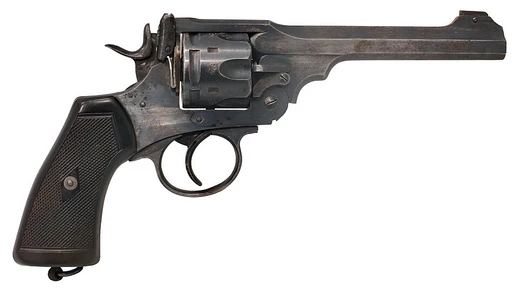
Colt Police Positive
Small-frame revolver with Positive Lock safety for law enforcement.

The Colt Police Positive is a small-frame, double-action revolver with a six-round cylinder, chambered for .32 or .38 caliber, with a .22 caliber model also offered. Designed primarily for sale to federal, state, or local law enforcement agencies, it was introduced into the firearms market by Colt's Manufacturing Company in 1905. The Police Positive was an improvement of Colt's earlier 'New Police' revolver, upgraded with an internal hammer block safety named the 'Positive Lock', which became part of the revolver's namesake.
Quick Facts
- Origin
- United States
- Is Ranged
- yes
- Wars
- Constitutionalist Revolution
- Manufacturer
- Colt's Manufacturing Company
- Production Date
- 1907–1947
- Part Length
- 2.5 in (63.5 mm) / 4 in (102 mm) / 5 in (125 mm) / 6 in (153 mm)
- Cartridge
- .22 LR / .22 WRF / .32 Long/Short Colt / .32 Colt New Police (.32 S&W Long) / .38 Colt New Police (.38 S&W) / .32-20 Winchester ("Special" variant) / .38 Special ("Special" variant)
- Action
- Double-action revolver
- Feed
- Six round cylinder
- Sights
- Fixed iron; half-moon blade front, V-notch rear
Facts from the source article.
Lore & Background
The Colt Police Positive was developed as a successor to Colt's 'New Police' revolver, incorporating the 'Positive Lock' safety that prevented the firing pin from striking the primer unless the trigger was deliberately pulled. This addressed deficiencies of earlier models such as the Single Action Army, allowing the revolver to be safely carried with all six chambers loaded. The cylinder rotated clockwise, opposite to Smith & Wesson's competing models, and Colt marketed this feature with the slogan 'All Colt cylinders TURN TO THE RIGHT', claiming it forced the cylinder crane against the frame for tighter lockup and better accuracy.
The Police Positive was very successful, dominating the law enforcement firearms market in the early 1900s alongside the Colt Official Police. The First issue ran from 1907 to 1927, with hard rubber grips and barrel lengths of 2.5 (in .32 caliber only), 4, 5, and 6 inches. Checkered walnut grips became standard after 1923. The Second issue began in 1928 and ran until 1947, adding a heavier frame and serrated topstrap to reduce sight glare. Both of Colt's 'New Police' rounds were redesigns of existing S&W cartridges with flattened bullet noses, as Colt avoided advertising its competitor.
Notable users included John Schrank, who used a Police Positive in his attempted assassination of former president Theodore Roosevelt. In fiction, James Bond kept a .38-caliber Police Positive with a sawn-off barrel under his pillow in 'Casino Royale'. A nickel .32 Police Positive with pearl grips was used by Charles Bronson as Paul Kersey in 'Death Wish'. Al Capone owned a nickel .38 Police Positive with walnut grips and a 4-inch barrel, manufactured in 1929; a private collector sold it at Christie's in June 2011 for £67,250/$109,080/€75,656.
Reader's Guide
The Colt Police Positive holds significance as a widely adopted law enforcement sidearm in the early 20th century, alongside the Colt Official Police. Its Positive Lock safety was a notable innovation, addressing accidental discharge concerns and allowing safe carry with a full cylinder. The revolver's clockwise cylinder rotation and Colt's marketing campaign emphasized a design difference from Smith & Wesson, though the practical advantage was debated. The Police Positive's success led to variants such as the Police Positive Special, with a lengthened cylinder and frame for .32-20 Winchester and .38 Special cartridges, and the Bankers' Special, a 2-inch barrel model. The Detective Special series, introduced in 1927, was a shortened variant of the Police Positive Special. The Police Positive was also used in notable historical events, including John Schrank's attempted assassination of Theodore Roosevelt, and appeared in popular culture, such as James Bond's 'Casino Royale' and the film 'Death Wish'. Its legacy includes its role as a standard sidearm for the Hong Kong Police Force from the 1920s to the 1960s, supplemented by the .38 Webley Mk III in the 1930s and gradually replaced by the Smith & Wesson Model 10.
Did You Know?
- The Colt Police Positive was introduced in 1905 and featured a 'Positive Lock' safety that prevented accidental discharge if the revolver was dropped.
- Al Capone's nickel .38 Police Positive with walnut grips sold at Christie's in June 2011 for £67,250.
- The cylinder of the Police Positive rotated clockwise, opposite to Smith & Wesson's models, and Colt advertised this as 'All Colt cylinders TURN TO THE RIGHT'.
More in Revolvers, Part 4 1-24
Spotted an error? Know more?
Reader corrections go straight into our review queue. Suggest an edit · How this site is sourced