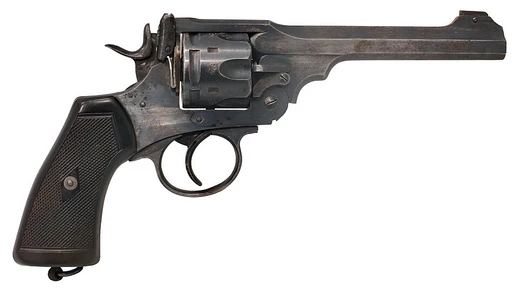
Colt Police Positive Special
A widely produced law enforcement revolver with over 750,000 built.

The Colt Police Positive Special, a small-frame double-action revolver, hit the market in 1907. It was built around a six-round cylinder and chambered mainly for the .38 Special cartridge, though it also came in .32-20 Winchester, .38 Colt New Police, and .32 Colt New Police. Designed for law enforcement sales, it became one of Colt’s most prolific models, with over 750,000 units produced.
This revolver was an upgrade of the earlier Police Positive, featuring a longer cylinder and a strengthened frame to handle more powerful rounds. Barrel lengths of 4, 5, and 6 inches were offered, with grips made from wood or hard rubber. Early in the 20th century, the Positive Special and its sibling, the Official Police, dominated the law enforcement market. The first production series (1907–1927) used Colt’s signature black hard rubber grips. The second series introduced wooden grips—first smooth, then checkered—and swapped the smooth top strap for a serrated one to cut glare. The third series began in 1947, and the fourth in 1977 added a Python-style shrouded ejector-rod housing. Production ended in 1995.
Made from fine carbon steel, the Positive Special had Colt’s highly polished finish, available in bright royal blue or nickel plate. Built on the “D” frame, a 4-inch model weighed just 23 ounces. It included Colt’s “Positive Lock” safety, which kept the firing pin from hitting the primer unless the trigger was pulled, preventing accidental discharge if dropped or struck. Sights were a blade front and a fixed V-notch rear groove milled into the top strap.
Around the mid-1920s, John Henry Fitzgerald created the Fitz Special snubnosed revolver by modifying a .38 Special Police Positive Special, whose shortest factory barrel was 4 inches. He shortened the barrel to 2 inches, bobbed the hammer spur, rounded the butt, and cut away the front half of the trigger guard. This made the gun quick to draw without snagging and easy to fire with gloved or large fingers. Between 40 and 200 Fitz Specials are thought to have been made at the factory by Fitzgerald himself, using various Colt revolvers. The Fitz Special paved the way for the modern snubnose and directly inspired the Colt Detective Special, the first production 2-inch snubnose. Even after the Detective Special debuted in 1927, Fitzgerald kept making custom Fitz Specials for select clients.
Quick Facts
- Origin
- United States
- Is Ranged
- yes
- Wars
- Constitutionalist Revolution
- Manufacturer
- Colt's Manufacturing Company
- Production Date
- 1907–1995
- Number
- over 750,000
- Part Length
- 4 in (101.6 mm) / 5 in (127 mm) / 6 in (152.4 mm)
- Cartridge
- .32 (.32 Colt New Police, .32-20 Winchester) / .38 NP (.38 Colt New Police, .38 S&W) / .38 Special (.38 Special)
- Action
- Double-action
- Feed
- six round cylinder
- Sights
- Fixed iron; Blade front, V-notch rear
Facts from the source article.
Lore & Background
The Police Positive Special was an iterative improvement of Colt's earlier Police Positive model, with a slightly lengthened cylinder and elongated and strengthened frame to allow chambering of longer, more powerful cartridges such as .32-20 Winchester and .38 Special. It was also made in .32 Colt New Police and .38 Colt New Police. The revolver was offered with 4-, 5-, and 6-inch barrels and came with either wood or hard rubber grips.
In the early 20th century, the Colt Positive and Positive Special teamed with Colt's Official Police to capture most of the law enforcement firearms market. The Positive Special went through a number of series or 'issues'. The first issue ran from introduction to 1927 and had distinctive Colt black hard rubber grips. The second issue introduced wooden grips, smooth in early years then checkered, and replaced the smooth top strap with a serrated one to reduce glare. The third issue began in 1947, and the fourth issue in 1977 introduced a Colt Python-style shrouded ejector-rod housing. Production ended in 1995.
The revolver featured Colt's 'Positive Lock' safety, which prevented the firing pin from hitting the primer unless the trigger was deliberately pulled, allowing safe carry with all six chambers loaded. Sights consisted of a blade front with a fixed V-notch rear groove milled into the topstrap.
Reader's Guide
The Colt Police Positive Special holds significance as one of Colt's most widely produced revolver designs, with over 750,000 units built. Its light weight made it popular with law enforcement officers, and it went through four distinct series or issues over its production life from 1907 to 1995. The revolver's 'Positive Lock' safety addressed deficiencies of earlier models such as the Single Action Army, preventing accidental discharge if the hammer was struck or the pistol was dropped.
The Police Positive Special also served as the basis for the Fitz Special, a custom snubnosed revolver created by John Henry Fitzgerald around the mid-1920s. Fitz shortened the barrel to two inches, bobbed the hammer spur, rounded the butt, and removed the front half of the trigger guard. Somewhere between forty and two hundred Fitz Specials are believed to have left the factory, made from various Colt revolvers by Fitzgerald himself. The Fitz Special was the precursor to the modern snubnosed revolver and specifically the prototype for the Colt Detective Special, the first production two-inch snubnosed revolver. Colonels Rex Applegate and Charles Askins were proponents of the Fitz Special, and it became a popular after-market conversion. Charles Lindbergh, William Powell, and Clyde Barrow were also known to carry Fitz Specials.
Did You Know?
- The Police Positive Special was introduced in 1907 and production ended in 1995.
- Over 750,000 Police Positive Special revolvers were built.
- The Fitz Special, based on the Police Positive Special, was the prototype for the Colt Detective Special.
- Charles Lindbergh, William Powell, and Clyde Barrow were known to carry Fitz Specials.
More in Revolvers, Part 4 1-24
Spotted an error? Know more?
Reader corrections go straight into our review queue. Suggest an edit · How this site is sourced