Tarantula
Large, hairy spiders of the family Theraphosidae.
Last updated
Tarantulas are large, often hairy spiders belonging to the family Theraphosidae, with over a thousand identified species across almost 200 genera.[1] The term originally referred to the wolf spider Lycosa tarantula from Mediterranean Europe, later applied to many large ground-dwelling spiders.[2] Certain tarantula species that are frequently kept as pets have gained popularity among exotic animal enthusiasts.[3]
Scientific classification
- KingdomAnimalia
- PhylumArthropoda
- SubphylumChelicerata
- ClassArachnida
- OrderAraneae
- InfraorderMygalomorphae
- FamilyTheraphosidae
Named by Thorell, 1869
Sources: Wikipedia taxobox: Tarantula (CC BY-SA 4.0)
Quick Facts
- Diversity
- 186 genera, 1,164 species
Facts from the source article.
Biology and range
Like all arthropods, tarantulas rely on an exoskeleton for muscular support, and their body has two main parts: the prosoma and opisthosoma.[4] The digestive organ is a tube running the length of the body, with a wider sucking stomach in the prosoma.[5] Tarantula body sizes vary by species, measuring from roughly 5 to 11 cm in length, while their leg spans extend from 8 to 30 cm.[6] The goliath birdeater (Theraphosa blondi), found in Venezuela and Brazil, is the largest tarantula species, reaching a weight of 170 g and a leg span up to 30 cm.[7][8]
Unlike true spiders, which possess a single book lung, tarantulas have two book lungs.[9] Tarantulas employ their webs not for capturing prey but as construction material or as tripwires.[9] Once a tarantula has finished feeding, it compacts the remaining material into a small sphere and discards it.[5] Numerous animals prey on tarantulas, including large wasps from the family Pompilidae that are commonly referred to as "tarantula hawks".[10]
What the specialist sources record
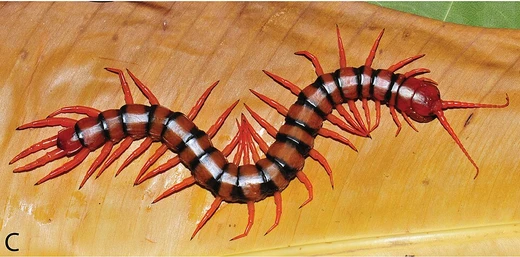
A 2014 LiveScience article by Lewis reports that the goliath birdeater's leg span can reach a foot, about the size of a child's forearm.[8] The same source states the spider can weigh up to 6 oz (170 grams), about as much as a young puppy.[8] An online account on howtogetridofhousecentipedes describes giant centipedes as predators that can overpower tarantulas with tougher armor and more legs.[11] That account notes that according to scientific studies, tarantula venom is not potent enough to kill humans, with no verified human deaths from a tarantula bite.[11]
The GBIF Backbone Taxonomy accepts Theraphosidae as a family within order Araneae, holding 67,417 occurrence records as of October 2026.[12]
References
- Wikipedia, "Tarantula" (CC BY-SA 4.0), which cites: Shultz, "The Tarantula Keeper's Guide", Barron's, 2009, p. 28; "Families", World Spider Catalog (we also read that source) en.wikipedia.org
- Wikipedia, "Tarantula" (CC BY-SA 4.0), which cites: Fabre, Jean-Henri; Translated by Alexander Teixeira de Mattos (1916) The Life of the spider, Dodd, Mead, New York.; "Taranto", lifeinitaly (original not read by us) en.wikipedia.org
- Wikipedia, "Tarantula" (CC BY-SA 4.0), which cites: Blaikie, "Eye disease associated with handling pet tarantulas: three case reports", BMJ, 24 May 1997, p. 1524–5 (original not read by us) en.wikipedia.org
- Wikipedia, "Tarantula" (CC BY-SA 4.0), which cites: Pomeroy, R. (4 February 2014). Pub. Real Clear Science, "Spiders, and Their Amazing Hydraulic Legs and Genitalia". Retrieved 13 October 2019, from https://www.r (original not read by us) en.wikipedia.org
- Wikipedia, "Tarantula" (CC BY-SA 4.0), which cites: Kovařík, F (2001), Chov sklípkanů (Keeping Tarantulas); Madagaskar, Jihlava, p. 23 (original not read by us) en.wikipedia.org
- Wikipedia, "Tarantula" (CC BY-SA 4.0), which cites: Jovan, Dennis, Kj, & Kenneth. (1 May 2019). Theraphosa blondi. Retrieved 13 October 2019, from https://www.theraphosidae.be/en/theraphosa-blondi/ . (original not read by us) en.wikipedia.org
- Wikipedia, "Tarantula" (CC BY-SA 4.0), which cites: Lewis, "Goliath Encounter: Puppy-Sized Spider Surprises Scientist in Rainforest", LiveScience.com, 17 October 2014 (we also read that source) en.wikipedia.org
- Lewis, "Goliath Encounter: Puppy-Sized Spider Surprises Scientist in Rainforest", LiveScience.com, 17 October 2014. facts only, no text reused. livescience.com
- Wikipedia, "Tarantula" (CC BY-SA 4.0), which cites: "Tarantula vs Other Spiders – 7 Key Differences – Fauna Facts" (original not read by us) en.wikipedia.org
- Wikipedia, "Tarantula" (CC BY-SA 4.0), which cites: Piper, R (2007) Extraordinary Animals: An Encyclopedia of Curious and Unusual Animals, Greenwood Press, .; "Wild or Giant Centipedes versus Other Predators", howtogetridofhousecentipedes (we also read that source) en.wikipedia.org
- "Wild or Giant Centipedes versus Other Predators", howtogetridofhousecentipedes. facts only, no text reused. howtogetridofhousecentipedes.blogspot.com
- GBIF Backbone Taxonomy and occurrence index, Theraphosidae (taxon key 5650). CC BY 4.0 (backbone); counts are facts. gbif.org
Each numbered sentence above was checked against the source it cites before publication. Sentences citing Wikipedia adapt text from the English Wikipedia article Tarantula (contributors), used under CC BY-SA 4.0; this entry is available under the same licence. Other sources were used for facts only; no text or images are copied from them.
More in Arachnids & Myriapods
Sources
Compiled from Wikipedia and the sources listed below. Text from Wikipedia is available under CC BY-SA 4.0; this entry is adapted from it.
- Wikipedia: Tarantula (CC BY-SA 4.0).
- Word definitions: the , each quoted from its Wikipedia article.
Spotted an error? Know more?
Reader corrections go straight into our review queue. Suggest an edit · How this site is sourced