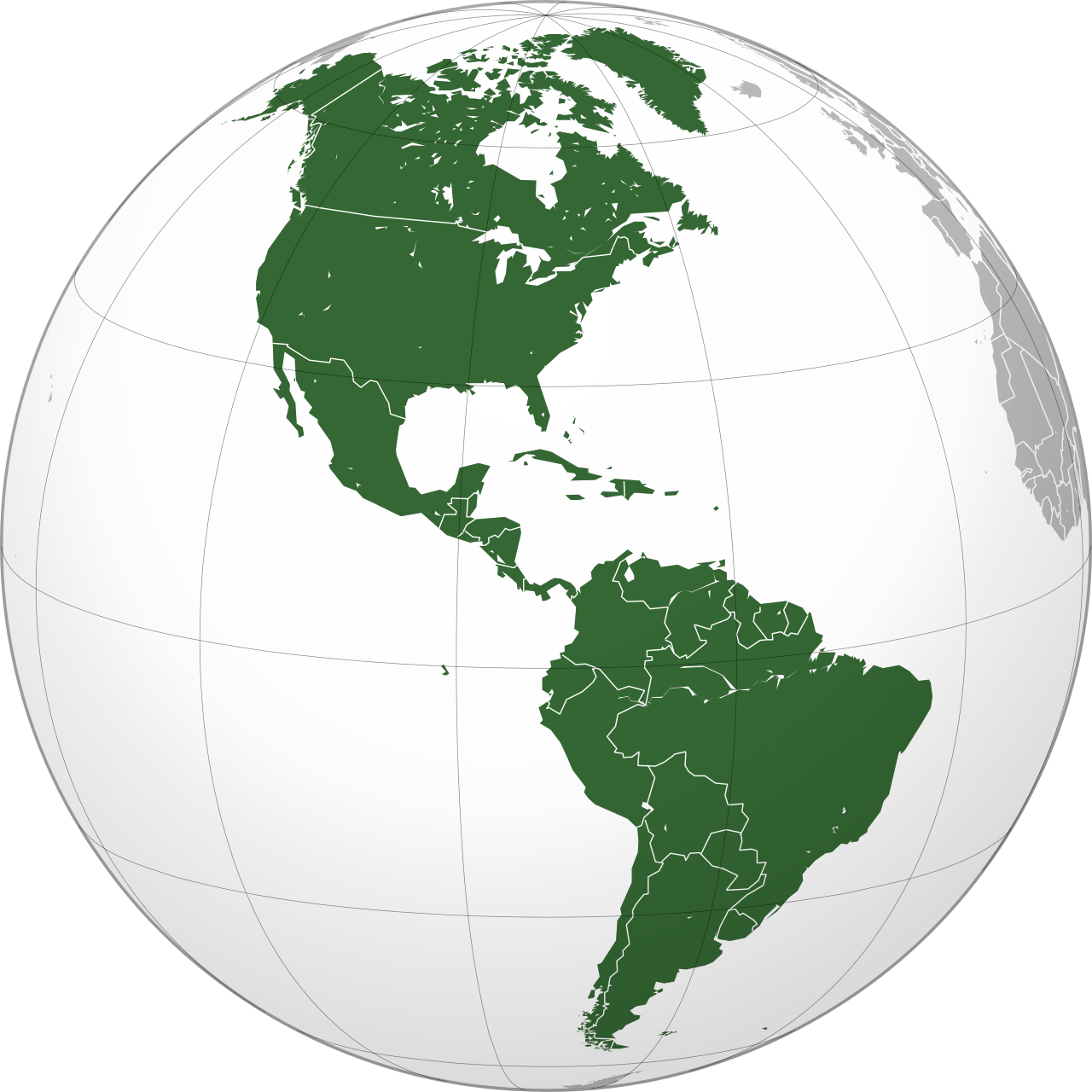
Americas

GrandEscogriffe · CC BY-SA 4.0
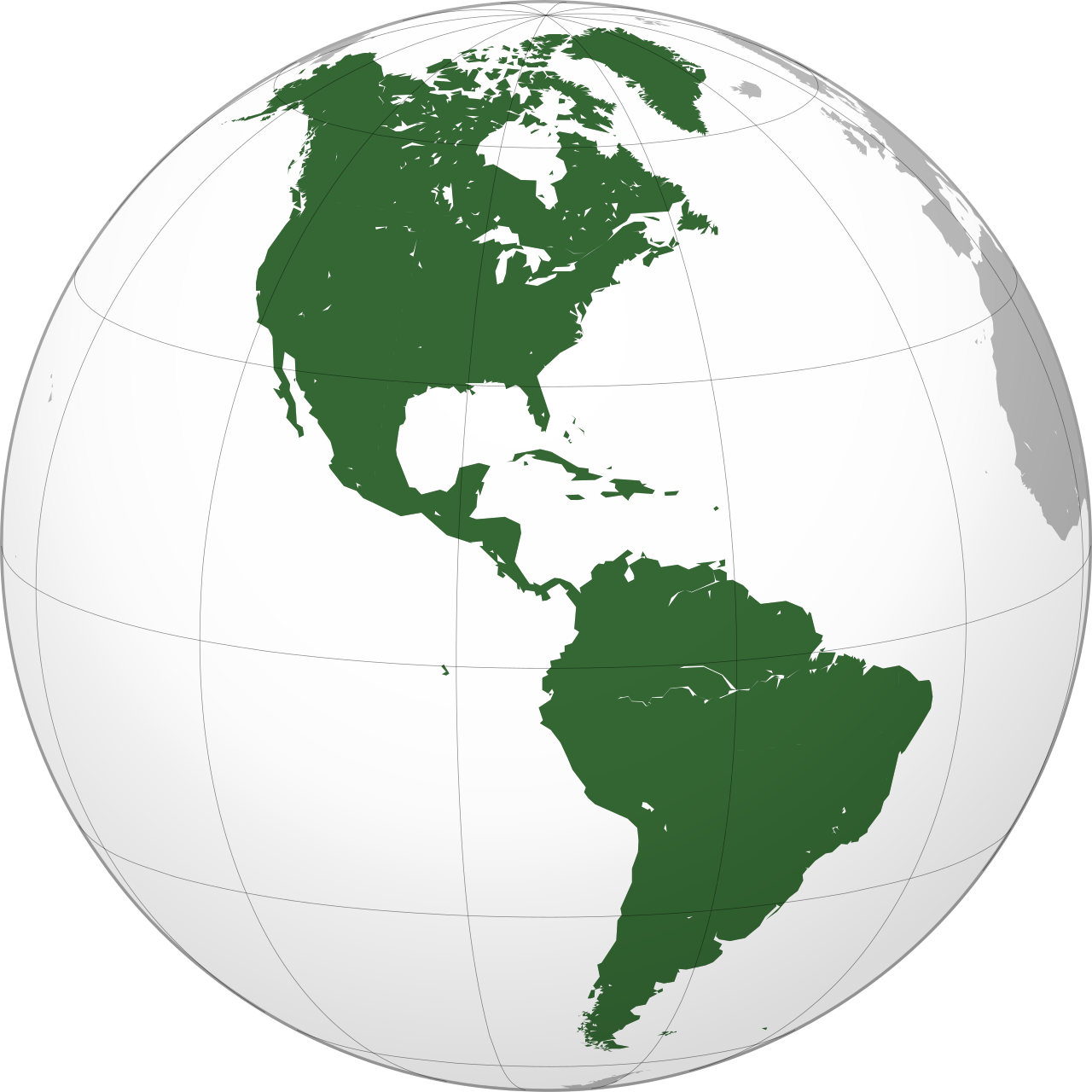
The Americas are a landmass comprising North America and South America, making up most of the Western Hemisphere.[1][2] Eight megacities in the Americas each have over 10 million inhabitants.[3] Over a billion people inhabit the Americas, with the United States, Brazil, and Mexico accounting for two-thirds of that total.[3]
Quick Facts
- Area
- 42,549,000 km / 26,438,723 mi; 2 (16,428,000 sq mi)
- Population
- 1.02 billion
- Density
- 22.67/km; 2 (58.74/sq mi)
- Demonym
- American (see usage)
- Countries
- 35
- Dependencies
- 23
Facts from the source article.
Geography and history
The first inhabitants migrated from Asia, with habitation sites in Alaska and Yukon known from at least 20,000 years ago.[4] A second migration brought Na Dene speakers, with the highest genetic frequency among Athabaskans at 42%.[5] The Arctic small tool tradition moved into North America around 2500 BCE, later displaced by Thule people by 1000 CE.[6] Viking settlers arrived in Greenland in 982 and established a settlement at L'Anse aux Meadows in Newfoundland.[7]
The name "America" was first recorded in 1507 on a map by Martin Waldseemüller.[8] Spanish colonization involved enslavement of indigenous populations and introduced diseases that devastated them.[9] The Isthmus of Panama linked North and South America about three million years ago, forming the single landmass.[10] The American Cordillera dominates western geography, with the Andes and Rocky Mountains.[11]
Gallery
References
- Wikipedia, "Americas" (CC BY-SA 4.0), which cites: "America." The Oxford Companion to the English Language ( ). McArthur, Tom, ed., 1992. New York: Oxford University Press, p. 33: "[16c: from the feminine of Ame; Burchfield, R. W. 2004. Fowler's Modern English Usage. ( ) Oxford, UK: Oxford University Press; p. 48.; "America", Oxford Learner's Dictionary; Webster's New World College Dictionary, 2010 by Wiley Publishing, Inc., Cleveland, Ohio.; "Merriam Webster dictionary", Merriam-Webster, Incorporated, 2013; "continent n. 5. a." (1989) Oxford English Dictionary, 2nd edition. Oxford University en.wikipedia.org
- Wikipedia, "Americas" (CC BY-SA 4.0), which cites: "America." The Oxford Companion to the English Language ( ). McArthur, Tom, ed., 1992. New York: Oxford University Press, p. 33: "[16c: from the feminine of Ame (original not read by us) en.wikipedia.org
- Wikipedia, "Americas" (CC BY-SA 4.0), which cites: "Censo 2010. Resultados provisionales: cuadros y grá" (original not read by us) en.wikipedia.org
- Wikipedia, "Americas" (CC BY-SA 4.0), which cites: "Introduction", Government of Canada, 2009; "Pleistocene Archaeology of the Old Crow Flats", Vuntut National Park of Canada, 2008; "Journey of mankind", Brad Shaw Foundation; "Atlas of the Human Journey-The Genographic Project", National Geographic Society., 1996–2008; "Journey of mankind", Brad Shaw Foundation; Bonatto, "A single and early migration for the peopling of the Americas supported by mitochondrial DNA sequence data", Proceedings of the National Academy of Sciences of the United States of America, 1997, p. 1866–71 (original not read en.wikipedia.org
- Wikipedia, "Americas" (CC BY-SA 4.0), which cites: Meltzer, "First Peoples in a New World: Colonizing Ice Age America", University of California Press, May 27, 2009, p. 146; Reich, "Reconstructing Native American population history", Nature, August 16, 2012, p. 370–374; Meltzer, "First Peoples in a New World: Colonizing Ice Age America", University of California Press, May 27, 2009, p. 146; Lyovi, "An introduction to the languages of the world", Oxford University Press, 1997, p. 309; Mithun, "Studies of North American Indian Languages", Annual Review of Anthropology, 1990, p. 309–330; Vajda, " en.wikipedia.org
- Wikipedia, "Americas" (CC BY-SA 4.0), which cites: Fagan, "Ancient North America: The Archaeology of a Continent", Thames & Hudson Inc., 2005, p. 390, p396; "Health Transitions in Arctic Populations", University of Toronto Press, June 28, 2008, p. 121; "Health Transitions in Arctic Populations", University of Toronto Press, June 28, 2008, p. 121 (we also read that source) en.wikipedia.org
- Wikipedia, "Americas" (CC BY-SA 4.0), which cites: "Vinland", Canadian Museum of Civilization (original not read by us) en.wikipedia.org
- Wikipedia, "Americas" (CC BY-SA 4.0), which cites: Lawless, "Oldest map to use word 'America' up for sale", News and Record, November 7, 2017; "The Map That Named America (September 2003) – Library of Congress Information Bulletin", Loc.gov (original not read by us) en.wikipedia.org
- Wikipedia, "Americas" (CC BY-SA 4.0), which cites: Kamen, "Spain's Road to Empire: The Making of a World Power, 1492–1763"; Taylor, "American Colonies", Penguin Books, 2001 (original not read by us) en.wikipedia.org
- Wikipedia, "Americas" (CC BY-SA 4.0), which cites: "Land bridge: How did the formation of a sliver of land result in major changes in biodiversity", Public Broadcasting Corporation; "Panama: Isthmus that Changed the World", NASA Earth Observatory (original not read by us) en.wikipedia.org
- Wikipedia, "Americas" (CC BY-SA 4.0), which cites: "Andes Mountain Range"; "Rocky Mountains"; "Appalachian Mountains", Ohio History Central; "Arctic Cordillera", evergreen.ca (original not read by us) en.wikipedia.org
- Open Library record, ISBN 9781400040063 ("1491"). CC0 (metadata); book content not read. openlibrary.org
- Wikipedia, "Americas" (CC BY-SA 4.0), which cites: Mann, "1491: New Revelations of the Americas Before Columbus", Knopf, 2005 (we also read that source) en.wikipedia.org
- Open Library record, ISBN 9780520250529 ("First peoples in a new world"). CC0 (metadata); book content not read. openlibrary.org
- Open Library record, ISBN 9780802094018 ("Health transitions in Arctic populations"). CC0 (metadata); book content not read. openlibrary.org
Each numbered sentence above was checked against the source it cites before publication. Sentences citing Wikipedia adapt text from the English Wikipedia article Americas (contributors), used under CC BY-SA 4.0; this entry is available under the same licence. Other sources were used for facts only; no text or images are copied from them.
More in Regions & Cultural Spheres
Spotted an error? Know more?
Reader corrections go straight into our review queue. Suggest an edit · How this site is sourced