Anglosphere
A Western-led sphere of influence among five core English-speaking nations.

Nagihuin · CC BY-SA 4.0
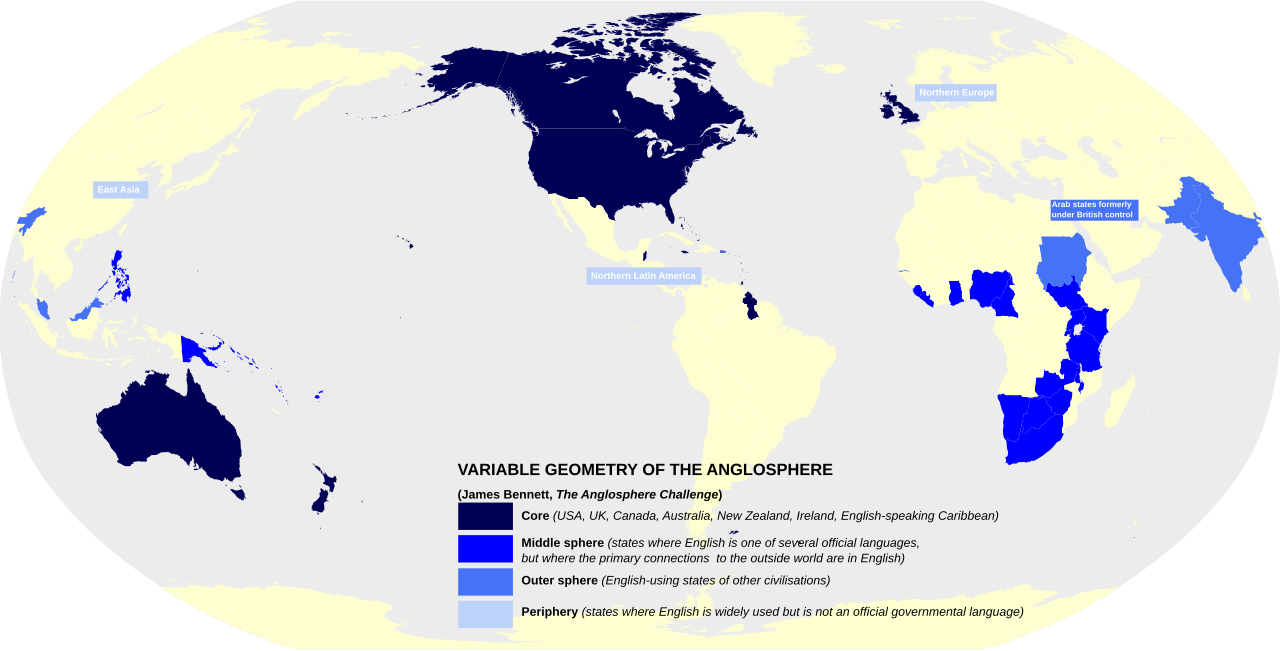
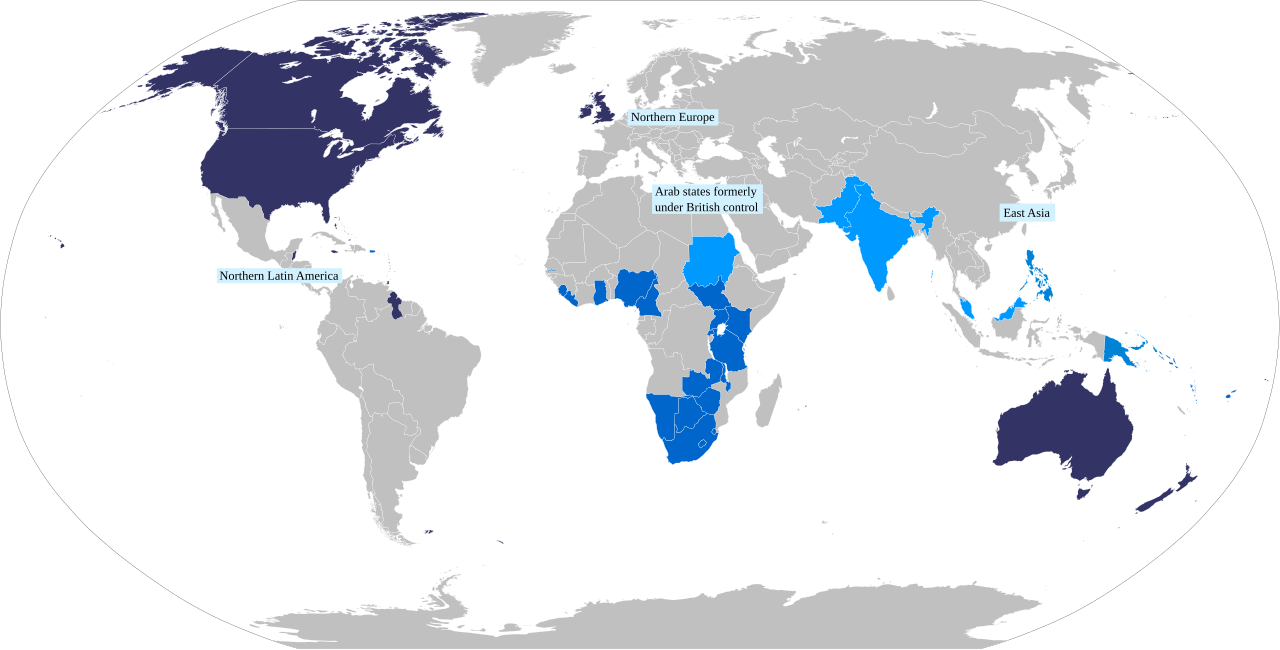
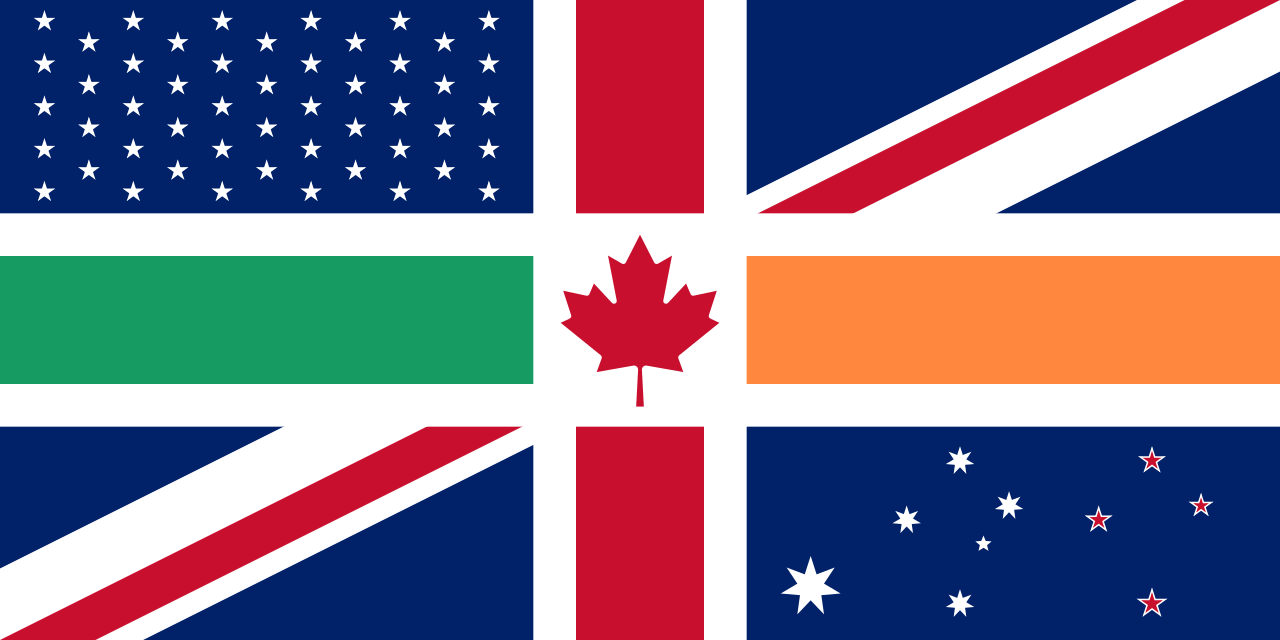
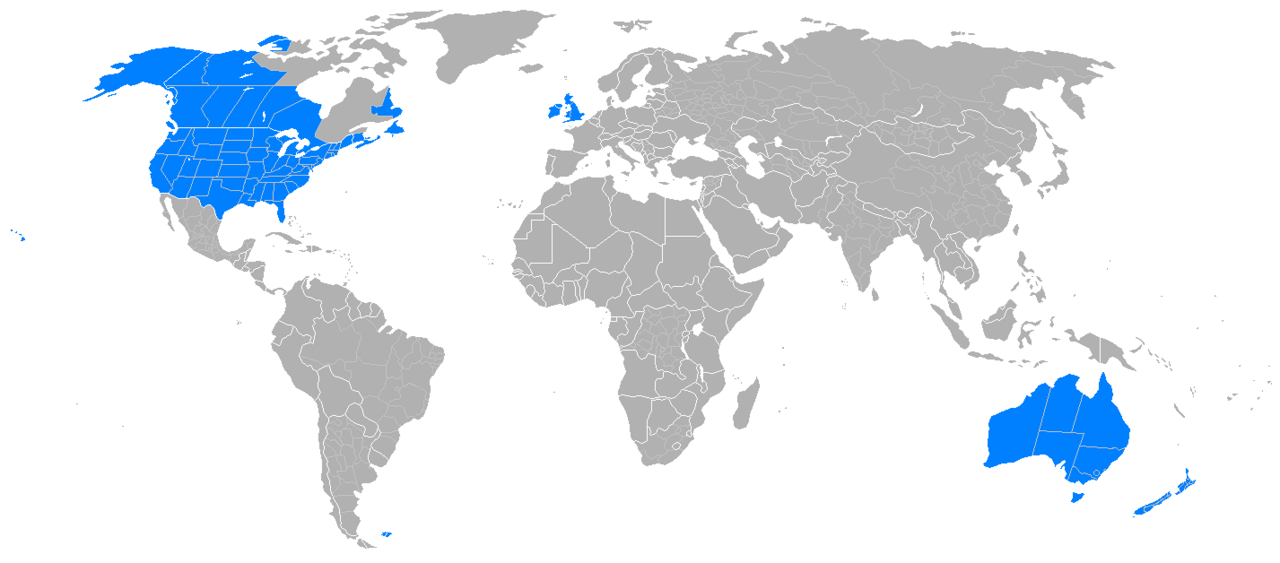
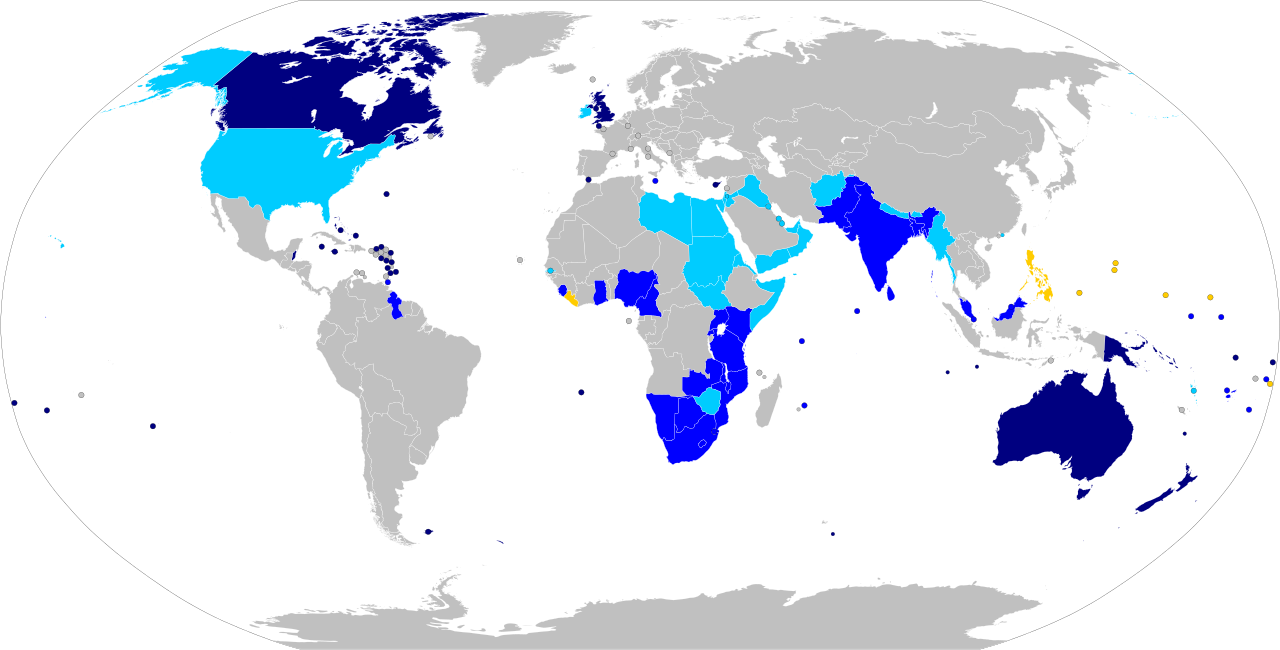
The Anglosphere is a Western-aligned grouping of English-speaking nations bound by close political, economic, cultural, and military connections. Its core consists of five developed countries with strong alliances: Australia, Canada, New Zealand, the United Kingdom, and the United States. Broader definitions sometimes include non-Western and developing nations that were once part of the British Empire and have kept English influence and common law after independence. However, the Anglosphere is a specific grouping, not simply the same as every country where English is an official language. These nations generally coordinate on global issues and work together extensively on security, seen in alliances like Five Eyes. The five core countries are either members of NATO or are designated by the United States as major non-NATO allies. The term was used by science fiction writer Neal Stephenson in his 1995 book The Diamond Age to mean the Anglo-American sphere of influence. Journalist John Lloyd adopted it in 2000, including the UK, US, Canada, Australia, New Zealand, Ireland, South Africa, and the British West Indies. James C. Bennett defines the Anglosphere as “the English-speaking Common Law-based nations of the world,” arguing that former British colonies retaining English common law and language have fared better than those colonized by other European powers. Merriam-Webster defines it as “the countries of the world in which the English language and cultural values predominate.” Recent studies describe it as a non-continuous region united by a transnational imagined community based on shared language, history, and cultural values. Still, the Anglosphere is not usually considered to include all countries where English is an official language, so it is not the same as the anglophone world. The definition typically covers Australia, Canada, New Zealand, the United Kingdom, and the United States—a group of developed nations called the core Anglosphere. The term can also include, but often leaves out, Ireland and the Commonwealth Caribbean countries, even though English and common law are dominant there. The five core countries maintain close cultural and diplomatic links. They align under military and security programs such as ABCANZ Armies, the Air and Space Interoperability Council, AUKUS (a 2021 trilateral pact for Australia to acquire nuclear-powered submarines), AUSCANNZUKUS navies, Border Five, the Combined Communications Electronics Board, Five Eyes intelligence, the Five Nations Passport Group, Migration 5, The Technical Cooperation Program, and the UKUSA Agreement on signals intelligence. For over a century, relations among Anglosphere countries have been warm. Bilateral partnerships—like those between Australia and New Zealand, the US and Canada, and the US and the UK (the Special Relationship)—are among the most successful in the world. Politically, Canada, Australia, New Zealand, and the UK share King Charles III as head of state, belong to the Commonwealth of Nations, and use the Westminster parliamentary system. The US is a presidential republic. Most core countries use first-past-the-post electoral systems, though Australia and New Zealand have reformed theirs, and other systems appear in some UK elections. As a result, politics in most core Anglosphere countries is dominated by two major parties. Historical ties mean Anglosphere countries share many cultural traits. Most follow the rule of law through common law rather than civil law, and favor democracy with legislative chambers. Private property is protected by law or constitution. Market freedom is high in all five core countries, which share the Anglo-Saxon economic model—a capitalist model that emerged in the 1970s from the Chicago school of economics, with roots in 18th-century Britain. Shared globalization has made cities like New York, London, Los Angeles, Sydney, and Toronto major influences on international markets and the global economy. US and UK popular culture has heavily shaped global trends. Supporters of the Anglosphere concept usually come from the political right (e.g., Andrew Roberts of the UK Conservative Party), while critics tend to be from the center-left (e.g., Michael Ignatieff of the Liberal Party of Canada). As early as 1897, Albert Venn Dicey proposed an Anglo-Saxon “intercitizenship” in a speech to the Fellows of All Souls at Oxford. American businessman James C. Bennett, who argues that the cultural and legal (common law) traditions of English-speaking nations are special, wrote in his 2004 book The Anglosphere Challenge: “The Anglosphere, as a network civilization without a corresponding political form, has necessarily imprecise boundaries. Geographically, the densest nodes of the Anglosphere are found in the United States and the United Kingdom.
Quick Facts
- Core countries
- Australia
- Canada
- New Zealand
- United Kingdom
- United States
- Key military alliance
- Five Eyes
- Economic model
- Anglo-Saxon economic model
- Legal tradition
- Common law
- Political system (four core)
- Westminster parliamentary system
- Political system (united states)
- Presidential republic
Facts from the source article.
Reader's Guide
The Anglosphere concept is significant for describing a network of developed English-speaking nations that maintain close cultural, diplomatic, and security links. Proponents, often from the political right, argue that shared common law traditions and language foster unique prosperity and cooperation. The core Anglosphere countries collaborate extensively through military and security programmes such as Five Eyes, AUKUS, and the UKUSA Agreement. Critics, including Michael Ignatieff, contend that the term neglects fundamental legal and cultural differences between the US and the UK, and that UK and European norms drew closer together during Britain's EU membership. Others have criticized the concept as a romantic illusion or a replacement for 'the white Commonwealth.' The term remains contested, with its boundaries imprecise and its inclusion of countries like Ireland and the Commonwealth Caribbean frequently omitted despite their English language and common law traditions.
Gallery
More in Regions & Cultural Spheres
Spotted an error? Know more?
Reader corrections go straight into our review queue. Suggest an edit · How this site is sourced