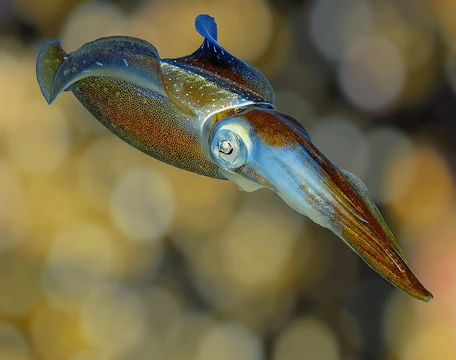
Sepia zanzibarica
A commercially important cuttlefish of the western Indian Ocean.
Last updated
The species is commercially important for fisheries in the Gulf of Aden.[1] Along the eastern coast of Africa, in the western Indian Ocean, one can find the cuttlefish species known as Sepia zanzibarica.[2]
Scientific classification
Named by Pfeffer, 1884
Close relatives
Other species of Sepia with a Codexery entry.
- Common cuttlefish Sepia officinalis
- Sepia australis Sepia australis
- Sepia braggi Sepia braggi
- Sepia dollfusi Sepia dollfusi
- Sepia hedleyi Sepia hedleyi
- Sepia hierredda Sepia hierredda
- Sepia prashadi Sepia prashadi
- Sepia tuberculata Sepia tuberculata
Sources: Wikipedia taxobox: Sepia zanzibarica (CC BY-SA 4.0) · order, family and genus agree with WoRMS AphiaID 342187 (CC BY 4.0)
Conservation status
Data Deficient (DD)
Data Deficient: there is not enough information to place this species on the risk scale.
Source: IUCN Red List assessment · GBIF copy of the Red List category
How big is it?
Largest length in the source, 0.25 m, next to a 1.8 m person.
Diagram: drawn by Codexery, schematic shapes to scale (not a likeness). Length: Wikipedia: Sepia zanzibarica
Where the sepia zanzibarica has been recorded
Map: drawn by Codexery. Data: Natural Earth basemap (public domain) · place coordinates: Wikipedia (CC BY-SA 4.0)
Key facts and history
The suckers in the middle portion of the hectocotylus are significantly reduced in size.[3] The tentacular clubs are short and oval with six suckers in crosswise rows.[3] Its distribution extends from Port Elizabeth, South Africa, north to Djibouti and the Gulf of Aden, and includes Madagascar, the Comoro Islands, the Mascarene Islands, the Seychelles, and Socotra.[2] Four series of suckers are present on each arm of Sepia zanzibarica.[3]
A hectocotylus, which has six rows of suckers, is formed from the left ventral arm.[3] Transversely grooved ridges are found on the wide, engorged, and fleshy oral surface of the modified region.[3] The cuttlebone has an oblong shape, with both edges rounded, a dorsal surface that is evenly convex, and a ventral surface that is strongly recurved.[3] Depths ranging from 34 to 95 m are where this species is found.[1]
What the cited sources add
That source notes the buccal membrane has a small number of tiny suckers.[3] The swimming keel of the club reaches slightly beyond the carpus, and the ventral protective membranes do not join at the club base.[3]
References
- Wikipedia, "Sepia zanzibarica" (CC BY-SA 4.0), which cites: "Cephalopods of the World an Annotated and Illustrated Catalogue of Cephalopod Species Known to Date Volume 1 Chambered Nautiluses and Sepioids (Nautilidae, Sepiidae, Sepiolidae, Sepiadariidae, Idiosepiidae and Spirulida (we also read that source) en.wikipedia.org
- Wikipedia, "Sepia zanzibarica" (CC BY-SA 4.0), which cites: Barratt, I., "Sepia zanzibarica", 2012 (original not read by us) en.wikipedia.org
- Wikipedia, "Sepia zanzibarica" (CC BY-SA 4.0), which cites: "Cephalopods of the World an Annotated and Illustrated Catalogue of Cephalopod Species Known to Date Volume 1 Chambered Nautiluses and Sepioids (Nautilidae, Sepiidae, Sepiolidae, Sepiadariidae, Idiosepiidae and Spirulida; Barratt, I., "Sepia zanzibarica", 2012 (we also read that source) en.wikipedia.org
Each numbered sentence above was checked against the source it cites before publication. Sentences citing Wikipedia adapt text from the English Wikipedia article Sepia zanzibarica (contributors), used under CC BY-SA 4.0; this entry is available under the same licence. Other sources were used for facts only; no text or images are copied from them.
More in Reef Cephalopods
Sources
Compiled from Wikipedia and the sources listed below. Text from Wikipedia is available under CC BY-SA 4.0; this entry is adapted from it.
- Wikipedia: Sepia zanzibarica (CC BY-SA 4.0).
- Classification: the source article's taxobox; order, family and genus checked against WoRMS, the World Register of Marine Species (CC BY 4.0).
- Conservation status: IUCN Red List assessment.
- Occurrence records: GBIF (CC0 / CC BY). Basemap: Natural Earth (public domain).
- Word definitions: the Codexery glossary, each quoted from its Wikipedia article.
Spotted an error? Know more?
Reader corrections go straight into our review queue. Suggest an edit · How this site is sourced