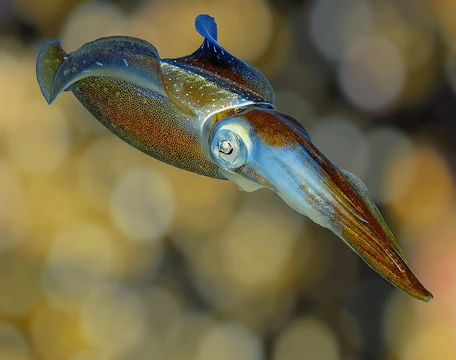
Sepia dollfusi
A data-deficient cuttlefish native to the Red Sea and Suez Canal.
Last updated

Adam, 1941 · via Wikipedia: Sepia dollfusi · CC0
The species is considered data deficient by the IUCN Red List.[1] The cuttlefish species Sepia dollfusi belongs to the Class Cephalopoda and the Order Sepiida, within the Phylum Mollusca.[2] William Adam first described this species in the early 1940s.[2]
Scientific classification
Named by Adam, 1941
Close relatives
Other species of Sepia with a Codexery entry.
- Common cuttlefish Sepia officinalis
- Sepia australis Sepia australis
- Sepia braggi Sepia braggi
- Sepia hedleyi Sepia hedleyi
- Sepia hierredda Sepia hierredda
- Sepia prashadi Sepia prashadi
- Sepia tuberculata Sepia tuberculata
- Sepia vermiculata Sepia vermiculata
Sources: Wikipedia taxobox: Sepia dollfusi (CC BY-SA 4.0) · order, family and genus agree with WoRMS AphiaID 220307 (CC BY 4.0)
Conservation status
Data Deficient (DD)
Data Deficient: there is not enough information to place this species on the risk scale.
Source: IUCN Red List assessment · GBIF copy of the Red List category
How big is it?
Largest length in the source, 0.11 m, next to a 1.8 m person.
Diagram: drawn by Codexery, schematic shapes to scale (not a likeness). Length: Wikipedia: Sepia dollfusi
Where the sepia dollfusi has been recorded
Map: drawn by Codexery. Data: Natural Earth basemap (public domain) · place coordinates: Wikipedia (CC BY-SA 4.0)
Key facts and history
It has an oval cuttlebone roughly the same length as its mantle, short arms, and a white underside with ventral bulging.[3] The species is native to the Red Sea and southern Suez Canal in Egypt.[4] It was first documented in the Mediterranean Sea in 2014, making it a potential Lessepsian migrant.[4] The species is commercially important for human consumption in the Suez Canal.[5]
Adam himself provided a second specimen, a bone lacking locality data, which appears in a catalogue of the Royal Scottish Museum in Edinburgh.[6] The average mantle length for Sepia dollfusi is approximately 110 mm.[3] As both sexes progress through sexual maturity, their feeding decreases, and the resulting lack of nutrition leads to death soon after breeding.[7]
What the cited sources add
A 1998 study in Fisheries Research reported that Sepia dollfusi is more difficult to find during summer after its spawning season.[8] A 1999 paper in Bulletin of Marine Science found that females show a decline in total body mass with sexual maturity, while males only show decline in the viscera.[7] The IUCN Red List last assessed the species on 23 March 2009.[9] The same research indicated that the locations where this species deposits its eggs remain largely unknown.[8]
A 2015 paper in the Egyptian Journal of Aquatic Biology and Fisheries reported a small cuttlefish with a mantle length around 15 cm, found in benthic neritic zone habitats.[4]
References
- Wikipedia, "Sepia dollfusi" (CC BY-SA 4.0), which cites: "Catalogue of the Egyptian Cephalopod Species", niof-eg.researchcommons.org (original not read by us) en.wikipedia.org
- Wikipedia, "Sepia dollfusi" (CC BY-SA 4.0), which cites: "Sepia dollfusi", iNaturalist; Riad, "Taxonomical Studies on the Cephalopods (Cephalopoda: Mollusca) Inhabiting both the Egyptian Mediterranean and the Red Sea Waters", Jordan Journal of Natural History, 7, 2020, p. 64–92 (original not read by us) en.wikipedia.org
- Wikipedia, "Sepia dollfusi" (CC BY-SA 4.0), which cites: Reid, A., P. Jereb, & C.F.E. Roper 2005. Family Sepiidae. In: P. Jereb & C.F.E. Roper, eds. Cephalopods of the world. An annotated and illustrated catalogue of ; Riad, "Taxonomical Studies on the Cephalopods (Cephalopoda: Mollusca) Inhabiting both the Egyptian Mediterranean and the Red Sea Waters", Jordan Journal of Natural History, 7, 2020, p. 64–92; BARICHE, "New records of introduced species in the Mediterranean Sea (December 2025)", Mediterranean Marine Science, 2025-12-11, p. 941–971; BARICHE, "New records of introduced species in t en.wikipedia.org
- Wikipedia, "Sepia dollfusi" (CC BY-SA 4.0), which cites: "Sepia dollfusi", sealifebase.ca; BELLO, "Non-indigenous cephalopods in the Mediterranean Sea: a review", Acta Adriat, 2021, p. 113–134; Rafik Riad, "First record of the cuttlefish Sepia dollfusi (Cephalopoda: Sepioidea) from the Egyptian Mediterranean waters", Egyptian Journal of Aquatic Biology and Fisheries, 2015, p. 1–7; BARICHE, "New records of introduced species in the Mediterranean Sea (December 2025)", Mediterranean Marine Science, 2025-12-11, p. 941–971; BELLO, "Non-indigenous cephalopods in the Mediterranean Sea: a review", Act en.wikipedia.org
- Wikipedia, "Sepia dollfusi" (CC BY-SA 4.0), which cites: Rafik Riad, "First record of the cuttlefish Sepia dollfusi (Cephalopoda: Sepioidea) from the Egyptian Mediterranean waters", Egyptian Journal of Aquatic Biology and Fisheries, 2015, p. 1–7 (original not read by us) en.wikipedia.org
- Wikipedia, "Sepia dollfusi" (CC BY-SA 4.0), which cites: "Current Classification of Recent Cephalopoda"; Heppell, "Recent Cephalopoda in the collections of the Royal Scottish Museum, Edinburgh", Recent Cephalopoda in the Collections of the Royal Scottish Museum, Edinburgh, March 1983, p. 5 (original not read by us) en.wikipedia.org
- Wikipedia, "Sepia dollfusi" (CC BY-SA 4.0), which cites: Gabr, "Maturation, fecundity and seasonality of reproduction of two commercially valuable cuttlefish, Sepia pharaonis and S. dollfusi, in the Suez Canal", Fisheries Research, 1998-06-15, p. 99–115; Gabr, "Reproductive versus somatic tissue allocation in the cuttlefish Sepia dollfusi Adam (1941)", Bulletin of Marine Science, July 1999, p. 159–173; Gabr, "Reproductive versus somatic tissue allocation in the cuttlefish Sepia dollfusi Adam (1941)", Bulletin of Marine Science, July 1999, p. 159–173; Gabr, "Reproductive versus somatic tissue a en.wikipedia.org
- Wikipedia, "Sepia dollfusi" (CC BY-SA 4.0), which cites: Gabr, "Maturation, fecundity and seasonality of reproduction of two commercially valuable cuttlefish, Sepia pharaonis and S. dollfusi, in the Suez Canal", Fisheries Research, 1998-06-15, p. 99–115; Gabr, "Maturation, fecundity and seasonality of reproduction of two commercially valuable cuttlefish, Sepia pharaonis and S. dollfusi, in the Suez Canal", Fisheries Research, 1998-06-15, p. 99–115; Gabr, "Maturation, fecundity and seasonality of reproduction of two commercially valuable cuttlefish, Sepia pharaonis and S. dollfusi, in the Suez en.wikipedia.org
- Wikipedia, "Sepia dollfusi" (CC BY-SA 4.0), which cites: Barrat, "Sepia dollfusi", IUCN Red List, 23 March 2009 (original not read by us) en.wikipedia.org
Each numbered sentence above was checked against the source it cites before publication. Sentences citing Wikipedia adapt text from the English Wikipedia article Sepia dollfusi (contributors), used under CC BY-SA 4.0; this entry is available under the same licence. Other sources were used for facts only; no text or images are copied from them.
More in Reef Cephalopods
Sources
Compiled from Wikipedia and the sources listed below. Text from Wikipedia is available under CC BY-SA 4.0; this entry is adapted from it.
- Wikipedia: Sepia dollfusi (CC BY-SA 4.0).
- Classification: the source article's taxobox; order, family and genus checked against WoRMS, the World Register of Marine Species (CC BY 4.0).
- Conservation status: IUCN Red List assessment.
- Occurrence records: GBIF (CC0 / CC BY). Basemap: Natural Earth (public domain).
- Word definitions: the Codexery glossary, each quoted from its Wikipedia article.
Spotted an error? Know more?
Reader corrections go straight into our review queue. Suggest an edit · How this site is sourced