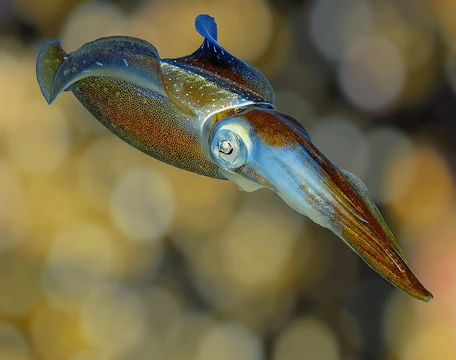
Sepiella inermis
A small, economically important cuttlefish of the Indo-Pacific.
Last updated

Van Hasselt, 1835 · via Wikipedia: Sepiella inermis · CC0
It is native to the Indo-Pacific region and is economically important there as a food species.[1] Mantle length for this cuttlefish averages roughly 50 mm, with the largest individuals reaching about 125 mm.[2]
Scientific classification
- OrderSepiida
- FamilySepiidae
- GenusSepiella
- SpeciesSepiella inermis
Named by (Van Hasselt, 1835)
Close relatives
Other species of Sepiella with a Codexery entry.
- Sepiella japonica Sepiella japonica
- Sepiella ornata Sepiella ornata
Sources: Wikipedia taxobox: Sepiella inermis (CC BY-SA 4.0) · order, family and genus agree with WoRMS AphiaID 220314 (CC BY 4.0)
Conservation status
Data Deficient (DD)
Data Deficient: there is not enough information to place this species on the risk scale.
Source: IUCN Red List assessment · GBIF copy of the Red List category
How big is it?
Largest length in the source, 0.12 m, next to a 1.8 m person.
Diagram: drawn by Codexery, schematic shapes to scale (not a likeness). Length: Wikipedia: Sepiella inermis
Where the sepiella inermis has been recorded
Each dot is a place where the species has been observed and reported (131 records, half-degree grid) — not a modelled range. 25 inland records left out (institution coordinates).
Map: drawn by Codexery. Data: GBIF occurrence search (records CC0 / CC BY) · Natural Earth basemap (public domain)
Key facts and history
Sepiella inermis lives primarily benthically in shallow waters down to about 40 m depth.[3] It spawns throughout the year, with seasonal peaks affected by geography, environment, and habitat.[4] Mating occurs in a head-to-head position.[5] A female lays about 400 eggs in one to five batches and does not eat between batch releases.[5]
Egg capsules are black, round, with a tip and stalk, and each contains one egg.[5] The embryonic period averages about 13 days, ranging from 8 to 19 days.[5] A female signals acceptance of a male by exhibiting white spots along her fins.[5]
What the cited sources add
Unnithan (1982) reported that at Mandapam, Sepiella inermis reaches 50 mm mantle length at the end of its first year and 80 mm at the end of its second year.[6] The same study found that size at first sexual maturity is 50 mm for males and 31 mm for females.[6]
References
- Wikipedia, "Sepiella inermis" (CC BY-SA 4.0), which cites: Roper, C. F. E., Sweeney, M. J. and Nauen, C. E. 1984. FAO species catalogue, Vol.3, Cephalopods of the world. An annotated and illustrated catalogue of species; Sundaram, Sujit, and Mohammed Zafar Khan. “Biology of the Spineless Cuttlefish Sepiella Inermis (Orbigny, 1848) from Mumbai Waters.” Indian Journal of Fisheries (original not read by us) en.wikipedia.org
- Wikipedia, "Sepiella inermis" (CC BY-SA 4.0), which cites: Nabhitabhata J. (2014) Sepiella inermis. In: Iglesias J., Fuentes L., Villanueva R. (eds) Cephalopod Culture. Springer, Dordrecht.; Nabhitabhata J. (2014) Sepiella inermis. In: Iglesias J., Fuentes L., Villanueva R. (eds) Cephalopod Culture. Springer, Dordrecht.; Unnithan, K Asokakumaran (1982) Observations on the biology of cuttlefish Sepiella inermis at Mandapam. Indian Journal of Fisheries, 29 (1&2). pp. 101–111. http; Unnithan, K Asokakumaran (1982) Observations on the biology of cuttlefish Sepiella inermis at Mandapam. Indian Jour en.wikipedia.org
- Wikipedia, "Sepiella inermis" (CC BY-SA 4.0), which cites: Roper, C. F. E., Sweeney, M. J. and Nauen, C. E. 1984. FAO species catalogue, Vol.3, Cephalopods of the world. An annotated and illustrated catalogue of species; Nabhitabhata J. (2014) Sepiella inermis. In: Iglesias J., Fuentes L., Villanueva R. (eds) Cephalopod Culture. Springer, Dordrecht. (original not read by us) en.wikipedia.org
- Wikipedia, "Sepiella inermis" (CC BY-SA 4.0), which cites: Nabhitabhata J. (2014) Sepiella inermis. In: Iglesias J., Fuentes L., Villanueva R. (eds) Cephalopod Culture. Springer, Dordrecht. (original not read by us) en.wikipedia.org
- Wikipedia, "Sepiella inermis" (CC BY-SA 4.0), which cites: Nabhitabhata J. (2014) Sepiella inermis. In: Iglesias J., Fuentes L., Villanueva R. (eds) Cephalopod Culture. Springer, Dordrecht.; Nabhitabhata J. (2014) Sepiella inermis. In: Iglesias J., Fuentes L., Villanueva R. (eds) Cephalopod Culture. Springer, Dordrecht. (original not read by us) en.wikipedia.org
- Unnithan, K Asokakumaran (1982) Observations on the biology of cuttlefish Sepiella inermis at Mandapam. Indian Journal of Fisheries, 29 (1&2). pp. 101–111. http. facts only, no text reused. eprints.cmfri.org.in
Each numbered sentence above was checked against the source it cites before publication. Sentences citing Wikipedia adapt text from the English Wikipedia article Sepiella inermis (contributors), used under CC BY-SA 4.0; this entry is available under the same licence. Other sources were used for facts only; no text or images are copied from them.
More in Reef Cephalopods
Sources
Compiled from Wikipedia and the sources listed below. Text from Wikipedia is available under CC BY-SA 4.0; this entry is adapted from it.
- Wikipedia: Sepiella inermis (CC BY-SA 4.0).
- Classification: the source article's taxobox; order, family and genus checked against WoRMS, the World Register of Marine Species (CC BY 4.0).
- Conservation status: IUCN Red List assessment.
- Occurrence records: GBIF (CC0 / CC BY). Basemap: Natural Earth (public domain).
Spotted an error? Know more?
Reader corrections go straight into our review queue. Suggest an edit · How this site is sourced