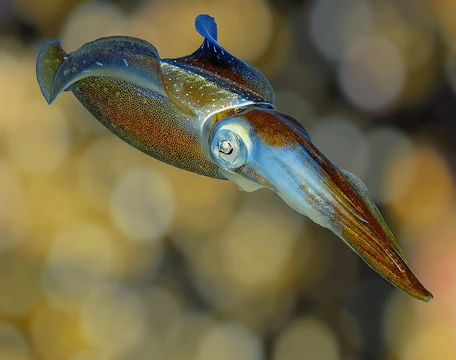
Sepiella japonica
A migratory cuttlefish nearly harvested to extinction.
Last updated
It was nearly harvested to extinction due to overfishing and habitat damage.[1]
Scientific classification
- OrderSepiida
- FamilySepiidae
- GenusSepiella
- SpeciesSepiella japonica
Named by M. Sasaki, 1929
Close relatives
Other species of Sepiella with a Codexery entry.
- Sepiella inermis Sepiella inermis
- Sepiella ornata Sepiella ornata
Sources: Wikipedia taxobox: Sepiella japonica (CC BY-SA 4.0) · order, family and genus agree with WoRMS AphiaID 153107 (CC BY 4.0)
Conservation status
Data Deficient (DD)
Data Deficient: there is not enough information to place this species on the risk scale.
Source: IUCN Red List assessment · GBIF copy of the Red List category
Where the sepiella japonica has been recorded
Each dot is a place where the species has been observed and reported (40 records, half-degree grid) — not a modelled range. 8 inland records left out (institution coordinates).
Map: drawn by Codexery. Data: GBIF occurrence search (records CC0 / CC BY) · Natural Earth basemap (public domain)
Quick Facts
- Species
- japonica
Facts from the source article.
Key facts and history
This species belongs to the class Cephalopoda and phylum Mollusca.[2] Like other cuttlefish, it has a cuttlebone used for buoyancy regulation.[2] The species has chromatophores that help with camouflage and communication.[3] Historically, it was very valuable to Asian fishery industries due to its abundance and short lifespan.[4]
The species is semelparous, reproducing only once before dying.[5] The descriptor "spineless" describes the structure of this cuttlefish's internal cuttlebone.[6] Sepiella japonica possesses a total of ten limbs: eight arms and two tentacles that have suckers.[7] The tentacles make the first contact with prey, after which the arms bring the food toward the mouth.[7]
Historically, the ink of this species has been employed in traditional medicine and is noted for antimicrobial qualities.[4] The species was driven nearly to extinction by the destruction of migratory sites and excessive harvesting near spawning areas.[4]
What the cited sources add
The MarLIN account for a related species notes that cuttlefish embryos are more sensitive to salinity decreases than adults.[8] The same source states that Sepia officinalis contributes about 5-10% of landings to local Mediterranean fisheries.[8] The A-Z Animals account describes that cuttlefish have eight arms plus two retractile feeding tentacles with clubs.[9] That account also notes that adults range from tiny dwarf species to giants near 50 cm mantle length.[9]
The A-Z Animals source adds that cuttlefish can raise skin papillae to mimic textures like sand or rock.[9]
References
- Wikipedia, "Sepiella japonica" (CC BY-SA 4.0), which cites: "WoRMS - World Register of Marine Species - Sepiella japonica M. Sasaki, 1929", www.marinespecies.org; Wu, "The Factors Driving the Spatial Variation in the Selection of Spawning Grounds for Sepiella japonica in Offshore Zhejiang Province, China", Fishes, 2023-12-31, p. 20; Wu, "The Factors Driving the Spatial Variation in the Selection of Spawning Grounds for Sepiella japonica in Offshore Zhejiang Province, China", Fishes, 2023-12-31, p. 20 (original not read by us) en.wikipedia.org
- Wikipedia, "Sepiella japonica" (CC BY-SA 4.0), which cites: "Common cuttlefish (Sepia officinalis) - MarLIN - The Marine Life Information Network", www.marlin.ac.uk (we also read that source) en.wikipedia.org
- Wikipedia, "Sepiella japonica" (CC BY-SA 4.0), which cites: "Common Cuttlefishes MarineBio Conservation Society", www.marinebio.org, 2017-05-18; Cybele, "Cuttlefish", A-Z Animals, 2019-11-08; "Cuttlefish, facts and photos", Animals, 2021-04-23; Han, "Changes in microRNAs Expression Profile of Mimetic Aging Mice Treated with Melanin from Sepiella japonica Ink", Journal of Agricultural and Food Chemistry, 20 May 2020, p. 5616–5622; "Cuttlefish, facts and photos", Animals, 2021-04-23; Liang, "Habitat suitability and ecological corridors for cuttlefish Sepiella japonica: Informing conservation and en.wikipedia.org
- Wikipedia, "Sepiella japonica" (CC BY-SA 4.0), which cites: Wu, "The Factors Driving the Spatial Variation in the Selection of Spawning Grounds for Sepiella japonica in Offshore Zhejiang Province, China", Fishes, 2023-12-31, p. 20; Han, "Changes in microRNAs Expression Profile of Mimetic Aging Mice Treated with Melanin from Sepiella japonica Ink", Journal of Agricultural and Food Chemistry, 20 May 2020, p. 5616–5622; Guo, "Genetic diversity and population structure of Sepiella japonica (Mollusca: Cephalopoda: Decapoda) inferred by 16S rDNA variations", Aquaculture Research, September 2016, p. en.wikipedia.org
- Wikipedia, "Sepiella japonica" (CC BY-SA 4.0), which cites: "Sepiella inermis", Sealifebaseca; Dong, "Transcriptome profiling and RXR gene family identification reveals the molecular mechanism of rapid aging after spawning of cuttlefish Sepiella japonica", Journal of Oceanology and Limnology, May 2024, p. 865–880 (original not read by us) en.wikipedia.org
- Wikipedia, "Sepiella japonica" (CC BY-SA 4.0), which cites: Yoshida, "Phylogeny of Selected Sepiidae (Mollusca, Cephalopoda) on 12S, 16S, and COI Sequences, with Comments on the Taxonomic Reliability of Several Morphological Characters", Zoological Science, April 2006, p. 341–351; Yoshida, "Phylogeny of Selected Sepiidae (Mollusca, Cephalopoda) on 12S, 16S, and COI Sequences, with Comments on the Taxonomic Reliability of Several Morphological Characters", Zoological Science, April 2006, p. 341–351 (original not read by us) en.wikipedia.org
- Wikipedia, "Sepiella japonica" (CC BY-SA 4.0), which cites: "Common Cuttlefishes MarineBio Conservation Society", www.marinebio.org, 2017-05-18; "Common cuttlefish (Sepia officinalis) - MarLIN - The Marine Life Information Network", www.marlin.ac.uk; "Common Cuttlefishes MarineBio Conservation Society", www.marinebio.org, 2017-05-18; "Common cuttlefish (Sepia officinalis) - MarLIN - The Marine Life Information Network", www.marlin.ac.uk; Cybele, "Cuttlefish", A-Z Animals, 2019-11-08 (we also read that source) en.wikipedia.org
- "Common cuttlefish (Sepia officinalis) - MarLIN - The Marine Life Information Network", www.marlin.ac.uk. facts only, no text reused. marlin.ac.uk
- Cybele, "Cuttlefish", A-Z Animals, 2019-11-08. facts only, no text reused. a-z-animals.com
Each numbered sentence above was checked against the source it cites before publication. Sentences citing Wikipedia adapt text from the English Wikipedia article Sepiella japonica (contributors), used under CC BY-SA 4.0; this entry is available under the same licence. Other sources were used for facts only; no text or images are copied from them.
More in Reef Cephalopods
Sources
Compiled from Wikipedia and the sources listed below. Text from Wikipedia is available under CC BY-SA 4.0; this entry is adapted from it.
- Wikipedia: Sepiella japonica (CC BY-SA 4.0).
- Classification: the source article's taxobox; order, family and genus checked against WoRMS, the World Register of Marine Species (CC BY 4.0).
- Conservation status: IUCN Red List assessment.
- Occurrence records: GBIF (CC0 / CC BY). Basemap: Natural Earth (public domain).
- Word definitions: the Codexery glossary, each quoted from its Wikipedia article.
Spotted an error? Know more?
Reader corrections go straight into our review queue. Suggest an edit · How this site is sourced