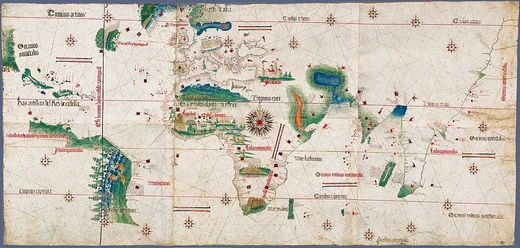
Volta do mar
Navigational technique using the North Atlantic Gyre for return voyages.
Volta do mar, also known as volta do mar largo or volta do largo, is a navigational technique perfected by Portuguese navigators during the Age of Discovery in the late fifteenth century. It relies on the dependable phenomenon of the great permanent wind circle, the North Atlantic Gyre. This technique was a major step in the history of navigation, as understanding winds in the age of sail was crucial to success, and European sea empires would not have been established without an understanding of the trade winds.
Quick Facts
- Key phenomenon
- North Atlantic Gyre
Facts from the source article.
History
The volta do mar was a sailing technique that emerged from the need to return from islands in the Atlantic. Instead of sailing directly back to Europe, a pilot had to steer far to the west first to find favorable following winds. This was a counterintuitive move, as it meant sailing perpendicular to the direction of Portuguese ports. A lack of this knowledge may have caused the loss of the 13th-century expedition led by Vandino and Ugolino Vivaldi. They were heading toward the Canary Islands, which were still unknown to Europeans, and became lost. Once there, without understanding the Atlantic gyre and the volta do mar, they could not sail against the wind to reach the Strait of Gibraltar and return home. Mastering this technique was essential for later voyages; for instance, Christopher Columbus could not have returned from the Americas without using the volta do mar. He sailed north from the Caribbean through the Horse Latitudes to catch the prevailing westerlies of the mid-latitudes.
A similar pattern exists in the South Atlantic, but the South Atlantic Gyre rotates counterclockwise. Portuguese explorers and traders bound for India, after crossing the equator and intending to sail along the entire western coast of Africa, found their journeys taking them far to the west, near Brazil.
More in Portuguese Exploration in the Age of Discovery
Spotted an error? Know more?
Reader corrections go straight into our review queue. Suggest an edit · How this site is sourced