Monument of the Discoveries
Monument on the Tagus celebrating Portuguese Age of Discovery.
Standing on Lisbon’s northern Tagus riverbank in Santa Maria de Belém, the Monument of the Discoveries marks the spot where ships once set sail for India and the Orient. It honors Portugal’s 15th- and 16th-century Age of Discovery.
Quick Facts
- Location
- Santa Maria de Belém
- City
- Lisbon
- Country
- Portugal
- Building type
- Monument
- Material
- Steel
- Opened date
- 3 February 1958
- Owner
- Portuguese Republic
- Architect
- Cottinelli Telmo
Facts from the source article.
Did You Know?
- The monument was featured in Lisa Stansfield's music video for the single 'Change', where she is seen walking up and down the eastern ledge.
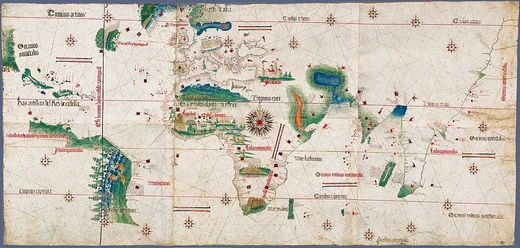
- The monument was featured on the 23rd season of The Amazing Race, where the mappa mundi was used as part of a challenge measuring the route Ferdinand Magellan sailed across the world.
History
The Monument to the Discoveries began as a temporary structure for the 1940 Portuguese World Exhibition, designed in 1939 by architect José Ângelo Cottinelli Telmo and sculptor Leopoldo de Almeida. It reflected the Estado Novo regime’s romanticized view of Portugal’s Age of Exploration, under António de Oliveira Salazar. Built in Praça do Império as part of an urban renewal push by minister Duarte Pacheco—despite Cottinelli Telmo’s objections—the original was torn down in June 1943 after the fair ended, with no permanent plans in place. A government decree on 3 February 1958, from the Ministry of Public Works, the Overseas Provinces, and Lisbon’s city council, revived the idea. From November 1958 to January 1960, a larger, permanent version rose from cement and rose-tinted stone from Leiria, with limestone statues from the Sintra area. This new monument commemorated the 500th anniversary of Henry the Navigator’s death. Following Cottinelli Telmo’s death, architect António Pardal Monteiro took over, with engineers Edgar Cardoso, Ruy Correia, and António Franco e Abreu handling stability. Pardal Monteiro designed the interior, while Luís Cristino da Silva planned the surrounding square. The northern section was built by Pardal Monteiro’s firm, the southern by José Raimundo. Leopoldo de Almeida created the sculptures, aided by Soares Branco and António Santos, using models by António Cândido and Carlos Escobar, overseen by António Branco and Alfredo Henriques. Inaugurated on 9 August 1960 for the Comemorações Henriquinas, it was fully completed on 10 October 1960, then handed to the Administração Geral do Porto de Lisboa.
Architecture
The Monument of the Discoveries stands on the Tagus River’s northern shore, next to the Belém Marina, the Algés and Dafundo Nautical Centre, and the Museum of Popular Art. Stone pedestals topped with armillary spheres mark its boundaries. Across the Avenida da Índia-Avenida de Brasília motorway, opposite the large square, lies the Praça do Império, which faces the Jerónimos Monastery, the Belém Cultural Center, and the Jardim Vasco da Gama. The original monument was built from steel and cement, while its 33 statues were made from a mix of plaster and tow. The structure is a 56-meter slab set vertically along the riverbank, shaped like the prow of a caravel. Ramps on both sides of the slab meet at the water’s edge, where the figure of Henry the Navigator stands. Along each ramp, 16 figures (33 in total) depict notable people from the Portuguese Age of Discovery, including monarchs, explorers, cartographers, artists, scientists, and missionaries. Each idealized figure leans forward, as if moving toward the unknown sea, symbolizing their role in the events that followed Henry’s leadership. The South African government donated the square in front of the monument. It features a 50-meter compass rose made from various types of limestone, including lioz, a rare beige limestone found only near Lisbon, especially in Sintra. Architect Cristino da Silva designed the square, which also includes a 14-meter-wide world map showing the routes of Portuguese carracks and caravels during the Age of Discovery. On the northern side, flanking the staircase, are two metal inscriptions. The left one reads, “AO INFANTE D. HENRIQVE E AOS PORTVGVESES QVE DESCOBRIRAM OS CAMINHOS DO MAR” (To Prince Lord Henry and the Portuguese that Discovered the Paths of the Sea), placed above a metal anchor. The right inscription says, “NO V CENTENÁRIO DO INFANTE D. HENRIQVE 1460 – 1960” (On the Fifth centenary of Prince Lord Henry 1460–1960), set over a laurel crown. The double staircase rises one level before reaching the entrance, offering a view of the square and the figures on either side.
More in Portuguese Exploration in the Age of Discovery
Spotted an error? Know more?
Reader corrections go straight into our review queue. Suggest an edit · How this site is sourced