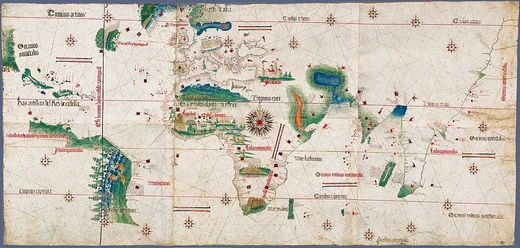
Torrid zone
Ancient belief in an uninhabitable equatorial zone, later disproved.
Ancient Greek and Roman geographers coined the term "torrid zone" for Earth's equatorial region, believing its extreme heat made it impossible for sailors or explorers to cross. This belief discouraged European voyages until the 1400s, and by the 1500s, the idea that the zone was uninhabitable had been proven false.
Quick Facts
- First recorded by
- Parmenides
- Developed by
- Aristotle
- Latin term
- torridus (burned, parched)
- Key disproving event
- Portuguese sailed past Cape Bojador in 1434
- Century disproved
- 16th century
Facts from the source article.
Early theories and origins
Like other thinkers of the classical era, Aristotle accepted that the Earth was a sphere. He reasoned that a temperate zone in the Southern Hemisphere must mirror the one in the north, and that the western part of the northern temperate zone, on the far side of the globe from Greece, might be inhabited. However, he believed the torrid zone’s extreme heat made travel across it impossible. This concept of a torrid zone came from natural observation and reasoning, developed by figures such as Parmenides and Aristotle. Though Parmenides is often credited with first describing it as one of five climatic zones—placing it around the equator and defining it by intense heat—his original writings on the subject are lost. Aristotle expanded on the idea in his Meteorologica, using natural philosophy to account for northern and southern winds. He thought the torrid zone was vast, open, barren, and uninhabitable, and that southern winds did not come from the poles but from a hot, flat central region. Later, the Roman geographer Pomponius Mela stated that the Earth had two habitable zones, one in the north and one in the south, whose inhabitants were called Antichthones. He argued that the unbearable heat at the equator prevented any contact between them. The word “torrid” comes from the Latin torridus, meaning burned or parched.
Proved wrong
Before 1434, many Europeans believed Cape Bojador in Western Sahara was the edge of an impassable torrid zone. That year, Portuguese sailors passed the cape and found no such zone. Sixteenth-century exploration further disproved the idea of an uninhabitable torrid zone. Spanish conquistadors, explorers, and missionaries in Peru who entered the region reported it was habitable and fertile. They observed complex weather patterns, contradicting Aristotle and earlier claims that the torrid zone was hot and dry. The Americas, lying within this zone, showed a complete contrast to those early perceptions, with diverse climates and human inhabitants.
Cultural and historical significance
Even after science disproved older ideas about the torrid zone, European views from earlier times continued to influence how it was understood. Imperialist thinking made environmental determinism a key part of European records. Once Europeans learned the torrid zone was actually tropical and habitable, they described it as primitive and savage compared to themselves. The way they depicted the tropics—sometimes as a paradise, sometimes as dangerous—helped justify colonialism and reinforced racial hierarchies that put Europeans above the native peoples of those regions.
More in Portuguese Exploration in the Age of Discovery
Spotted an error? Know more?
Reader corrections go straight into our review queue. Suggest an edit · How this site is sourced