Spice trade
Ancient network linking Asia, Africa and Europe through spice exchange.
The spice trade involved historical civilizations in Asia, Northeast Africa and Europe, with spices such as cinnamon, cassia, cardamom, ginger, pepper, nutmeg, star anise, clove, and turmeric known and traded since antiquity. The maritime aspect was dominated by Austronesian peoples in Southeast Asia, who established routes from Southeast Asia to Sri Lanka and India by 1500 BC. The trade was transformed by the European Age of Discovery, particularly after the Portuguese pioneered the Cape Route in 1498.
Quick Facts
- Earliest known trade network
- Austronesian peoples of Maritime Southeast Asia, from around 1500 BC to 600 BC
- Key early maritime traders
- Austronesian peoples
- Arabs
- Phoenicians
- Indians
- Portuguese conquest of malacca
- 1511, by Afonso de Albuquerque
Facts from the source article.
Origins
Trade in spices, obsidian, seashells, gemstones and other high-value materials in the Indian Ocean and Island Southeast Asia dates to the 10th millennium BC. The ancient Egyptians are the first to mention such trade in historical periods, exchanging with the Land of Punt in the 3rd millennium BC. The first true maritime trade network in the Indian Ocean was established by Austronesian peoples of Maritime Southeast Asia, who from around 1500 BC to 600 BC created routes with South India and Sri Lanka, exchanging material culture such as catamarans, outrigger boats, and cultigens including coconuts, bananas, and sugarcane, as well as spices endemic to the Maluku Islands. This network later connected India and China via the Maritime Silk Road. Ethnic groups in Indonesia traded spices like cinnamon and cassia with East Africa using catamarans and outrigger boats, sailing with the westerlies. The network expanded to Africa and the Arabian Peninsula, leading to the Austronesian colonization of Madagascar by the first half of the first millennium AD. In the first millennium BC, Arabs, Phoenicians, and Indians also engaged in sea and land trade of luxury goods, with maritime routes in the Red Sea and Indian Ocean.
Arab trade and medieval Europe
Rome's role in the spice trade during the 5th century did not persist through the Middle Ages. The spice trade brought great riches to the Abbasid Caliphate and inspired legends such as that of Sinbad the Sailor, whose voyages began from Basra and ended in Baghdad. During the 7th and 8th centuries, Arab merchants, mainly descendants of sailors from Yemen and Oman, dominated Indian Ocean maritime routes, linking to the secret spice islands of Maluku and Banda. Moluccan products were shipped to trading emporiums in India, passing through ports like Kozhikode in Kerala and Sri Lanka, then westward across Arabian ports to the Near East, Ormus in the Persian Gulf, Jeddah in the Red Sea, and sometimes East Africa. The Abbasids used Alexandria, Damietta, Aden and Siraf as entry ports for trade with India and China. Merchants arriving in Aden paid tribute in musk, camphor, ambergris and sandalwood to the sultan of Yemen. Indian spice exports are mentioned in works by Ibn Khurdadhbeh, al-Ghafiqi, Ishak bin Imaran and Al Kalkashandi, and the Chinese traveler Xuanzang noted the town of Puri where merchants depart for distant countries.
Age of Discovery: a new route and a New World
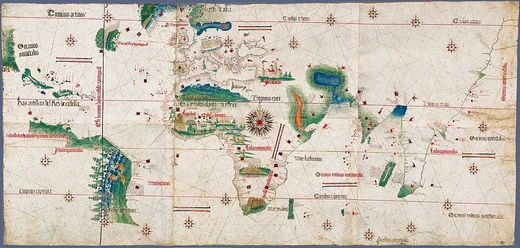
The Republic of Venice had become a key player in the Eastern spice trade, prompting other powers to build maritime capability to break its hold. Until the mid-15th century, trade with the East went through the Silk Road, with the Byzantine Empire and the Italian city-states of Venice and Genoa as middlemen. Portugal, having begun exploring northern Africa under Henry the Navigator in the early 15th century, first rounded the Cape of Good Hope in 1488 on an expedition led by Bartolomeu Dias. In 1497, on orders of Manuel I of Portugal, four vessels under Vasco da Gama sailed beyond to Malindi on the eastern coast of Africa and across the Indian Ocean to Calicut on the Malabar Coast in South India, the capital of the local Zamorin rulers. The Portuguese Empire became the earliest European seaborne empire to grow from the spice trade. In 1511, Afonso de Albuquerque conquered Malacca, the center of Asian trade, and sent an expedition led by António de Abreu to Banda, where they were the first Europeans to arrive in early 1512. From 1507 to 1515 Albuquerque tried to block Arab and other traditional routes through conquest of strategic bases in the Persian Gulf and at the entrance of the Red Sea. By the early 16th century the Portuguese had complete control of the African sea route, linking three oceans from the Moluccas to Lisbon.
Cultural diffusion
A key technological exchange from the spice trade network was the introduction of maritime technologies by Austronesian peoples to India, the Middle East, East Africa, and China, including plank-sewn hulls, catamarans, outrigger boats, and possibly the lateen sail. Linguistic evidence survives in South Indian and Sri Lankan languages, with words for 'ship' derived from Proto-Hesperonesian padaw. Austronesians also introduced cultigens such as bananas, Pacific domesticated coconuts, Dioscorea yams, wetland rice, sandalwood, giant taro, Polynesian arrowroot, ginger, lengkuas, tailed pepper, betel, areca nut, and sugarcane to southern India, Sri Lanka, and eastern Africa. Hindu and Buddhist religious establishments in Southeast Asia became associated with economic activity as patrons, and Buddhism spread alongside maritime trade, promoting coinage, art, and literacy. Islam reached maritime Southeast Asia in the 10th century through Muslim merchants. Christian missionaries, including Saint Francis Xavier, spread Christianity in the East, competing with Islam in the Moluccas, though natives accommodated aspects of both religions. Portuguese colonial settlements saw traders from various groups involved, and knowledge of Portuguese became essential. The colonial pepper trade changed modernity in Europe and Kerala, bringing early capitalism to India's Malabar Coast and altering cultures of work and caste.
More in Portuguese Exploration in the Age of Discovery
Spotted an error? Know more?
Reader corrections go straight into our review queue. Suggest an edit · How this site is sourced