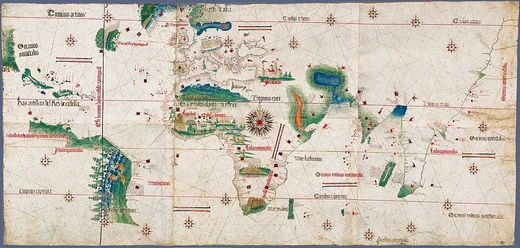
Portuguese raids in Senegambia
Mid-15th century Portuguese expeditions along the Senegambian coast.
The Portuguese raids in Senegambia were mid-15th century expeditions by explorers and slave raiders serving Prince Henry of Portugal along the coasts of present-day Senegal and The Gambia. Though largely unsuccessful, these ventures marked the initial phase of Portuguese expansion along West Africa, a process that later contributed to its naval victory at Diu in 1509. The encounters also revealed the military organization of the Malian and Jolof empires and the limits of European naval superiority.
Quick Facts
- Part of
- the Henrican explorations and early Transatlantic slave trade
- Date
- 15th century
- Location
- Senegambia
- Result
- Portuguese failure
Facts from the source article.
Background
The West African slave trade, begun under Prince Henry of Portugal in the 1420s, had already flourished from the 8th to 14th century CE via Muslim merchants, with an estimated three to four million people enslaved. From the mid-15th century, Portuguese voyages down the West African coast sought routes to India, Christian allies, trade, and material goods, while desire for conquest, honor, plunder, and glory grew among participants. In Senegambia, the Mali Empire, in decline and having lost provinces to the Songhai Empire, still controlled the Gambia River, while the Jolof Empire, a rising confederacy of Senegalese city-states, had recently broken free from Mali. Both polities possessed well-organized militaries including infantry, archers with poisoned arrows, cavalry, and war-canoes effective against European caravels. Jolof was highly intolerant of foreign religions or people, determined to preserve its authority, but Prince Henry justified expeditions using Reconquista rhetoric as a just war for Christian conversion.
Raids and Expeditions
The first Portuguese captains to attempt landings on the Senegambian coast, Gomes Pires and Dinis Dias, found the beaches heavily guarded. The defenders were archers and infantry armed with iron darts and multi-pronged spears, all tipped with plant poison. Judging the risk too high, both men sailed elsewhere. Their caution was scorned by Nuno Tristão, a knight and friend of Prince Henry the Navigator. Tristão had already made his name on Portugal’s first slaving voyage in 1441, capturing sixty Africans, and had become a national hero by raiding the undefended coasts of Morocco and Mauritania. In 1446, he sailed past Cape Verde into a Senegalese river—likely the Saloum—seeking what he called the Land of the Blacks. Expecting an easy prize, he instead met twelve war canoes carrying seventy to eighty archers. The canoes surrounded his ship; one landed on the bank, and the archers opened fire with poisoned arrows. Two men were hit immediately, and of the twenty-four wounded, twenty-two died either on the spot or during the voyage back. Among the dead were Tristão and four young aristocrats: Diogo Machado, Estevão de Almeida, Duarte de Holanda, and João Correia. The survivors fled to the caravel and eventually reached Portugal. Though a small engagement, the defeat shocked the Portuguese nobility. The next year, another of Henry’s protégés, Álvaro Fernandes, sailed to Senegal, entering a different river, the Cabo dos Mastos, perhaps hoping to avoid the area where Tristão had died. But he had not escaped the Jolof Empire, which claimed control over nearly the entire Senegalese coast and its rivers.
Aftermath
By 1448, about fifty vessels had traveled beyond Bojador, capturing an estimated 927 slaves. By Prince Henry's death in 1460, the Portuguese had explored much of West Africa's coastline and rivers. This exploration led to further expeditions south under Afonso V and John II. The Mali Empire later depended heavily on Portuguese trade, with Mansa Mahmud Keita II establishing diplomatic relations with Portugal, but by the end of the 16th century Portugal used its economic supremacy to take over all trade in the region, bringing down the African empires that had once threatened them.
More in Portuguese Exploration in the Age of Discovery
Spotted an error? Know more?
Reader corrections go straight into our review queue. Suggest an edit · How this site is sourced