Portuguese discovery of the sea route to India
First sea voyage from Europe to India via the Cape of Good Hope.
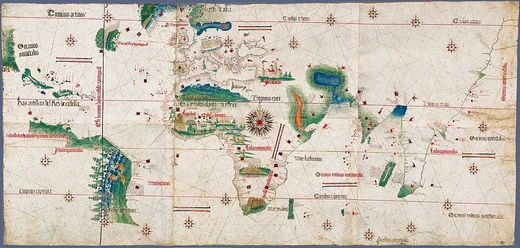
The Portuguese discovery of the sea route to India was the first recorded direct voyage from Europe to the Indian subcontinent, rounding the Cape of Good Hope. Commanded by Vasco da Gama during the reign of King Manuel I, the expedition took place from 1497 to 1499. It is considered a pivotal event of the Age of Discovery and initiated Portuguese maritime trade and military presence on the Malabar Coast and in Goa and Bombay.
Quick Facts
- Commander
- Vasco da Gama
- Reigning monarch
- King Manuel I
- Duration
- 1497–1499
- Crew size
- Up to 170 men
- Survivors
- 55 of 148 men
- Arrival in india
- 17 May 1498 at Kappakadavu, near Calicut
Facts from the source article.
Did You Know?
- Only 55 of the 148 men who started the expedition survived; the São Rafael was burned due to inability to maneuver after disease reduced the crew.
- Vasco da Gama returned home on 31 August and was granted the title of Don and great rewards by King Manuel I.
Preparations of the trip
King John II of Portugal devised the plan for a Cape Route to India as a cost-saving measure for Asian trade and an attempt to monopolize the spice trade. He sought new trade routes and expansion of the Portuguese Empire, but the project was not realized during his reign. His successor, King Manuel I, maintained the original plan and designated Vasco da Gama to lead the expedition. The upper classes opposed the venture; at the Cortes de Montemor-o-Novo of 1495, a contrary view favored trade with Guinea and North Africa and feared the costs and challenges of overseas territories. This opposition is embodied in the character of The Old Man of Restelo in Os Lusíadas by Luís Vaz de Camões. Manuel I disregarded this opinion, equipped the ships, and chose Vasco da Gama as captain of the armada. John II had originally appointed Vasco's father, Stephen da Gama, but both were deceased by the time the plan was implemented. The Portuguese sought spices, which were expensive due to the dangers and time of overland travel from Europe to India. John II had ordered ships to explore the African coast to see if India was reachable via the cape and the Indian Ocean. He appointed Bartolomeu Dias on 10 October 1486 to sail around the southern tip of Africa. Dias later helped construct the São Gabriel and São Rafael, which Vasco da Gama used to round the Cape of Good Hope and continue to India.
The context
Spices such as cinnamon, ginger, cloves, black pepper, and turmeric were difficult to obtain in Europe and were brought by caravans from the East. A Lisbon merchant described the overland spice route as supplying only the markets of Venice and Genoa, at great cost and without guaranteed arrival. A popular theory from the late 19th century held that the Ottoman capture of Constantinople in 1453 severely reduced Venetian and Genoese trade with the East, making the Portuguese sea route advantageous and profitable. However, this theory was shown to lack substance as early as 1915 by Albert H. Lybyer. Around 1481, João Afonso of Aveiro explored the kingdom of Benin and gathered information about a legendary prince Ogané, thought to be Christian and located far to the east. Excited, John II sent Frei António de Lisboa and Pedro de Montarroio in 1487 to find Prester John, but they only reached Jerusalem and returned. The king then secretly dispatched Afonso de Paiva and Pêro da Covilhã, who traveled through Valencia, Barcelona, Naples, Rhodes, Alexandria, Cairo, and Aden. Afonso de Paiva headed to Ethiopia and Pêro da Covilhã to India. Neither returned, but the information they gathered was brought back by intermediaries and used to support the maritime expedition.
The voyage
The expedition departed on 8 July 1497, following the usual Lisbon shipping line to Cabo Verde. The Indian Ocean route went along the coast to Malindi and then directly to Calicut. Latitudes were determined by solar observation. Some tribes played rustic flutes in a coordinated manner. Scurvy affected the crew. In Mozambique, they encountered palm trees with coconuts. The crew raided ships for pilots, trading with prisoners or putting them to work. According to Damião de Góis, five padrões were set: São Rafael at the Bons Sinais river, São Jorge in Mozambique, the Holy Spirit in Malindi, Santa Maria in Ilhéus, and São Gabriel in Calicut. These marked Portuguese sovereignty. Only the Vasco da Gama Pillar in Malindi survives.
Arrival in Calicut
On 17 May 1498 the fleet reached Kappakadavu, near Calicut in Kerala, establishing the sea route from Europe to India. Negotiations with the local governor, Samutiri Manavikraman Raja, Zamorin of Calicut, were difficult. Vasco da Gama's efforts were hampered by cultural differences and the low value of his gifts; in the East, kings expected rich offerings. Arab merchants already in Calicut resisted competition. Vasco da Gama persisted and obtained an ambiguous letter granting trade rights. The Portuguese sold their goods at low prices for small amounts of spices and jewels. The fleet departed without warning after the Zamorin demanded they leave all assets as collateral. Vasco da Gama kept his goods but left a few Portuguese to start a trading post.
More in Portuguese Exploration in the Age of Discovery
Spotted an error? Know more?
Reader corrections go straight into our review queue. Suggest an edit · How this site is sourced