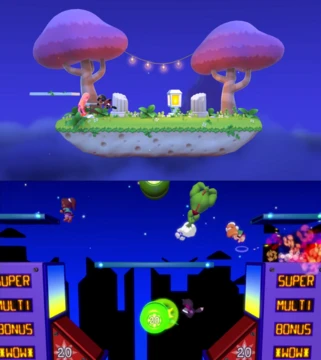
Platform fighter
A fighting subgenre defined by free movement and launch-based defeat.

U.S. Air Force 31FWPA by Airman 1st Class Zachary Jakel · Public domain
A platform fighter is a fighting game subgenre where characters move freely in two dimensions, often across floating platforms that resemble those in platform games. Combat involves two or more players attacking each other until one is knocked out. These games are sometimes called "Smash clones," after the hugely popular *Super Smash Bros.* series. Unlike traditional fighting games, platform fighters usually lack a health bar. Instead, damage builds up on a character, making them fly farther when hit. A character is defeated when they are knocked past the arena's boundaries.
- Subgenre
- Platform fighter
- First defined by
- Super Smash Bros. (1999)
- Key mechanics
- Free 2D movement, platforms, launch-based defeat
- Colloquial name
- Smash clones
- Notable early example
- The Outfoxies
Lore & Background
While some 2D fighting games have used mechanics like platforms in stages, such as in Savage Reign, these games are not considered platform fighters, as they play like traditional 2D fighting games with an added gimmick. Though The Outfoxies was an early example of many of the mechanics featured in most platform fighters, the subgenre would be most defined by the release of Super Smash Bros. in 1999, which was the first game in the subgenre to achieve wide success and defined the mechanics for most games that followed. After the release of the original Super Smash Bros., many companies released their own games similar in style, including crossover games like DreamMix TV World Fighters and games with licensed characters like Digimon Rumble Arena and Battle Stadium D.O.N. Teenage Mutant Ninja Turtles: Smash-Up was notably developed by a studio that contributed to Super Smash Bros. Brawl.
Reader's Guide
The platform fighter subgenre gained its identity through the success of Super Smash Bros., which established the core mechanics of free 2D movement, floating platforms, and launch-based defeat instead of health bars. This design influenced numerous subsequent titles, both from major companies and indie developers. In the mid-2010s, indie developers began producing games that imitated these mechanics, including Rivals of Aether, Brawlout, and Brawlhalla, and the term 'platform fighter' became more frequently used to refer to such games. Following the success of Super Smash Bros. Ultimate in 2018, new platform fighters emerged based on licensed properties, such as Nickelodeon All-Star Brawl and its sequel, Fraymakers, and MultiVersus. The subgenre's legacy lies in its departure from traditional fighting game conventions, creating a distinct style that emphasizes stage control and ring-out victories over health depletion.
Did You Know?
- Platform fighters are sometimes colloquially referred to as 'Smash clones'.
- The Outfoxies was an early example of many mechanics featured in most platform fighters.
- The term 'platform fighter' began to be used more frequently in the mid-2010s.
Core Gameplay Mechanics
The defining mechanical distinction of a platform fighter from traditional fighting games lies in its approach to damage and defeat. Rather than displaying a depleting health bar, the sub-genre tracks the cumulative damage a character has absorbed, and that accumulated value directly determines how far the character is sent flying when struck by an opponent's attack. Victory is achieved not by reducing a meter to zero but by knocking a rival outside the visible arena boundaries. This launch-based system rewards both aggressive offense and careful positioning, since a heavily damaged character becomes increasingly vulnerable to being sent off-stage. The movement vocabulary is equally distinctive: free two-dimensional traversal across floating platforms, drawing a clear lineage from classic platformers rather than the fixed horizontal lanes of conventional fighters. Matches typically pit two or more player-controlled characters against one another in a shared arena. Because of the genre's strong association with one particular franchise, titles in this space are often colloquially labeled "Smash clones," a shorthand that references the Super Smash Bros. series as the archetype players instinctively compare everything else against.
Origins and the Defining Moment
Tracing the roots of the platform fighter reveals a gradual evolution rather than a single invention. Certain two-dimensional fighting titles, such as Savage Reign, incorporated floating platforms into their stage design, yet these games retained the core structure of traditional side-scrolling fighters with an added visual gimmick, and the community does not classify them as true platform fighters. A more meaningful precursor is The Outfoxies, which featured many of the mechanical ingredients—free movement, launch-based knockback, arena boundaries—that would later become genre staples. However, the sub-genre as a recognizable category truly crystallized with the 1999 release of Super Smash Bros. That title was the first in the space to achieve broad commercial and cultural success, and in doing so it established the mechanical template that nearly every subsequent entry would follow. Its influence was so total that for years the term "platform fighter" was barely necessary; people simply said "a Smash game" or "a Smash-like game." The 1999 landmark effectively drew the line between experimental stage gimmicks and a coherent, repeatable design philosophy.
The Wave of Imitators and Licensed Entries
In the years following the original Super Smash Bros., the commercial success of the formula prompted a wave of publishers and developers to produce their own entries in the emerging style. Some took a crossover approach, assembling rosters drawn from multiple franchises; DreamMix TV World Fighters is a notable example of this multi-property strategy. Others leaned into a single licensed brand, giving fans of a particular franchise a dedicated arena-battle experience. Digimon Rumble Arena and Battle Stadium D.O.N. each built their rosters around well-known character lineups, while Teenage Mutant Ninja Turtles: Smash-Up brought the genre to the beloved turtle franchise. That last title carries an interesting behind-the-scenes connection: it was developed by a studio whose personnel had previously contributed to Super Smash Bros. Brawl, meaning the design DNA of the genre's flagship was literally present in the making of one of its most direct imitators. Together, these mid-2000s and early-2010s releases demonstrated that the launch-and-knockout formula could be successfully adapted across a wide range of intellectual properties and audience demographics.
Indie Renaissance and the Modern Era
A second wave of platform fighters emerged in the mid-2010s, driven largely by independent developers who were inspired to recreate the mechanics of Super Smash Bros. in their own original or fan-made projects. Titles such as Rivals of Aether, Brawlout, and Brawlhalla each brought fresh interpretations of the launch-based combat loop while remaining firmly within the sub-genre's mechanical boundaries. It was around this period that the specific term "platform fighter" began appearing with increasing regularity in discussions, reviews, and community writing, replacing the older habit of simply calling these games "Smash clones" or "Smash-like." The 2018 release of Super Smash Bros. Ultimate then acted as a catalyst for a new round of licensed entries. Nickelodeon All-Star Brawl and its sequel, Fraymakers, and MultiVersus all appeared in the wake of Ultimate's massive commercial and cultural footprint, each adapting the genre's core loop to a different roster of characters. The sub-genre, once a niche imitation, had by the late 2010s become an established and recurring category in the broader fighting-game landscape.
Gallery



Frequently Asked Questions
What is a platform fighter?
A platform fighter is a fighting-game subgenre built around free two-dimensional movement across floating platforms. Rather than draining a health bar, characters accumulate damage that increases their launch distance, and the match ends when someone is sent past the arena's edges.
How does a platform fighter differ from a traditional fighting game?
Traditional fighters track a depleting health bar, while platform fighters use a damage-percentage model where higher damage simply means a bigger launch on the next hit. Victory is achieved by knocking an opponent beyond the stage boundary instead of reducing their HP to zero.
Which game first defined the platform fighter genre?
Super Smash Bros. (1999) is the title most often credited with establishing the subgenre's core loop. Its combination of free movement, platform traversal, and launch-based knockout became the blueprint later entries follow.
Why do fans call these games 'Smash clones'?
'Smash clone' is an informal label for any platform fighter that borrows the gameplay template popularized by the Super Smash Bros. series. It is not an official category name but a shorthand that reflects that franchise's outsized cultural influence on the subgenre.
What core mechanics does every platform fighter share?
At minimum, the genre features free two-dimensional movement, floating platforms to navigate, and a launch-based defeat system where accumulated damage dictates how far a character is sent flying. These three pillars set the subgenre apart from linear, health-bar-based fighting games.
More in Platform fighters 1-24
Spotted an error? Know more?
Reader corrections go straight into our review queue. Suggest an edit · How this site is sourced