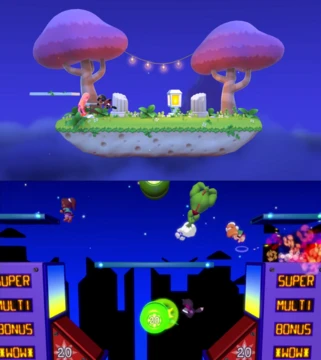
Brawlout
A platform fighter with combo-based gameplay and guest characters.

Brawlout is a fighting game developed and published by Angry Mob Games for Microsoft Windows, Nintendo Switch, PlayStation 4, and Xbox One. It was revealed at EVO in July 2016 and entered closed beta in December 2016, with an early access release for Microsoft Windows on April 20, 2017. The game has been compared to the Super Smash Bros. series by outlets such as Engadget.
Quick Facts
- Title
- Brawlout
- Developer
- Angry Mob Games
- Publisher
- Angry Mob Games / Merge Games
- Engine
- Unity
- Platforms
- Microsoft Windows / Nintendo Switch / PlayStation 4 / Xbox One
- Genre
- Fighting
- Released
- August 21, 2018
- Modes
- Single-player, multiplayer
Facts from the source article.
Lore & Background
Brawlout is a platform fighter designed for two to four players, set in environments with various platforms. Its combat system does not include blocking, and most characters cannot grab opponents; instead, gameplay centers on combos. Players build a Rage Meter through fighting, which fuels powerful special attacks and introduces strategic elements like the Combo Breaker or Rage Mode. The goal is to throw opponents off the stage by increasing their damage percent, causing them to fly further.
Reader's Guide
Brawlout's significance lies in its attempt to offer a platform fighter experience outside the Super Smash Bros. franchise, with a focus on combo-based mechanics and a Rage Meter system that adds strategic depth. The inclusion of guest fighters and online features such as ranked ladders, private lobbies, and Brawlout TV for streaming tournaments aimed to build a competitive community. The digital Nintendo Switch version sold over 50,000 copies in its first two weeks, and the game won the 'Game, Original Fighting' award at the National Academy of Video Game Trade Reviewers Awards. However, the Nintendo Switch, Xbox One, and PlayStation 4 versions received 'mixed or average reviews' on Metacritic, indicating a divisive reception. Its legacy is as a niche title that sought to innovate within the platform fighter genre while facing mixed critical response.
Did You Know?
- The game entered closed beta in December 2016.
- Angry Mob Games partnered with UK publisher Merge Games for physical retail copies on Nintendo Switch in May 2018.
The Core Mechanics Brawlout Inherited
Platform fighters like Brawlout operate on a fundamentally different combat philosophy than traditional fighting games. Rather than depleting an opponent's health bar through exchanges of blows, the damage a character accumulates works as a multiplier on launch distance. Each hit you take makes the next one send you flying further, and the ultimate goal is to knock your opponent beyond the arena's boundaries entirely. This creates a risk-reward dynamic where taking damage is not just about losing a fight—it is about being physically displaced from the stage. The movement itself is free and two-dimensional, often across floating platforms that players can traverse in any direction. Brawlout, as a mid-2010s indie title, inherited this entire mechanical framework from the subgenre's defining ancestor, Super Smash Bros., and the wave of imitators that followed. The genre is sometimes colloquially called "Smash clones," a nod to how deeply that 1999 title shaped every subsequent entry, including Brawlout's design DNA.
The Mid-2010s Indie Renaissance
Before the mid-2010s, the platform fighter space was largely dominated by licensed properties and crossover titles—games like DreamMix TV World Fighters, Digimon Rumble Arena, Battle Stadium D.O.N., and Teenage Mutant Ninja Turtles: Smash-Up. While these brought the subgenre to wider audiences, they were typically products of larger studios working with established franchises. Then a shift occurred: independent developers began building their own platform fighters from the ground up, imitating the core mechanics that Super Smash Bros. had established. Brawlout emerged as part of this indie wave, alongside titles like Rivals of Aether and Brawlhalla. This period also saw the term "platform fighter" gain more consistent usage as a recognized subgenre label, moving beyond the informal "Smash clone" shorthand. The indie movement demonstrated that the genre's appeal was not locked to licensed characters or big-budget production—it could thrive as a creative space for smaller teams building self-contained rosters.
The Long Lineage from 1999
To understand where Brawlout sits, you have to trace the thread back to 1999, when Super Smash Bros. became the first title in the subgenre to achieve wide commercial success and, crucially, defined the mechanical template that nearly every subsequent platform fighter would follow. Before that, there were 2D fighting games with platform gimmicks—Savage Reign is one example—but these played like traditional fighters with an added flourish rather than embracing free-form arena combat. The Outfoxies is sometimes cited as an early mechanical precursor, but it was Smash that codified the genre. In the years that followed, the formula was replicated across licensed properties and crossover experiments, with some notable connections to the Smash development team itself, as seen with the studio behind TMNT: Smash-Up contributing to Super Smash Bros. Brawl. Brawlout, arriving in the mid-2010s, represents the latest iteration of this long chain of developers looking at Smash's blueprint and asking how to reinterpret it.
Brawlout in the Broader Ecosystem
Brawlout occupies a specific moment in the platform fighter timeline: after the early licensed and crossover wave of the 2000s, during the indie renaissance of the mid-2010s, and before the post-Smash Ultimate explosion of 2018 and beyond. That 2018 release of Super Smash Bros. Ultimate re-energized the subgenre, spawning a new generation of entries based on various licensed properties—Nickelodeon All-Star Brawl and its sequel, Fraymakers, and MultiVersus all emerged in that wake. Brawlout, by contrast, belongs to the earlier indie cohort that proved the genre could sustain itself outside the Smash franchise's orbit. It shares its mechanical DNA with Rivals of Aether and Brawlhalla, all three drawing on the same foundational rules: no health bars, damage-as-launch, arena boundaries as the kill condition, and free two-dimensional movement across platforms. Together, these mid-2010s titles helped solidify "platform fighter" as a recognized category in its own right, setting the stage for the broader ecosystem that would follow.
Gallery

Frequently Asked Questions
What is Brawlout?
Brawlout is a platform-fighting game created by Angry Mob Games, featuring combo-driven combat and a roster that includes guest fighters. It has drawn comparisons to the Super Smash Bros. series from outlets like Engadget.
Who developed and published Brawlout?
Angry Mob Games handled both development and digital publishing across all platforms. For the Nintendo Switch physical retail edition, Merge Games took on the publishing role.
When did Brawlout launch and on which platforms?
The game entered early access on Microsoft Windows on April 20, 2017, after a closed beta that began in December 2016. It later received a physical retail release for Nintendo Switch in May 2018, with PlayStation 4 and Xbox One versions also available.
How large is Brawlout's character roster?
The game offers 25 playable fighters in total. This count includes four guest characters alongside the core cast.
What sets Brawlout apart from other platform fighters?
Its core identity revolves around a combo-based combat system rather than purely hit-and-knockback mechanics. The inclusion of guest fighters from outside its own universe also broadens the roster in a way that distinguishes it from many peers in the genre.
More in Platform fighters 1-24
Spotted an error? Know more?
Reader corrections go straight into our review queue. Suggest an edit · How this site is sourced