Sugarcane
A tall perennial grass used for sugar production, native to New Guinea.
Last updated

Vis M · CC BY-SA 4.0
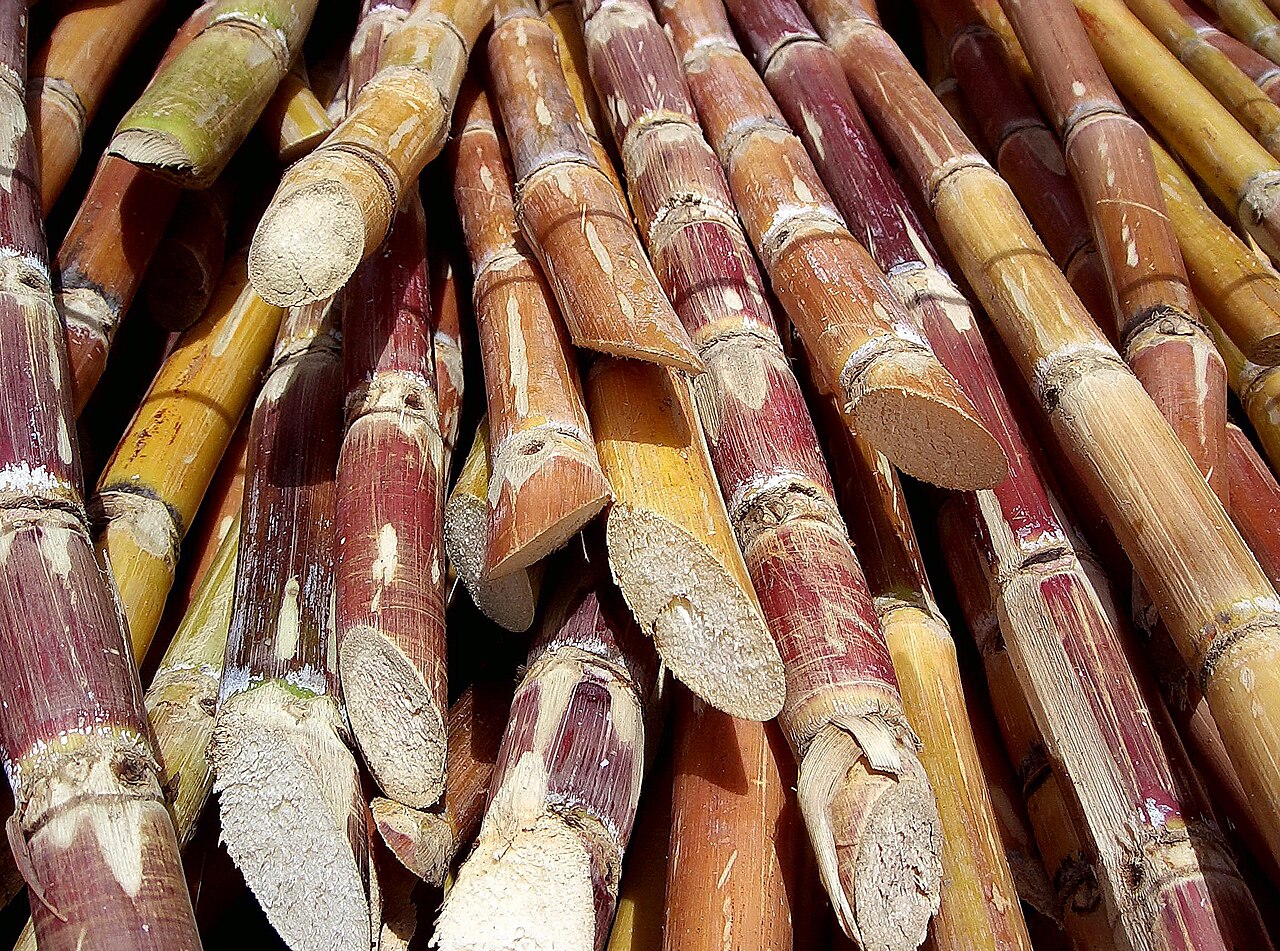
A tall, perennial grass species classified under the genus Saccharum and tribe Andropogoneae, sugarcane is cultivated for producing sugar.[1] Stalks of this plant, which are fibrous, jointed, and stout, can reach heights of 2–7 m and store sucrose within their internodes.[1] With a global production of 1.9 billion tonnes in 2020, sugarcane ranks as the highest-volume crop worldwide.[2]
Biology and range
Sugarcane is a perennial tropical grass that produces lateral shoots at its base, forming multiple stems.[3] Most of the world's sugarcane is grown between 22°N and 22°S.[4] New Guinea is the original native region of this plant.[5] Sugarcane is a member of the Poaceae family, a flowering plant group that also contains economically significant species like maize, wheat, rice, and sorghum.[5]
As a C4 plant, it can transform as much as 1% of the sunlight it receives into biomass.[6] Severe frost conditions are not tolerated by sugarcane.[4] Near the equator, sugarcane fields can be located at elevations up to 1600 m, for instance in Colombia, Ecuador, and Peru.[7]
What the specialist sources record
The Whitmarsh 1999 source notes that photosynthesis is initiated by photon absorption in about a femtosecond.[8]
References
- Wikipedia, "Sugarcane" (CC BY-SA 4.0), which cites: Papini-Terzi, "Sugarcane genes associated with sucrose content", BMC Genomics, 21 March 2009, p. 120 (original not read by us) en.wikipedia.org
- Wikipedia, "Sugarcane" (CC BY-SA 4.0), which cites: "Plants & Fungi: Saccharum officinarum (sugar cane)", Royal Botanical Gardens, Kew; Vilela, "Analysis of Three Sugarcane Homo/Homeologous Regions Suggests Independent Polyploidization Events of Saccharum officinarum and Saccharum spontaneum", Genome Biology and Evolution, 2017, p. 266–278 (original not read by us) en.wikipedia.org
- Wikipedia, "Sugarcane" (CC BY-SA 4.0), which cites: "Sugar and Sweeteners Economic Research Service", www.ers.usda.gov (original not read by us) en.wikipedia.org
- Wikipedia, "Sugarcane" (CC BY-SA 4.0), which cites: Rolph, George, "Something about sugar: its history, growth, manufacture and distribution", San Francisco, J. J. Newbegin, 1873 (original not read by us) en.wikipedia.org
- Wikipedia, "Sugarcane" (CC BY-SA 4.0), which cites: "Saccharum officinarum L.", Plants of the World Online (original not read by us) en.wikipedia.org
- Wikipedia, "Sugarcane" (CC BY-SA 4.0), which cites: Whitmarsh, John, "Concepts in Photobiology: Photosynthesis and Photomorphogenesis", Narosa Publishers/New Delhi and Kluwer Academic/Dordrecht, 1999, p. 11–51 (we also read that source) en.wikipedia.org
- Wikipedia, "Sugarcane" (CC BY-SA 4.0), which cites: Abhishek, "Sugarcane Farming: Complete Guide [to the] Farming of Sugarcane", Agriculture Review, 2021 (original not read by us) en.wikipedia.org
- Whitmarsh, John, "Concepts in Photobiology: Photosynthesis and Photomorphogenesis", Narosa Publishers/New Delhi and Kluwer Academic/Dordrecht, 1999, p. 11–51. facts only, no text reused. life.illinois.edu
Each numbered sentence above was checked against the source it cites before publication. Sentences citing Wikipedia adapt text from the English Wikipedia article Sugarcane (contributors), used under CC BY-SA 4.0; this entry is available under the same licence. Other sources were used for facts only; no text or images are copied from them.
More in Plants & Crops
Sources
Compiled from Wikipedia and the sources listed below. Text from Wikipedia is available under CC BY-SA 4.0; this entry is adapted from it.
- Wikipedia: Sugarcane (CC BY-SA 4.0).
- Word definitions: the Codexery glossary, each quoted from its Wikipedia article.
Spotted an error? Know more?
Reader corrections go straight into our review queue. Suggest an edit · How this site is sourced