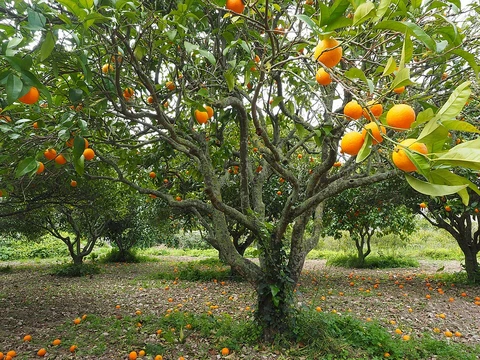
Tamarind
A versatile tropical tree bearing sweet-sour pods, used in cuisines worldwide.
Last updated

Flocci Nivis · CC BY 4.0
The leguminous tree Tamarindus indica is the sole species within its genus and yields edible fruit.[1] Fabaceae is the family to which Tamarindus indica is assigned.[2][3] Tropical Africa is the native region of this tree, and it has become naturalized in Asia.[1]
Scientific classification
- CladeTracheophytes
- CladeAngiosperms
- CladeEudicots
- CladeRosids
- OrderFabales
- FamilyFabaceae
- GenusTamarindus
- SpeciesTamarindus indica
Named by L. 1753
Sources: Wikipedia taxobox: Tamarind (CC BY-SA 4.0) · order, family and genus agree with WoRMS AphiaID 1492126 (CC BY 4.0)
Conservation status
Least Concern (LC)
- LC▲ this species
- NT
- VU
- EN
- CR
- EW
- EX
Source: IUCN Red List assessment · GBIF copy of the Red List category
Where the tamarind has been recorded
Each dot is a place where the species has been observed and reported (38,116 records, half-degree grid) — not a modelled range. 175 inland records left out (institution coordinates).
Map: drawn by Codexery. Data: GBIF occurrence search (records CC0 / CC BY) · Natural Earth basemap (public domain) · place coordinates: Wikipedia (CC BY-SA 4.0)
Quick Facts
- Genus
- Tamarindus
- Species
- indica
Facts from the source article.
Biology and range
Its trunk may grow to a circumference of 7.5 m, with an irregular, vase-shaped crown up to 12 m wide.[4] Tamarindus indica is indigenous to tropical Africa, growing wild in the dry savannas of the Sudanian belt.[5] A tamarind tree is long-lived, grows at a medium rate, and can achieve a maximum crown height between 25 and 30 meters.[4] Annually, a fully grown tree can yield as much as 225 kg of fruit.[4]
Human transport and cultivation likely brought the tamarind to South Asia many thousands of years ago.[6]
What the specialist sources record
The Wood Database states that tamarind is generally considered difficult to work due to its density and interlocked grain.[7] The Nosher account by Myerson explains that tamarind was adopted by Middle Eastern Jewish communities in the seventh century via the Silk Road.[8] The Middle East Eye article by Ayoubi states that street vendors carry large copper pots of tamarind juice on their backs during Ramadan.[9] According to The Wood Database, the heartwood of tamarind is a deep reddish brown, which can occasionally display a purplish tint.[7]
The Wood Database states that the sapwood is a pale yellow, quite broad, and has a clear boundary separating it from the heartwood.[7] Myerson's article describes that Syrian Jewish communities prepare a tamarind syrup called ou, which is used in dishes like yebra and bazargan.[8]
References
- Wikipedia, "Tamarind" (CC BY-SA 4.0), which cites: Morton, Julia F., "Tamarind; In: Fruits of Warm Climates", New Crop Resource Online Program, Center for New Crops & Plant Products, Purdue University, 1987, p. 115–121; "Fruits for the Future. 1. Revised edition. Tamarind . (Tamarindus indica L.) by K. El-Siddeg, H. P. M. Gunesana, B. A. Prasad, D. K. N. G. Pushpukumara, K. V. R. Ramana, P. Vijayananand and J. T. Williams. Southampton, (we also read that source) en.wikipedia.org
- Wikipedia, "Tamarind" (CC BY-SA 4.0), which cites: "Tamarindus indica L.", WFO Plant List, 2026 (original not read by us) en.wikipedia.org
- World Register of Marine Species, Tamarindus indica (AphiaID 1492126). CC BY 4.0. marinespecies.org
- Wikipedia, "Tamarind" (CC BY-SA 4.0), which cites: Morton, Julia F., "Tamarind; In: Fruits of Warm Climates", New Crop Resource Online Program, Center for New Crops & Plant Products, Purdue University, 1987, p. 115–121; Morton, Julia F., "Tamarind; In: Fruits of Warm Climates", New Crop Resource Online Program, Center for New Crops & Plant Products, Purdue University, 1987, p. 115–121; Morton, Julia F., "Tamarind; In: Fruits of Warm Climates", New Crop Resource Online Program, Center for New Crops & Plant Products, Purdue University, 1987, p. 115–121 (we also read that source) en.wikipedia.org
- Wikipedia, "Tamarind" (CC BY-SA 4.0), which cites: Morton, Julia F., "Tamarind; In: Fruits of Warm Climates", New Crop Resource Online Program, Center for New Crops & Plant Products, Purdue University, 1987, p. 115–121; Martin, "<i>Fruits for the Future. 1. Revised edition. Tamarind</i>. (Tamarindus indica L.) By K. El-Siddeg, H. P. M. Gunesana, B. A. Prasad, D. K. N. G. Pushpukumara, K. V. R. Ramana, P. Vijayananand and J. T. Williams.; Bowe, "Quantifying the global environmental niche of an underutilised tropical fruit tree (Tamarindus indica) using herbarium records", Agriculture, Ecosystem en.wikipedia.org
- Wikipedia, "Tamarind" (CC BY-SA 4.0), which cites: Morton, Julia F., "Tamarind; In: Fruits of Warm Climates", New Crop Resource Online Program, Center for New Crops & Plant Products, Purdue University, 1987, p. 115–121; Popenoe, "Manual of Tropical and Subtropical Fruits", Hafner Press, 1974, p. 432–436; Morton, Julia F., "Tamarind; In: Fruits of Warm Climates", New Crop Resource Online Program, Center for New Crops & Plant Products, Purdue University, 1987, p. 115–121 (we also read that source) en.wikipedia.org
- "Tamarind", The Wood Database. facts only, no text reused. wood-database.com
- Myerson, "Tracing the Jewish History of Tamarind, From India to Syria and Beyond", The Nosher, February 2, 2023. facts only, no text reused. myjewishlearning.com
- Ramadan: Five thirst-quenching drinks from across the Middle East, Nur Ayoubi, 4 April 2022, Middle East Eye. facts only, no text reused. middleeasteye.net
Each numbered sentence above was checked against the source it cites before publication. Sentences citing Wikipedia adapt text from the English Wikipedia article Tamarind (contributors), used under CC BY-SA 4.0; this entry is available under the same licence. Other sources were used for facts only; no text or images are copied from them.
More in Plants & Crops
Sources
Compiled from Wikipedia and the sources listed below. Text from Wikipedia is available under CC BY-SA 4.0; this entry is adapted from it.
- Wikipedia: Tamarind (CC BY-SA 4.0).
- Classification: the source article's taxobox; order, family and genus checked against WoRMS, the World Register of Marine Species (CC BY 4.0).
- Conservation status: IUCN Red List assessment.
- Occurrence records: GBIF (CC0 / CC BY). Basemap: Natural Earth (public domain).
- Word definitions: the , each quoted from its Wikipedia article.
Spotted an error? Know more?
Reader corrections go straight into our review queue. Suggest an edit · How this site is sourced