Tennessine
Synthetic element 117, discovered by Russian–American collaboration.
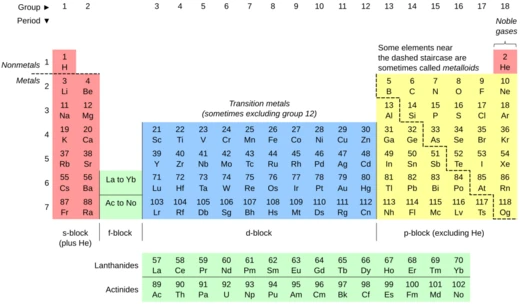
Tennessine is a synthetic chemical element, represented by the symbol Ts and carrying atomic number 117. It holds the second-highest atomic number and shares the highest atomic mass among all known elements, and it appears as the second-to-last element in the seventh period of the periodic table. The element takes its name from the U.S. state of Tennessee, where key research institutions involved in its discovery are based. The discovery of tennessine was first announced in April 2010 by a collaboration of Russian and American scientists working in Dubna, Russia, making it the most recently discovered element. A daughter isotope of the element was produced directly in 2011, which partially confirmed the initial experimental results. The same collaboration successfully repeated the experiment in 2012, and a joint German–American team did so again in May 2014. In December 2015, the Joint Working Party of the International Union of Pure and Applied Chemistry (IUPAC) and the International Union of Pure and Applied Physics (IUPAP) officially recognized the element and awarded priority for its discovery to the Russian–American team. In June 2016, IUPAC announced that the discoverers had proposed the name tennessine, which was formally adopted in November 2016. Tennessine may lie within the theoretical "island of stability," a concept that explains why certain superheavy elements are more stable than the general trend of decreasing stability for elements beyond bismuth. The synthesized atoms of tennessine have survived for tens to hundreds of milliseconds. On the periodic table, tennessine is expected to belong to group 17, the halogens, though some of its properties may differ significantly from lighter halogens due to relativistic effects. Consequently, tennessine is predicted to be a volatile metal that does not form anions or achieve high oxidation states. However, a few key properties—such as its melting point, boiling point, and first ionization energy—are still expected to follow the periodic trends observed in the halogens. History *Pre-discovery* In December 2004, the team at the Joint Institute for Nuclear Research (JINR) in Dubna, Russia, proposed a joint experiment with the Oak Ridge National Laboratory (ORNL) in Tennessee, United States, to synthesize element 117—so named for its 117 protons.
- Symbol
- Ts
- Atomic number
- 117
- Discovery year
- 2010
- Discovery location
- Dubna, Russia
- Named after
- Tennessee, U.S.
- Group
- 17 (halogens)
- Period
- 7
Lore & Background
The discovery of tennessine began with a proposal in December 2004 by the Joint Institute for Nuclear Research (JINR) in Dubna, Russia, to collaborate with Oak Ridge National Laboratory (ORNL) in Tennessee, U.S., to synthesize element 117. The plan involved fusing a berkelium target with a calcium-48 beam. However, ORNL had temporarily ceased berkelium production, and re-initiating it was too costly. The project was suspended until spring 2008, when ORNL resumed californium production, allowing berkelium to be extracted as a by-product. After a 250-day production run ending in December 2008, 22 milligrams of berkelium were obtained. The target was transported to Russia, where the experiment began in late July 2009. In January 2010, scientists detected decay chains indicating the formation of isotopes 294117 and 293117, with half-lives on the order of tens or hundreds of milliseconds. The official report was released on 9 April 2010 in Physical Review Letters.
Reader's Guide
Tennessine is significant as the most recently discovered element, officially recognized in December 2015 by the Joint Working Party of IUPAC and IUPAP. Its discovery confirmed the existence of element 117 and contributed to the exploration of the 'island of stability,' a concept explaining why some superheavy elements are more stable than expected. The element's name honors Tennessee, where key research institutions involved in its discovery are located. Tennessine is expected to be a member of the halogens (group 17), though relativistic effects may cause its properties to differ from lighter halogens; it is predicted to be a volatile metal that neither forms anions nor achieves high oxidation states. The synthesis required international collaboration between Russian and American institutions, including JINR, ORNL, Vanderbilt University, and others, and involved overcoming logistical challenges such as the short half-life of berkelium-249 (330 days) and customs delays.
Did You Know?
- Tennessine has the second-highest atomic number and the joint-highest atomic mass of all known elements.
- The berkelium target for the experiment had to be transported from the U.S. to Russia within six months due to its 330-day half-life.
- Russian customs officials twice refused entry of the berkelium target due to missing paperwork, causing it to cross the Atlantic Ocean five times.
- Clarice Phelps of ORNL is recognized by IUPAC as the first African-American woman involved in the discovery of a chemical element.
More in Periodic Table & Elements 1-21
Spotted an error? Know more?
Reader corrections go straight into our review queue. Suggest an edit · How this site is sourced