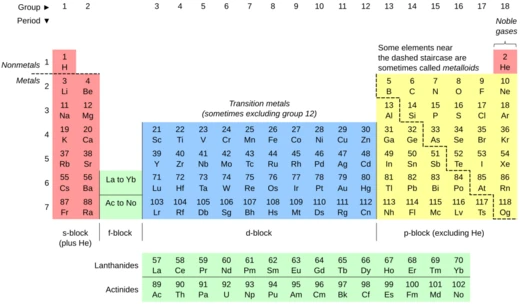
Group 4 element
Group 4 transition metals: hard, corrosion-resistant, with a protective oxide layer.

KKPCW · CC BY-SA 4.0
Group 4 is the second group of transition metals in the periodic table, comprising titanium, zirconium, hafnium, and rutherfordium, and is sometimes referred to as the titanium group after its lightest member. These elements are hard metals whose natural reactivity is effectively concealed by a dense, protective oxide layer that shields them from corrosion and resists attack by many acids and alkalis. The first three members occur naturally, while rutherfordium is a strongly radioactive element that does not exist in nature and must be created through artificial synthesis; none of the group 4 elements serve any biological role.
Historically, zircon was known as a gemstone in ancient times, but it was not recognized as containing a new element until 1789, when Martin Heinrich Klaproth analyzed the mineral jargoon and identified a new earth (oxide), though he could not isolate the element. Humphry Davy attempted electrolysis in 1808 without success, naming the element zirconium. Jöns Jakob Berzelius first produced impure zirconium in 1824 by heating potassium and potassium zirconium fluoride. Titanium was first identified by William Gregor in 1791 in ilmenite sand from Cornwall, who found iron oxide and an unidentified metal oxide; Franz Joseph Muller produced the same oxide that year, and Klaproth independently rediscovered it in 1795 in rutile, naming it after the Titans. Berzelius prepared impure titanium metal in 1825. Henry Moseley’s 1914 X-ray spectroscopy linked spectral lines to atomic number, revealing a missing element at number 72, which Georges Urbain had claimed to find in rare earths as celtium, but his claim was later rejected. In 1923, Dirk Coster and Georg von Hevesy, guided by Niels Bohr’s theories and Moseley’s work, discovered hafnium in zirconium ores and named it after Copenhagen. Hafnium was separated from zirconium by repeated recrystallization, and metallic hafnium was first prepared in 1924 by passing hafnium tetraiodide vapor over a heated tungsten filament. The delay in hafnium’s discovery stemmed from its rarity and extreme similarity to zirconium, meaning all earlier zirconium samples were unknowingly contaminated with hafnium. Rutherfordium was first reported in 1964 by a team at the Joint Institute for Nuclear Research, though later questioned; more conclusive evidence came from the University of California, Berkeley in 1969. A
- elements
- Titanium (Ti), Zirconium (Zr), Hafnium (Hf), Rutherfordium (Rf)
- group_number
- 4
- periods
- 4, 5, 6, 7
- common_oxidation_state
- +4
- natural_occurrence
- First three occur naturally; rutherfordium is synthetic
- key_property
- Form protective oxide layer; resistant to corrosion
Lore & Background
All four members of group 4 are hard metals. Their inherent chemical reactivity is completely hidden by a dense, protective oxide layer that forms on their surface, making them resistant to corrosion and to attack by many acids and alkalis. The first three elements occur naturally, while rutherfordium is strongly radioactive, does not occur in nature, and must be produced artificially. Its observed and predicted properties are consistent with it being a heavier version of hafnium. None of the group 4 elements have any biological role. As typical for early transition metals, zirconium and hafnium primarily exhibit a +4 oxidation state, are quite electropositive, and have a less varied coordination chemistry. Because of the lanthanide contraction, these two elements are extremely similar in their properties. Titanium is somewhat different due to its smaller size; it has a well-defined +3 state in addition to the more stable +4 state. The extreme similarity between zirconium and hafnium, combined with hafnium’s rarity, caused a long delay in hafnium’s discovery, as all earlier samples of zirconium had unknowingly been contaminated with hafnium. Hafnium was finally identified in 1923 by Dirk Coster and Georg von Hevesy, who were motivated by suggestions from Niels Bohr and others that element 72 should resemble zirconium, not the rare earth elements. The element was named after the Latin name for Copenhagen, Hafnia.
Reader's Guide
Group 4 elements are significant as early transition metals that exemplify the effects of the lanthanide contraction, particularly in the extreme similarity between zirconium and hafnium. Their chemistry is dominated by the +4 oxidation state, though titanium also has a well-defined +3 state. The protective oxide layer makes them valuable for corrosion-resistant applications, while their hardness and refractory nature suit high-temperature uses. The discovery history illustrates key developments in analytical chemistry, from Klaproth's identification of new earths to Moseley's X-ray spectroscopy that predicted hafnium's existence. The controversy over rutherfordium's discovery highlights the challenges of naming synthetic elements and the role of international bodies like IUPAC in resolving disputes. The group's study has advanced understanding of periodic trends, coordination chemistry, and nuclear synthesis.
Did You Know?
- The extreme similarity of zirconium and hafnium, due to the lanthanide contraction, meant that all earlier samples of zirconium were unknowingly contaminated with hafnium.
The Chemical Logic Behind Grouping
Groups in the periodic table are columns of elements that share similar physical and chemical characteristics. This resemblance stems from the fact that elements within the same group possess comparable outermost electron shell configurations, meaning they share the same core charge. Because the orbital location of the outermost electron largely dictates an element's chemical behavior, organizing elements by this shared trait creates a remarkably powerful framework. The periodic table contains 18 numbered groups, though the 14 f-block columns situated between groups 2 and 3 remain unnumbered, bringing the total to 32 columns. This structural arrangement allows chemists to predict how an element will behave simply by identifying its column, making the table an indispensable tool for understanding reactivity, bonding patterns, and periodic trends across the entire spectrum of known elements.
Resolving the A/B Confusion
Before 1988, chemists in different parts of the world relied on two incompatible group-naming schemes that used identical numbers and letters to mean entirely different things. The Chemical Abstract Service system, widely adopted in the United States, assigned the letter A to main-group elements and B to transition elements. The older IUPAC convention, more common in Europe, instead placed A on the left side of the table and B on the right. Both systems used numerals that roughly indicated the highest oxidation state of the elements in that group, and both proceeded in a linearly increasing fashion across the table, with some irregularities among transition metals. This cross-Atlantic mismatch created genuine confusion in international literature.
Names Beyond Numbers
While the modern system identifies groups by their numbers from one to eighteen, chemists also commonly use trivial names rooted in the topmost element of each column. Group 16, for instance, is widely known as the oxygen group or the chalcogens, while group 13 is called the triels (from the Greek word for three), group 14 the tetrels (from the Greek for four), and group 15 the pentels (from the Greek for five). A notable exception is the so-called iron group, which in general chemistry usually points to group 8, but in specialized contexts may refer to iron, cobalt, and nickel, or even a broader set of elements sharing similar chemical properties. In astrophysics and nuclear physics, the iron group typically encompasses iron, cobalt, nickel, chromium, and manganese. Additionally, certain element sets are called groups even though they do not form a single column, including noble metals, coinage metals, precious metals, and refractory metals.
The F-Block and Membership Debates
Although the 1-to-18 numbering is broadly accepted across the chemistry community, it is not without controversy. The placement of hydrogen and helium remains a point of dissent, as neither fits neatly into the electron-configuration logic that underpins the rest of the table. Similarly, the positioning of the inner transition metals has generated ongoing variation in textbooks, even though the correct arrangement has been established since 1948 and was formally endorsed by IUPAC twice—first in 1988 alongside the new numbering scheme, and again in 2021. The 14 f-block columns, which sit between groups 2 and 3, are deliberately left unnumbered in the modern system. This structural choice reflects the fact that these elements do not follow the same simple s, p, and d electron progression that defines the numbered groups, making them a special case in an otherwise orderly framework.
Gallery




Frequently Asked Questions
What is Group 4 element?
Group 4, often called the titanium group, is the second column of transition metals running through periods 4 to 7 of the periodic table. Its four members are titanium (Ti), zirconium (Zr), hafnium (Hf), and rutherfordium (Rf).
What are Group 4 element's key properties?
These are hard, inherently reactive metals that share a +4 oxidation state as their most common ionic form. Their standout trait is a dense, self-forming oxide layer that makes them remarkably resistant to corrosion and to attack by most acids and alkalis.
How many elements are in Group 4 and which are natural?
There are four: titanium, zirconium, and hafnium all occur naturally in Earth's crust, while rutherfordium is intensely radioactive and must be synthesized in a laboratory. No Group 4 element plays a known role in any biological system.
Why is Group 4 element so corrosion-resistant despite being reactive?
A thin but extremely stable oxide film coats the metal surface the moment it contacts air or moisture, effectively sealing the reactive metal underneath. This passive barrier is what allows titanium and zirconium to survive in harsh chemical environments without degrading.
What makes rutherfordium different from the rest of Group 4?
Unlike titanium, zirconium, and hafnium, rutherfordium does not exist in nature and is produced only through artificial nuclear synthesis. Its strong radioactivity means it decays quickly, so it has no practical industrial applications the way its three lighter relatives do.
More in Periodic Table & Elements 1-21
Spotted an error? Know more?
This is a living reference — every entry is fact-audited, and reader corrections feed straight into our audit queue. Suggest an edit · See this site's audit record