Extended periodic table
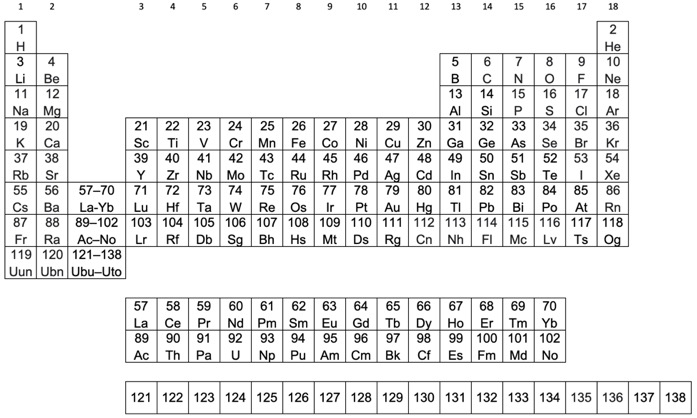
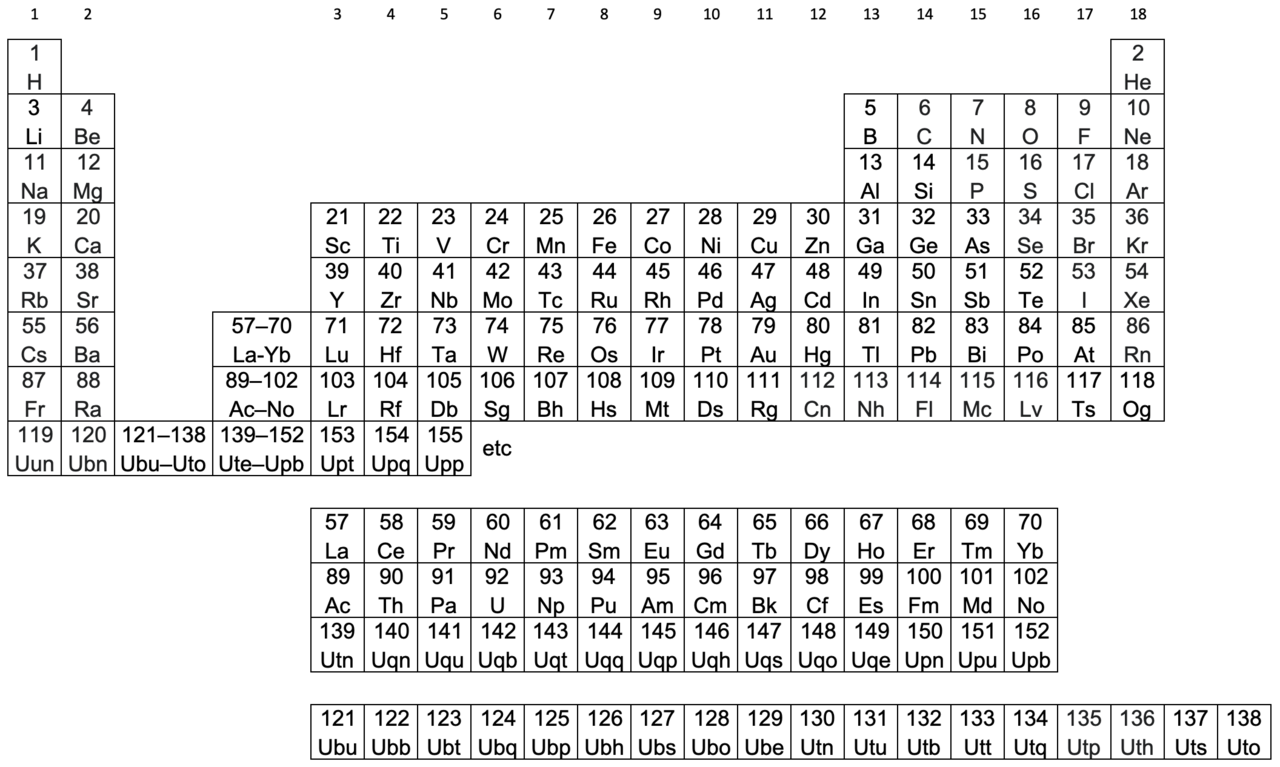
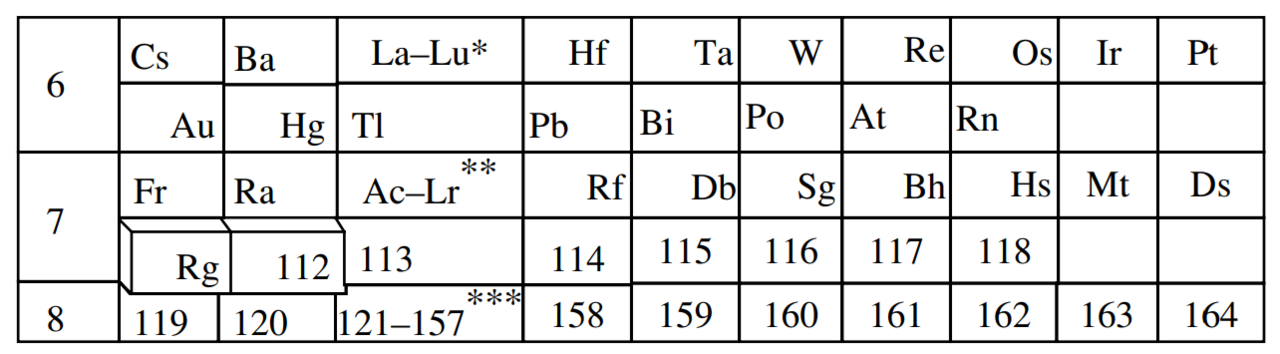
Hypothetical extension of the periodic table beyond element 118.

Pekka Pyykkö (original Pyykko table), WhiteTimberwolf (SVG Pyykko version) CxHy · CC BY-SA 3.0
The extended periodic table is a theoretical expansion of the standard periodic table to include chemical elements beyond the currently known and proven ones, with the highest confirmed atomic number being oganesson (Z = 118), which completes the seventh period. All elements in the eighth period and beyond remain hypothetical, and their placement is subject to ongoing debate due to uncertainties in predictions of chemical and physical properties, especially as relativistic effects become significant at high atomic numbers.
Any additional periods are expected to contain more elements than the seventh, as they are calculated to include a so-called g-block of at least 18 elements with partially filled g-orbitals per period. Glenn T. Seaborg suggested an eight-period table containing this block in 1969. The first element of the g-block may have atomic number 121, with the systematic name unbiunium, but despite many searches, no elements in this region have been synthesized or discovered in nature. Spin–orbit coupling effects reduce the validity of the orbital approximation for high atomic numbers, and models incorporating relativistic effects predict deviations from the pattern set by lighter elements. Computer modeling by Pekka Pyykkö and Burkhard Fricke for elements up to Z = 172 found several displaced from the Madelung rule, leading to no current consensus on placement beyond element 120.
Elements in this region are likely highly unstable, undergoing alpha decay or spontaneous fission with extremely short half-lives, though element 126 is hypothesized to be within an island of stability resistant to fission but not alpha decay. Another island around element 164 may be possible, but the extent of stabilizing effects from closed nuclear shells is uncertain. The International Union of Pure and Applied Chemistry defines an element as existing if its lifetime exceeds 10⁻¹⁴ seconds, the time needed for the nucleus to form an electron cloud. A simplistic interpretation of the Dirac equation suggests neutral atoms cannot exist beyond element 137, but a more rigorous analysis sets the limit at Z ≈ 168–172, where the 1s subshell dives into the Dirac sea, posing no obstacle to further extension of the periodic system. Atoms beyond this critical atomic number are called supercritical atoms.
- highest_known_element
- oganesson (Z = 118)
- governing_body
- International Union of Pure and Applied Chemistry (IUPAC)
Lore & Background
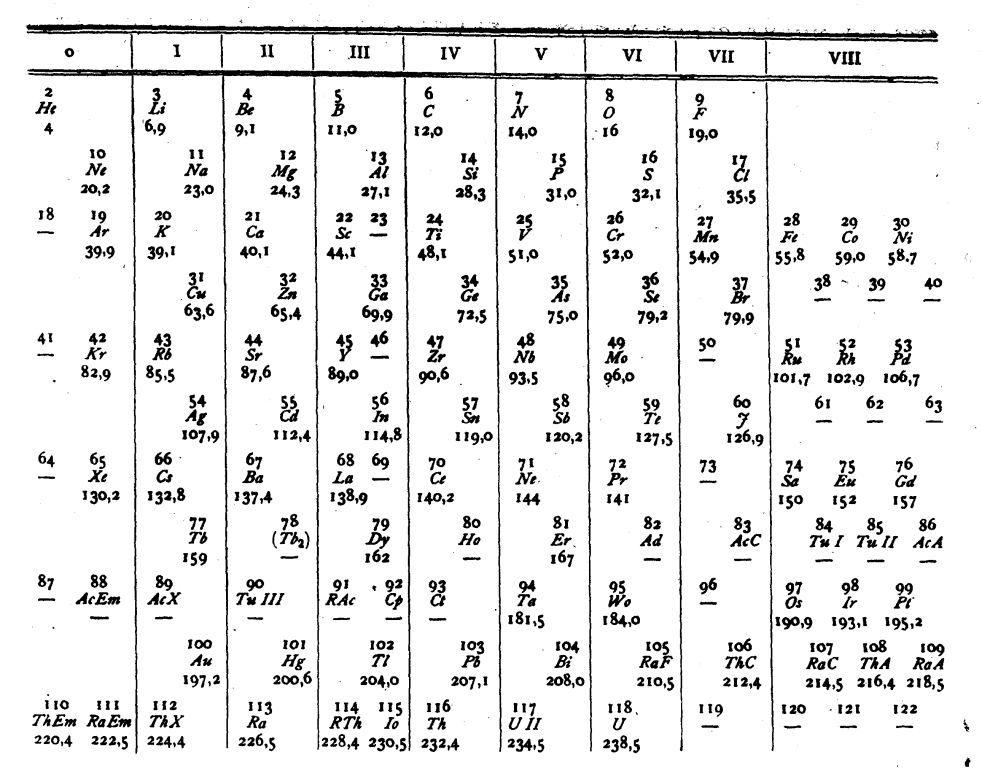
The extended periodic table is a theoretical arrangement of chemical elements beyond atomic number 118 (oganesson), which currently completes the seventh period. All elements in period eight and beyond are hypothetical, as none have been synthesized or observed in nature. These additional periods are predicted to contain more elements than the seventh period due to the inclusion of a g-block, comprising at least 18 elements with partially filled g-orbitals per period. Glenn T. Seaborg proposed an eight-period table featuring this block in 1969, with the first g-block element possibly at atomic number 121, systematically named unbiunium. However, spin–orbit coupling effects at high atomic numbers reduce the validity of the orbital approximation, and models incorporating relativistic effects—such as those by Pekka Pyykkö and Burkhard Fricke for elements up to Z = 172—predict deviations from the Madelung rule, leading to no consensus on placement beyond element 120. Elements in this region are expected to be highly unstable, decaying via alpha decay or spontaneous fission with extremely short half-lives, though an island of stability is hypothesized around element 126, resistant to fission but not alpha decay, and another around element 164. The International Union of Pure and Applied Chemistry (IUPAC) defines an element as existing if its nucleus lasts longer than 10⁻¹⁴ seconds, sufficient to form an electron cloud. A simplistic interpretation of the Dirac equation suggests neutral atoms cannot exist beyond Z ≈ 137, but a more rigorous analysis places the limit at Z ≈ 168–172, where the 1s subshell enters the Dirac sea, affecting bare nuclei rather than neutral atoms, thus not preventing further extension of the periodic system. Atoms beyond this critical number are termed supercritical atoms. Historically, predictions of elements beyond the actinides date to 1895, when Hans Peter Jørgen Julius Thomsen proposed a 32-element period ending at atomic weight 292. In 1913, Johannes Rydberg predicted noble gases at Z = 118, 168, 218, 290, 362, and 460. Niels Bohr in 1922 suggested elements beyond uranium were too unstable to be observed naturally. Richard Swinne in 1926 anticipated an island of stability, speculating longer-lived elements at Z = 98–102 and 108–110, possibly in Earth’s core or meteorites. By 1955, these were termed superheavy elements. The first pred
Reader's Guide
The extended periodic table theorizes about chemical elements beyond oganesson (atomic number 118), which completes the seventh period. All elements in the eighth period and beyond remain hypothetical. Any additional periods are expected to contain more elements than the seventh, including a so-called g-block of at least 18 elements with partially filled g-orbitals per period. Glenn T. Seaborg suggested an eight-period table containing this block in 1969. The first g-block element may have atomic number 121, named unbiunium, though no such elements have been synthesized or discovered. Quantum mechanical orbital approximations for these elements are complicated by spin–orbit coupling, which reduces the orbital approximation’s validity at high atomic numbers. Models incorporating relativistic effects predict deviations from Seaborg’s pattern; computer modeling by Pekka Pyykkö and Burkhard Fricke for elements up to Z = 172 found several displaced from the Madelung rule. There is no consensus on placement beyond element 120 due to uncertainty in predicted properties. These elements are likely highly unstable, undergoing alpha decay or spontaneous fission with extremely short half-lives, though element 126 is hypothesized to lie within an island of stability resistant to fission but not alpha decay. Another island around element 164 may exist, but stabilizing effects from closed nuclear shells are uncertain. The International Union of Pure and Applied Chemistry defines an element as existing if its lifetime exceeds 10⁻¹⁴ seconds. A simplistic interpretation of the Dirac equation suggests neutral atoms cannot exist beyond element 137, but a more rigorous analysis places the limit at Z ≈ 168–172, where the 1s subshell dives into the Dirac sea, posing no obstacle to further extension.
Spectroscopic Roots of Block Nomenclature
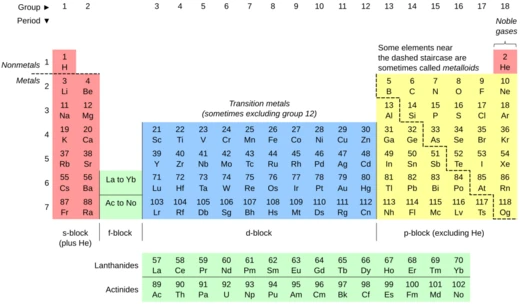
The block system of the periodic table traces its terminology back to the language of atomic spectroscopy. Each block takes its letter from the historical name assigned to a particular value of an electron's azimuthal quantum number. The s-block corresponds to "sharp" (quantum number 0), the p-block to "principal" (1), the d-block to "diffuse" (2), and the f-block to "fundamental" (3). Beyond these four, the naming simply continues in alphabetical order—g, h, and so on—though no elements occupying such hypothetical blocks have been discovered to date. The very concept of dividing the table into orbital-based blocks appears to have been introduced by Charles Janet, who is credited with the earliest use of the term. This nomenclature creates a direct bridge between the abstract mathematics of quantum mechanics and the practical layout of the periodic table, allowing chemists to predict where an element's valence electrons reside simply by identifying its block. The correspondence between orbital type and chemical behavior is not exact, but it provides a remarkably useful first approximation for understanding reactivity, bonding, and physical properties across the entire table.
The p-block: A Crucible of Chemical Diversity
The p-block, occupying groups 13 through 18 on the right side of the standard table, stands alone as the only block that contains all three fundamental categories of elements: metals, nonmetals, and metalloids. Its six columns arise directly from the capacity of a single p-orbital to hold up to six electrons, with each successive column adding one more p-electron to the valence shell. The groups carry their own traditional names—triels, tetrels, pnictogens, chalcogens, halogens, and the noble-gas group—reflecting centuries of accumulated chemical knowledge. Bonding within the p-block spans the full spectrum: highly ionic compounds like sodium chloride, covalent structures such as tungsten hexafluoride, and even metallic conductivity in certain metal oxides like ruthenium dioxide. The first row of the block is a stronghold of the octet rule, while elements in lower periods frequently exhibit hypervalence. Oxidation states tend to vary in steps of two, and reactivity generally diminishes as one moves down any given group. Helium, despite sitting in group 18, is excluded from the p-block because its electrons occupy the 1s orbital rather than a p-orbital.
The d-block and the Question of Transition Identity
The d-block stretches across groups 3 through 12 in the center of the table, beginning with the fourth period, where each subsequent row accommodates ten d-block elements. These metals occupy what is essentially a transitional zone in chemical behavior, sitting between the strongly electropositive s-block metals on one side and the more weakly electropositive p-block metals on the other. Because the energy gaps between individual d-orbitals are relatively small, the number of electrons an element can deploy in bonding is flexible, giving rise to the multiple oxidation states and colored compounds that define classic transition-metal chemistry. Yet the boundaries of "transition metal" are contested. Group 12 elements—zinc, cadmium, and mercury—are often treated as main-group elements because their chemistry more closely mirrors p-block behavior than that of their d-block neighbors. Similarly, group 3 elements are sometimes grouped with the main-group elements due to s-block-like similarities, even though they remain formally d-block members. This ambiguity underscores that orbital classification and chemical personality do not always align perfectly.
The s-block and the Curious Case of Helium
The s-block occupies the leftmost two columns of the conventional periodic table, plus a single element tucked into the rightmost column. Its members include hydrogen, helium, the alkali metals of group 1, and the alkaline earth metals of group 2, all sharing a general valence configuration of ns¹⁻². From the second period onward, the s-block metals tend to be soft, with relatively low melting and boiling points, and most impart distinctive colors to a flame. Chemically, every s-element except helium is highly reactive; the metals are strongly electropositive and readily form ionic compounds with electronegative nonmetals, particularly the halogens. Helium presents a persistent puzzle: its two electrons reside in the 1s orbital, making it an s-block element by strict orbital definition, yet its full-shell configuration gives it the chemical inertness of the p-block noble gases in group 18. As a result, helium is nearly always displayed above neon on the far right of the table, even though its orbital identity places it in an entirely different block. This single element thus embodies the tension between quantum-mechanical classification and observed chemical behavior.
Gallery

Frequently Asked Questions
What is the Extended periodic table?
The Extended periodic table is a theoretical framework that projects chemical elements beyond oganesson (Z = 118), where the currently confirmed table ends. Every element from the eighth period onward is hypothetical, and their exact placement is still debated because relativistic effects make predictions increasingly uncertain at high atomic numbers.
Who governs naming and classification in the Extended periodic table?
The International Union of Pure and Applied Chemistry (IUPAC) is the body responsible for officially naming and classifying elements, though it has not yet ratified any element beyond 118. Until IUPAC confirms a discovery, all extended-period elements remain unofficial and speculative.
More in Periodic Table & Elements 1-21
Spotted an error? Know more?
This is a living reference — every entry is fact-audited, and reader corrections feed straight into our audit queue. Suggest an edit · See this site's audit record