Technetium
First predominantly artificial element, used in nuclear medicine.

Marco Cardin · via Wikipedia: Technetium · CC BY-SA 4.0
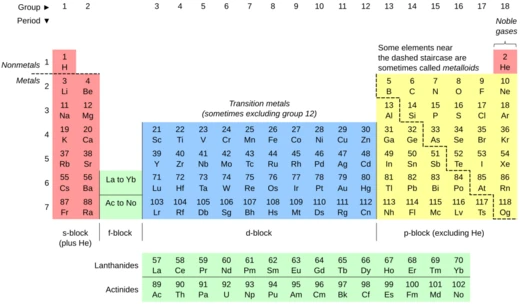
Technetium (symbol Tc, atomic number 43) is the lightest element that has no stable isotopes—all of its forms are radioactive. Along with promethium, it is one of only two radioactive elements that have stable neighbors on both sides in the periodic table. While technetium is primarily produced artificially, trace amounts do occur naturally: it appears as a spontaneous fission product in uranium and thorium ores (thorium ore being the most common natural source) and can also result from neutron capture in molybdenum ores. This silvery gray, crystalline transition metal sits in group 7 of the periodic table, between manganese and rhenium, and its chemical behavior falls between those two elements. The most abundant naturally occurring isotope is 99Tc, but it exists only in minuscule traces. Many of technetium’s properties were anticipated by Dmitri Mendeleev before its actual discovery. Noticing a gap in his periodic table, Mendeleev predicted the missing element and gave it the provisional name ekamanganese (Em). In 1937, technetium became the first element to be produced predominantly by artificial means, which inspired its name—from the Greek *technetos*, meaning “artificial,” plus the suffix *-ium*. A short-lived gamma-ray–emitting nuclear isomer, technetium-99m, is widely used in nuclear medicine for diagnostic tests, including bone cancer detection. The ground state of technetium-99 serves as a source of beta particles without gamma rays. Commercially, long-lived technetium isotopes are byproducts of uranium-235 fission in nuclear reactors and are extracted from spent fuel rods. Although the longest-lived technetium isotope has a half-life of only 4.21 million years, its detection in red giants in 1952 provided key evidence that stars can produce heavier elements. Between the 1860s and 1871, early versions of the periodic table created by Dmitri Mendeleev included a gap between molybdenum (element 42) and ruthenium (element 44). In 1871, Mendeleev predicted that this missing element would sit directly below manganese and share similar chemical properties. He gave it the provisional name eka-manganese—*eka* being the Sanskrit word for “one”—because it was one place down from the known element manganese.
- Symbol
- Tc
- Atomic number
- 43
- Group
- 7
- Most common natural isotope
- 99Tc
- Crystal structure
- hexagonal close-packed
- Superconducting temperature
- below 7.46 K
Lore & Background
Many of technetium's properties were predicted by Dmitri Mendeleev before its discovery; he noted a gap in his periodic table and gave the undiscovered element the provisional name ekamanganese (Em). In 1937, technetium became the first predominantly artificial element to be produced, hence its name from the Greek technetos, meaning 'artificial'. The discovery was confirmed by Carlo Perrier and Emilio Segrè at the University of Palermo in Sicily, using a molybdenum foil that had been part of a cyclotron deflector. Earlier claims of discovery by German chemists Walter Noddack, Otto Berg, and Ida Tacke in 1925, who named element 43 masurium, were later dismissed as irreproducible; Paul Kuroda's study showed the amount of technetium in the ores they studied could not have exceeded 3 × 10⁻¹¹ μg/kg, undetectable by their methods.
Reader's Guide
Technetium's significance lies in its role as the first artificially produced element, confirming Mendeleev's periodic table predictions and opening the door to synthetic element production. Its short-lived gamma-ray–emitting nuclear isomer, technetium-99m, is used in nuclear medicine for a wide variety of tests, such as bone cancer diagnoses, while the ground state technetium-99 serves as a gamma-ray–free source of beta particles. Long-lived technetium isotopes are byproducts of uranium-235 fission in nuclear reactors. The 1952 detection of technetium in red giants by astronomer Paul W. Merrill provided evidence that stars can produce heavier elements through nucleosynthesis, bolstering the hypothesis of stellar element formation. Technetium's chemical properties, intermediate between manganese and rhenium, include nine oxidation states and catalytic activity that affected nuclear fuel processing.
Did You Know?
- Technetium is the lightest element whose isotopes are all radioactive.
- The 1952 detection of technetium in red giants helped prove that stars can produce heavier elements.
- Technetium-99m is used in some ten million medical diagnostic procedures annually.
- Technetium dissolves in aqua regia, nitric acid, and concentrated sulfuric acid, but not in hydrochloric acid.
More in Periodic Table & Elements 1-21
Spotted an error? Know more?
Reader corrections go straight into our review queue. Suggest an edit · How this site is sourced