Seaborgium
Synthetic element named after Glenn T. Seaborg.
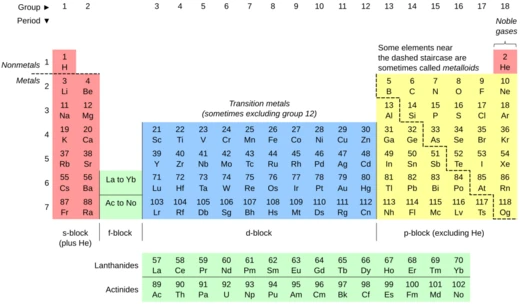
Seaborgium is a synthetic chemical element, represented by the symbol Sg and carrying the atomic number 106. Its name honors American nuclear chemist Glenn T. Seaborg. Because it is synthetic, seaborgium does not occur naturally and must be produced in a laboratory; it is also radioactive, and its most stable known isotopes have half-lives of only a few minutes. On the periodic table, seaborgium sits in the d-block as a transactinide element. It falls in period 7 and belongs to group 6, making it the fourth member of the 6d series of transition metals. Only a handful of its chemical reactions have been studied, since researchers can produce just a few atoms at a time, and those atoms decay rapidly. A small number of inorganic compounds and one carbonyl, thought to be Sg(CO)6, have been synthesized. These experiments confirm that seaborgium behaves as a heavier version of tungsten within group 6. In 1974, a few atoms of seaborgium were created in laboratories in both the Soviet Union and the United States. The priority of the discovery—and thus the naming rights—was disputed between Soviet and American scientists. It was not until 1997 that the International Union of Pure and Applied Chemistry (IUPAC) settled on seaborgium as the official name. This element is one of only two named after a person who was still alive at the time of naming; the other is oganesson, element 118. After claims of observing elements 104 and 105 in 1970 by Albert Ghiorso and colleagues at the Lawrence Livermore National Laboratory, the team searched for element 106 using oxygen-18 projectiles and a californium-249 target. They reported several alpha decays at 9.1 MeV, now thought to have come from element 106, though this was not confirmed at the time. In 1972, upgrades to the HILAC accelerator prevented the team from repeating the experiment, and data analysis was not carried out during the shutdown. When the reaction was tried again in 1974, the Berkeley team realized their new data matched their 1971 data, surprising Ghiorso. Thus, element 106 could have been discovered in 1971 if the original data had been analyzed more carefully. Two groups claimed discovery. Evidence of element 106 was first reported in 1974 by a Russian team in Dubna led by Yuri Oganessian.
- Symbol
- Sg
- Atomic number
- 106
- Element category
- synthetic, radioactive, transactinide
- Named after
- Glenn T. Seaborg
- Discovery year
- 1974
- Group
- 6
- Period
- 7
Lore & Background
The priority of the discovery and naming was disputed between Soviet and American scientists. The IUPAC/IUPAP Transfermium Working Group concluded in 1993 that the American synthesis was convincing due to its firm anchoring to known daughter nuclei, recognizing the Berkeley team as official discoverers. The Berkeley team then proposed the name seaborgium, which was announced in March 1994. IUPAC initially rejected the name because an element could not be named after a living person, but after public protest and a series of compromises, IUPAC finally adopted seaborgium as the official name in 1997. It is one of only two elements named after a living person at the time of naming, the other being oganesson.
Reader's Guide
Seaborgium is significant as a synthetic transactinide element that confirmed the extension of the periodic table into the 7th period and group 6. Its chemical behavior, studied through only a few atoms at a time, has been shown to be the heavier homologue to tungsten, confirming periodic trends. The element's discovery and naming process highlighted the international competition and cooperation in heavy-element research, as well as the role of IUPAC in resolving naming disputes. The controversy over naming an element after a living person led to a change in IUPAC policy, and seaborgium remains a symbol of the contributions of Glenn T. Seaborg to nuclear chemistry. Its synthesis required advanced accelerator technology and target preparation, and the experiments confirmed theoretical predictions about cross-sections and decay chains.
Did You Know?
- The most stable known isotopes of seaborgium have half-lives on the order of several minutes.
- The American synthesis of seaborgium-263m was confirmed by matching its alpha decay chain to previously known daughter nuclei rutherfordium-259 and nobelium-255.
- The name seaborgium was initially rejected by IUPAC because Glenn T. Seaborg was still alive, but was later adopted in 1997.
More in Periodic Table & Elements 1-21
Spotted an error? Know more?
Reader corrections go straight into our review queue. Suggest an edit · How this site is sourced