Roentgenium
Synthetic element named after the discoverer of X-rays.
Roentgenium is a synthetic, highly radioactive element with the symbol Rg and atomic number 111. It was first produced in December 1994 at the GSI Helmholtz Centre for Heavy Ion Research near Darmstadt, Germany, by a team led by Sigurd Hofmann. The element is named for Wilhelm Röntgen, the physicist who discovered X-rays. Only a handful of roentgenium atoms have ever been made, and it has no practical uses.
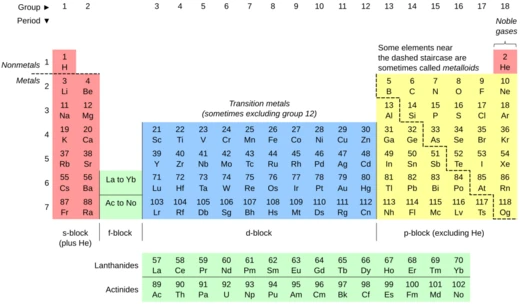
In the periodic table, roentgenium sits in the d-block as a transactinide element, belonging to period 7 and group 11. Although no chemical experiments have confirmed this, it is calculated to behave similarly to its lighter group 11 relatives—copper, silver, and gold—though some differences are expected. Roentgenium is predicted to be a noble metal, with a standard electrode potential for the Rg³⁺/Rg couple of 1.9 V, higher than gold’s 1.5 V. Its first ionization energy (1020 kJ/mol) is close to that of radon (1037 kJ/mol), while its second ionization energy (2070 kJ/mol) is nearly identical to silver’s. The most stable oxidation state is predicted to be +3, with +5 also stable and +1 less so.
No natural or stable isotopes of roentgenium exist. Nine radioactive isotopes have been synthesized in the lab, with atomic masses 272, 274, 278–283, and 286 (283 and 286 are unconfirmed). Two isotopes, 272Rg and 274Rg, have known but unconfirmed metastable states. All decay via alpha decay or spontaneous fission; 280Rg may also undergo electron capture. Heavier isotopes tend to be more stable. The most stable known isotope, 282Rg, has a half-life of 100 seconds, while the unconfirmed 286Rg may last about 10.7 minutes, making it one of the longest-lived superheavy nuclides. The unconfirmed 283Rg also appears to have a long half-life of roughly 5.1 minutes. Isotopes 280Rg and 281Rg have half-lives over a second; the rest decay within milliseconds. The missing isotopes between 274Rg and 278Rg are too light for hot fusion and too heavy for cold fusion, but could potentially be produced as daughters of nihonium or moscovium isotopes from hot fusion.
- Symbol
- Rg
- Atomic number
- 111
- Discovery year
- 1994
- Discovery location
- GSI Helmholtz Centre for Heavy Ion Research, Darmstadt, Germany
- Most stable isotope
- roentgenium-282 (half-life 130 seconds)
- Element category
- d-block transactinide, group 11
- Named after
- Wilhelm Röntgen
Lore & Background
Roentgenium was first synthesized on December 8, 1994, by an international team led by Sigurd Hofmann at the GSI in Darmstadt, Germany. The team bombarded a target of bismuth-209 with accelerated nuclei of nickel-64 and detected three nuclei of the isotope 272111. This reaction had previously been attempted at the Joint Institute for Nuclear Research in Dubna in 1986, but no atoms were observed. The IUPAC/IUPAP Joint Working Party initially found insufficient evidence for discovery in 2001, but after the GSI team repeated the experiment in 2002 and detected three more atoms, the JWP acknowledged the GSI team for the discovery in their 2003 report.
Reader's Guide
Roentgenium is significant as one of the heaviest synthetic elements, with its most stable known isotope, roentgenium-282, having a half-life of 130 seconds. An unconfirmed isotope, roentgenium-286, may have a half-life of about 10.7 minutes, potentially making it one of the longest-lived superheavy nuclides. In the periodic table, it is a d-block transactinide element in group 11, though no chemical experiments have confirmed it behaves as a heavier homologue to gold. Calculations predict it has similar properties to copper, silver, and gold, but may show differences. Its production is extremely limited and expensive, and no properties of roentgenium metal have been measured. The element's name, roentgenium, was suggested by the GSI team in 2004 and accepted by IUPAC on November 1, 2004, honoring Wilhelm Röntgen.
Did You Know?
- Roentgenium was first created in December 1994 by the GSI Helmholtz Centre for Heavy Ion Research near Darmstadt, Germany.
- The most stable known isotope, roentgenium-282, has a half-life of 130 seconds.
- Roentgenium is named after physicist Wilhelm Röntgen, who discovered X-rays.
- Only a few roentgenium atoms have ever been synthesized, and they have no practical application.
More in Periodic Table & Elements 1-21
Spotted an error? Know more?
Reader corrections go straight into our review queue. Suggest an edit · How this site is sourced