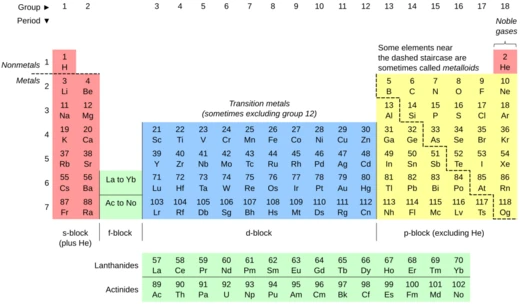
Group 7 element
Group 7 transition metals with +7 oxidation state trends.

Group 7 of the periodic table, as defined by IUPAC, includes the elements manganese, technetium, rhenium, and bohrium. These elements are all located in the d-block, classifying them as transition metals, and the group is occasionally referred to as the manganese family due to its lightest member. Unlike some other groups, it lacks a widely recognized trivial name. The elements exhibit a general tendency toward a +7 oxidation state, though this pattern is less consistent than in earlier groups. Their electron configurations, particularly in the outermost shells, influence their chemical behavior and show periodic trends. In terms of natural abundance, manganese is relatively common, while rhenium is scarce; technetium is found only in trace amounts, and bohrium does not occur naturally, being produced synthetically.
Physically, the group 7 elements generally crystallize in a hexagonal close-packed structure, with manganese being the exception as it adopts a body-centered cubic arrangement. Bohrium is predicted to share the hcp structure. Chemically, all members readily display the +7 oxidation state, which becomes more stable as the group is descended. Technetium also exhibits a stable +4 state, and rhenium shows stable +4 and +3 states; bohrium may similarly manifest lower oxidation states. The +7 state is often expressed in oxyanions like permanganate, pertechnetate, and perrhenate, with a corresponding perbohrate ion possible, though bohrium(VII) is likely unstable in water and prone to reduction to bohrium(IV). Manganese forms several oxides, including MnO, Mn3O4, Mn2O3, MnO2, and Mn2O7, with MnO2 being a key ore and battery component. Technetium’s main oxides are TcO2 and Tc2O7, the latter a rare molecular binary metal oxide. Rhenium oxides include ReO2, Re2O7, and a trioxide, with Re2O7 serving as the precursor for most rhenium compounds.
- elements
- Manganese, Technetium, Rhenium, Bohrium
- group_number
- 7 (IUPAC)
- block
- d-block (transition metals)
- common_oxidation_state
- +7
- crystal_structure
- Most crystallize in hexagonal close packed (hcp); manganese crystallizes in body centered cubic (bcc); bohrium expected to be hcp
Lore & Background
The group 7 elements tend to have a major group oxidation state (+7), though this trend is less coherent than in previous groups. Their electron configurations show patterns in outermost shells, leading to trends in chemical behavior. All members readily portray the +7 state, which becomes more stable as the group is descended. Technetium also shows a stable +4 state, while rhenium exhibits stable +4 and +3 states; bohrium may show these lower states as well. The higher +7 oxidation state is more likely to exist in oxyanions such as perbohrate (BhO4−), analogous to permanganate, pertechnetate, and perrhenate, though bohrium(VII) is likely unstable in aqueous solution and would probably be easily reduced to bohrium(IV).
Reader's Guide
Group 7 elements are significant as transition metals with a characteristic +7 oxidation state, though the trend is less coherent than in earlier groups. Manganese is a fairly common element with diverse oxides, including MnO2 used in dry-cell batteries, and Mn2O7, a dark green crystalline solid. Technetium, occurring only in trace quantities, forms oxides such as TcO2 and Tc2O7, the latter a rare molecular binary metal oxide. Rhenium, rare in nature, forms ReO2 and Re2O7, the latter being the raw material for all rhenium compounds; it also forms a stable trioxide, ReO3, the only stable trioxide of group 7. Bohrium is entirely synthetic and its properties are either unknown or predicted. The group's halides show varied structures, from molecular octahedral complexes to metal clusters. The physical properties reflect the addition of a filled f-shell into the core from the fifth to the sixth period. Overall, group 7 illustrates the periodic trends and chemical diversity among d-block elements, with applications ranging from battery technology to catalysis.
Did You Know?
- All group 7 elements crystallize in the hexagonal close packed structure except manganese, which crystallizes in body centered cubic.
- Technetium(VII) oxide is a rare example of a molecular binary metal oxide, along with ruthenium(VIII) oxide and osmium(VIII) oxide.
- Rhenium trioxide is the only stable trioxide of the group 7 elements and resembles copper in appearance.
- Bohrium(VII) is likely unstable in aqueous solution and would probably be easily reduced to bohrium(IV).
Frequently Asked Questions
What is Group 7 on the periodic table?
Group 7 is a vertical column of transition metals in the d-block, identified under IUPAC nomenclature. It sits between the chromium family (Group 6) and the iron family (Group 8) and is sometimes informally called the manganese group after its lightest member.
Which elements belong to Group 7?
The four members are manganese (Mn), technetium (Tc), rhenium (Re), and bohrium (Bh). Manganese is the most abundant in nature, while bohrium exists only in laboratory settings.
What is the characteristic oxidation state of Group 7 elements?
The group is well known for its +7 oxidation state, which is the highest common oxidation state these metals can reach. This trend is a defining feature that ties the four elements together chemically.
What crystal structure do Group 7 elements adopt?
Most Group 7 metals crystallize in a hexagonal close-packed (hcp) arrangement. Manganese is the notable exception, forming a body-centered cubic (bcc) lattice instead.
Why doesn't Group 7 have a trivial name like some other groups?
Because it falls under the broader umbrella of transition metals, no widely adopted trivial name has stuck for the group. Fans and textbooks simply refer to it as 'Group 7' or occasionally the 'manganese group.'
More in Periodic Table & Elements 1-21
Spotted an error? Know more?
This is a living reference — every entry is fact-audited, and reader corrections feed straight into our audit queue. Suggest an edit · See this site's audit record