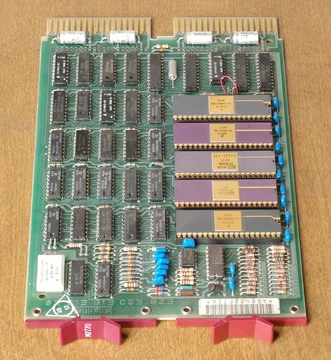
B5000 instruction set
Stack-based instruction set for early Burroughs mainframes.

The B5000 instruction set is the machine-level language of the Burroughs B5000 computer and its compatible models B5500 and B5700. It is notable for being designed around a stack architecture and for supporting segmented virtual memory, features that were uncommon at the time of its introduction in the early 1960s.
- Introduced
- early 1960s
- Models using this instruction set
- B5000, B5500, B5700
- Syllable size
- 12 bits
- Syllables per word
- 4
- Word size
- 48 bits
- Program reference table size
- 1024 words
- Modes
- Word Mode, Character Mode
Lore & Background
The B5000 instruction set consists of 12-bit syllables, with four syllables packed into each 48-bit word. The architecture operates in two modes: Word Mode and Character Mode, each with its own separate repertoire of syllables. A processor can be in either Control State or Normal State, and certain syllables are only permissible in Control State. The architecture does not provide for addressing registers or storage directly; all references are made through the 1024-word Program Reference Table (PRT), the current code segment, marked locations within the stack, or the A and B registers that hold the top two locations on the stack. Burroughs numbers bits in a syllable from 0 (high bit) to 11 (low bit) and in a word from 0 (high bit) to 47 (low bit).
In Word Mode, there are four types of syllables. The interpretation of the 10-bit relative address in Operand Call and Descriptor Call depends on the setting of several processor flags. For main programs (with SALF off), it is always an offset into the Program Reference Table (PRT). The instruction set was applied to the B5000, B5500, and B5700 models, but was not compatible with the later B6500, B7500, or B8500 series, which introduced a different architecture.
Reader's Guide
The B5000 instruction set is significant as one of the earliest implementations of a stack machine architecture, using stacks instead of general-purpose registers. This design was intended to support high-level programming languages through architectural features that were uncommon at the time. The instruction set also implemented segmented virtual memory, dividing memory into logical segments such as code and data, which allowed for better isolation and more flexible allocation. The use of 12-bit syllables and the Program Reference Table for all memory references reflects a design philosophy that prioritized indirect addressing and stack-based operations over direct register access. The instruction set's incompatibility with later B6500, B7500, and B8500 series indicates a clear architectural break in Burroughs' product line. Its legacy lies in demonstrating an alternative approach to computer architecture that prioritized language support and memory segmentation over the register-heavy designs that became more common.
Did You Know?
- The B5000 instruction set uses 12-bit syllables, with four syllables per 48-bit word.
- All memory references go through the 1024-word Program Reference Table (PRT), not directly to registers or storage.
- The instruction set was used on the B5000, B5500, and B5700, but not on the later B6500, B7500, or B8500 series.
A Hardware Architecture Built for Software
The B5000 represented a radical departure from the prevailing approach to computer design in the early 1960s. Rather than creating a processor first and then expecting software engineers to adapt, the team led by Robert (Bob) Barton designed the instruction set and hardware architecture with the specific needs of high-level programming languages as the starting point. The result was a stack machine where every operation drew its operands from a stack rather than from explicit registers, and where even interrupts and procedure calls were routed through that same stack. The architecture employed a partially data-driven, tagged, and descriptor-based design with very few programmer-accessible registers. There was no assembly language and no assembler; instead, all system software was written in ESPOL, an extended dialect of ALGOL 60 that included statements corresponding to each hardware syllable. Computing historian John Mashey later called it one of the most innovative examples of combined hardware and software design he had ever encountered, noting it was far ahead of its time.
The B5000 Family and Its Long Shadow
The B5000, introduced in 1961, was the opening entry in a family that would shape Burroughs' large-system offerings for decades. Its immediate successor, the B5500, swapped drum storage for disk drives, while the B5700 extended the concept to allow up to four systems to operate as a cluster around shared disk. Although the B5700 itself had no direct successor, the architectural ideas it embodied flowed heavily into the B6500 and B6700 lines, and Burroughs ported the Master Control Program to that platform. A separate, larger B8500 line was also attempted but achieved no commercial success. The B5000's DNA persisted far beyond Burroughs: the B6500/B6700 lineage eventually became the Unisys ClearPath Libra servers, which ran an evolved but compatible version of MCP. Unisys initially paired a proprietary CMOS processor with that software stack, later adding Intel Xeon chips and supporting Windows and Linux alongside MCP. By 2018, the custom silicon had been entirely phased out, leaving the Libra servers as commodity Intel machines—yet the architectural philosophy traceable to the B5000 endured in the software layer.
A Latecomer's Gambit in the Mainframe Market
By the late 1950s, Burroughs—founded in the 1880s and the oldest continuously operating company in computing—was still limited to electromechanical accounting machines like the Sensimatic. Its traditional rivals IBM and NCR had already moved into larger-scale computers, and the newly founded Univac was gaining ground. In 1956, Burroughs purchased ElectroData Corporation and rebranded its design as the B205, but that was still not a true internal design. The B5000, designed beginning in 1961, was Burroughs' first internally developed machine and a deliberate strategy to leapfrog its late market entry by adopting the most advanced computing ideas available. In the 1970s, the corporation organized into three divisions with fundamentally different instruction-set philosophies: the Large Systems (B5000, B6500, B8500 lines), the COBOL-optimized Medium Systems (B2000, B3000, B4000), and the flexible-architecture Small Systems (B1000). Each division grew from a distinct concept for optimizing an instruction set around particular programming languages, making Burroughs unique among mainframe vendors of the era.
ALGOL 60 as a Systems Language
At a time when FORTRAN and COBOL were the dominant high-level languages—and were considered by some to be weak for modern software techniques—the B5000 team made the bold choice to build its architecture around ALGOL 60, a newer and largely untried language. The specific dialect adopted was Elliott ALGOL, originally designed and implemented by C. A. R. Hoare on an Elliott 503, which extended ALGOL with practical I/O instructions and powerful string-processing capabilities that the original language had ignored. Hoare's famous Turing Award lecture addressed this very subject. Donald Knuth, who had implemented ALGOL 58 on an earlier Burroughs machine during a summer break, served as a peripheral consultant on the B5000 design. Many in the industry dismissed ALGOL, mistakenly believing high-level languages could not match assembler in power, and thus failed to recognize ALGOL's potential as a systems programming language. The B5000's single-pass compilers, its automatic reentrancy of all code, and its support for MCP demonstrated that a high-level language could serve as the sole interface between programmer and machine.
Frequently Asked Questions
What is the B5000 instruction set?
It is the machine-level language that powered the Burroughs B5000 mainframe and its successors, the B5500 and B5700. Introduced in the early 1960s, it organized computation around a stack-based architecture rather than the register-centric approach most other machines of that era used.
What made the B5000 instruction set stand out from other 1960s ISAs?
Two features were genuinely ahead of their time: a stack-based execution model and native support for segmented virtual memory. Most competing designs of the early 1960s relied on explicit registers and had no built-in memory segmentation.
How big are the words and syllables in the B5000 instruction set?
Each word is 48 bits wide, built from four 12-bit syllables. The program reference table that managed memory segments held 1,024 words.
Which computers actually ran the B5000 instruction set?
The original B5000, along with the later B5500 and B5700 models, all executed the same B5000-compatible instruction set. This meant software written for the B5000 could carry forward to the newer machines without rewriting.
Why do hardware enthusiasts still talk about the B5000 instruction set today?
It is often cited as a landmark in computer architecture because it proved that a stack machine could be practical and commercially viable in a production mainframe. Its combination of stack execution and segmented virtual memory anticipated design ideas that many other architectures only adopted years later.
More in PC Hardware 1-24
Spotted an error? Know more?
Reader corrections go straight into our review queue. Suggest an edit · How this site is sourced