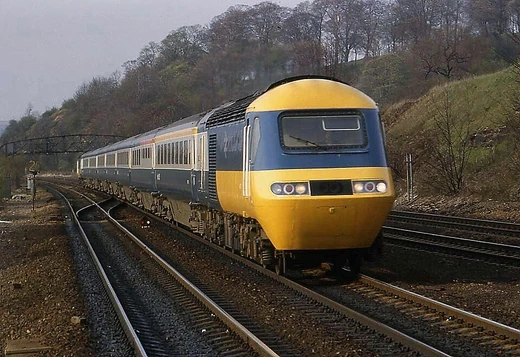
British Rail Class 221
Tilting diesel-electric multiple unit for express passenger services.
Last updated
The British Rail Class 221 Super Voyager is a tilting diesel-electric multiple unit express passenger train built by Bombardier Transportation in 2001–02. It achieves a maximum speed of 125 mph and is similar to the Class 220 Voyager but features a tilting mechanism for higher speeds on curves. The fleet is operated by CrossCountry and Grand Central, with additional sets in storage.
Details
Each coach of a Class 221 unit is powered by a Cummins QSK19 diesel engine producing 560 kW at 1,800 rpm, which drives a generator that supplies two motors per coach. The motors each drive one inner axle per bogie via a cardan shaft and final drive. The trains can travel 1200 mi between refuellings. The coach bodies and engines are shared with the Class 220, but the Class 221 uses Y36 bogies with a traditional outside-framed design, unlike the inside-framed B5000 bogies of the Class 220.
A hydraulic-actuated tilting system was originally fitted, though it has been disabled on CrossCountry sets. Each coach weighs between 55 and 57 tonnes; a five-car set totals 281.9 tonnes and a four-car set 227 tonnes.
Braking is air-operated and rheostatic, with an emergency stopping distance of 350 m at 60 mph. Automatic sanding systems are fitted, with different types used by Avanti West Coast and CrossCountry units. All units are maintained at Central Rivers TMD near Burton-on-Trent.
Formation and passenger facilities
Virgin CrossCountry originally ordered 40 five-carriage sets and 4 four-carriage sets, all entering service with that operator. In November 2010, Virgin Trains reformed three four-car sets into two five-car sets and a spare two-car set by inserting intermediate cars from 221144 into 221142 and 221143, resulting in 20 five-car sets. A further reformation in 2017 involved vehicle exchanges between Virgin and CrossCountry, reducing two CrossCountry sets to four-car formations.
All vehicles are air-conditioned and fitted with Wi-Fi; at-seat audio entertainment systems have been disabled since Wi-Fi was introduced. Power sockets are available for laptops and mobile phones. First-class seating is 2+1, standard class 2+2. Former Virgin Trains units have CCTV.
Exterior electronic information display boards show the train number, time, coach, destination, and next station. The trains have been criticised for insufficient luggage and bicycle space, and the tapered interior profile due to the tilting design reduces interior spaciousness compared to conventional carriages.
Operations
All Class 221 units are owned by Beacon Rail, having been purchased from Voyager Rail Leasing. They were introduced in 2002 by Virgin Trains, which used them on CrossCountry, West Coast Main Line, and North Wales Coast line services. On 11 November 2007, the fleet was split: Virgin West Coast received 221101–221118 and 221142–221144, while CrossCountry gained 221119–221141. Five units (221114–221118) were subleased to CrossCountry for 12 months during High Speed Train overhauls.
Avanti West Coast used the units primarily between London Euston, Chester, Wrexham, and North Wales, with some West Midlands services. North Wales services sometimes operated as double units. In December 2019, Avanti West Coast ordered 10 seven-car Class 807 electric units and 13 Class 805 bi-mode units to replace its Class 221 fleet, planned for 2023 entry. In June 2022, 221142 and 221143 were returned to owners after their Avanti leases ended.
Seven Class 221s were transferred to CrossCountry in 2024, and Avanti West Coast withdrew its final pair on 14 December 2024. CrossCountry's units operate alongside Class 220s on routes not cleared for tilting (except Wolverhampton to Stockport); the tilting equipment was locked out in 2008 and later isolated with fixed tie-bars. In June 2023, Grand Central announced it would lease 221142 and 221143 for London Kings Cross to Bradford Interchange services, entering service that year.
Accidents and incidents
On 8 December 2005, unit 221125 suffered an exhaust fire; similar fires occurred in other Voyager class units in 2005–2006 due to an incorrectly performed engine overhaul. On 25 September 2006, unit 221136 collided with a car on the track at Moor Lane, Copmanthorpe, North Yorkshire; the train derailed at 100 mph but remained upright, with no injuries. On 4 July 2009, unit 221112 struck open container doors of a freight train on the Eden Valley Loop, causing bodywork scratching and severe damage to a door step.
On 20 November 2013, unit 221105 overran a platform and hit buffers; one passenger was taken to hospital. The RAIB report attributed this to low adhesion and inadequate sanding, recommending an upgrade. In June 2014, a vehicle in CrossCountry unit 220007 caught fire at Eastleigh Works.
More in Passenger Trains Running at Least at 200 Km/h in Commercial Operations
Sources
Compiled from Wikipedia and the sources listed below. Text from Wikipedia is available under CC BY-SA 4.0; this entry is adapted from it.
- Wikipedia: British Rail Class 221 (CC BY-SA 4.0).
Spotted an error? Know more?
Reader corrections go straight into our review queue. Suggest an edit · How this site is sourced