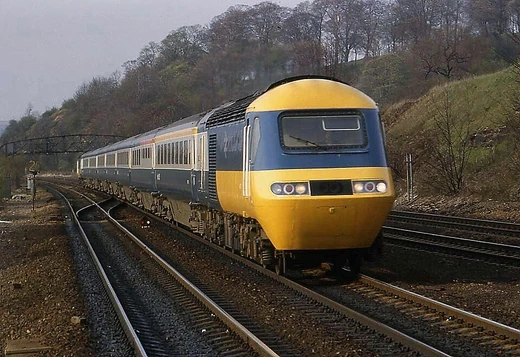
British Rail Class 220
Diesel-electric high-speed multiple unit introduced in 2001.
Last updated
The British Rail Class 220 Voyager is a diesel-electric high-speed multiple unit passenger train built in Belgium by Bombardier Transportation in 2000 and 2001. It was introduced in 2001 to replace the InterCity 125 and Class 47-hauled Mark 2 fleets on the Cross Country Route. Initially operated by Virgin CrossCountry, the class has been operated by CrossCountry since 2007.
Technical details
Each coach is powered by a Cummins QSK19 diesel engine producing 559 kW at 1,800 rpm, which drives a generator supplying current to motors on two axles per coach, one per bogie. The trains use both air and rheostatic brakes and are fitted with Dellner couplers, shared with the Class 222 and Class 390 Pendolino, allowing coupling in rescue/recovery mode with air brake only. Class 220s and 221s can be assisted by Dellner-fitted Class 57s or, via adaptor couplings, by any air-braked locomotive.
The Class 220 and related Class 222 use B5005 inside-frame bogies, where the axles are supported by bearings behind the wheels, leaving the outer wheel face visible. A four-coach set has a carriage mass of 45–48 tonnes and a total weight of 185.6 tonnes, with a top speed of 125 mph and a maximum range of about 1350 miles between refuellings. The lightweight bogie design contributes to a route availability of RA 2. The units are fitted with an AB Hoses variable rate sanding system and are maintained at Central Rivers TMD near Burton-on-Trent.
Current operations
As of 2013, CrossCountry is the sole operator. The fleet was transferred from Virgin CrossCountry to Arriva CrossCountry in November 2007, and by the end of that year CrossCountry was the only operator. Class 220 units often operate in multiple with Class 221 units, which are mechanically similar except for their bogies and share the same coupler type. In 2024, CrossCountry contracted Alstom to refurbish the Class 220 and Class 221 fleets, with the first refurbished unit unveiled in February 2026.
Did You Know?
- Units have been stopped by salt water when storm-driven waves at Dawlish inundated the resistor banks, a problem fixed by a control software upgrade.
- Exhaust fires occurred on the Voyager class during 2005–2006 due to incorrect fitting of equipment during overhauls, including at Starcross, Newcastle, and Congleton.
- The related tilting Class 221 Super Voyager has outside-frame bogies, giving a more conventional appearance.
More in Passenger Trains Running at Least at 200 Km/h in Commercial Operations
Test yourself
Three questions drawn from this entry’s sources. Pick an answer to check it.
Answers checked against the source article
Sources
Compiled from Wikipedia and the sources listed below. Text from Wikipedia is available under CC BY-SA 4.0; this entry is adapted from it.
- Wikipedia: British Rail Class 220 (CC BY-SA 4.0).
Spotted an error? Know more?
Reader corrections go straight into our review queue. Suggest an edit · How this site is sourced