British Rail Class 222
Diesel-electric multiple-unit of the Bombardier Voyager family.
Last updated
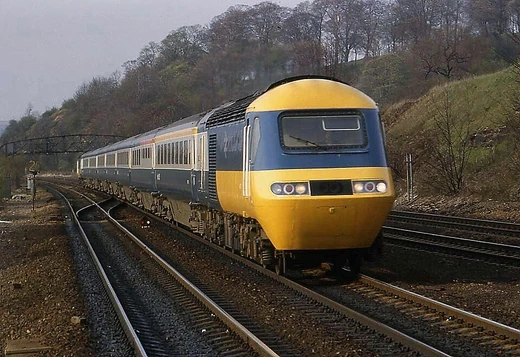
The Class 222 Meridian, a diesel-electric high-speed train, can reach 125 mph. Bombardier Transportation built 27 sets in Bruges, Belgium, between 2003 and 2005. A member of the Voyager family, it now serves with Lumo and East Midlands Railway.
Details
Each car has a Cummins QSK19 diesel engine producing 559 kW at 1,800 rpm, powering a generator that supplies current to Alstom Onix 800 motors driving two axles per coach. The trains can travel about 1350 mi between refuellings. A rheostatic braking system works alongside the air brakes; during braking the motors become generators, sending current to roof resistors where energy is dissipated as heat, reducing brake shoe wear.
Normal deceleration from 60 to 0 mph takes 400 m, and emergency braking takes 350 m. B5000 lightweight bogies, with inboard bearings and visible wheel exteriors, are used. Dellner couplers are fitted, but Class 222 units cannot work in multiple with Class 220 or Class 221 trains due to incompatible electric systems; the couplers do allow towing by Class 57 locomotives in emergencies.
Operations
Midland Mainline introduced the first of 23 Class 222 units on 31 May 2004, branding them Meridian, replacing all Turbostars and some High Speed Trains. The initial order comprised four-car and nine-car sets; Hull Trains ordered four-car units with an option for five cars. Seven nine-car sets were built for an enhanced London–Leeds service but the Strategic Rail Authority prevented that service, so they were used on London–Nottingham and some London–Sheffield services. Midland Mainline overestimated first-class demand, so a section of first-class seating in coach D was declassified.
In late 2006, a carriage was removed from each nine-car set to extend seven four-car sets. East Midlands Trains inherited the entire fleet in November 2007. Further rearrangements from March to October 2008 produced six seven-car sets and seventeen five-car sets.
Former proposed operators
In 2005, HSBC Rail took delivery of the seven nine-car trains intended for Midland Mainline's London–Leeds service, but they were left idle when the Strategic Rail Authority blocked that service. HSBC Rail contacted Northern Ireland Railways and Iarnród Éireann about leasing them for Enterprise on the Belfast–Dublin line, as one of several options. Ultimately, the trains entered service with Midland Mainline on fast London–Nottingham services. Grand Central planned to use five Class 222 units for its open-access operation announced in summer 2006, but this did not happen, delaying the start until December 2007 when it began with three High Speed Trains.
Accidents and incidents
On 10 June 2006, unit 222009 working the 10:30 London to Sheffield service had a door discovered open at Desborough, Northamptonshire while at speed. The RAIB report concluded that a piece of dirt in the door lock switch combined with a software bug allowed the door to remain unlocked after a stop at Luton without detection. Pneumatic door seal cycles at subsequent stations gradually prised the door open until an automatic brake application was triggered; the driver cancelled it due to ambiguous cab indications. The train was finally stopped at Desborough summit after a passenger reported the open door.
More in Passenger Trains Running at Least at 200 Km/h in Commercial Operations
Sources
Compiled from Wikipedia and the sources listed below. Text from Wikipedia is available under CC BY-SA 4.0; this entry is adapted from it.
- Wikipedia: British Rail Class 222 (CC BY-SA 4.0).
Spotted an error? Know more?
Reader corrections go straight into our review queue. Suggest an edit · How this site is sourced